


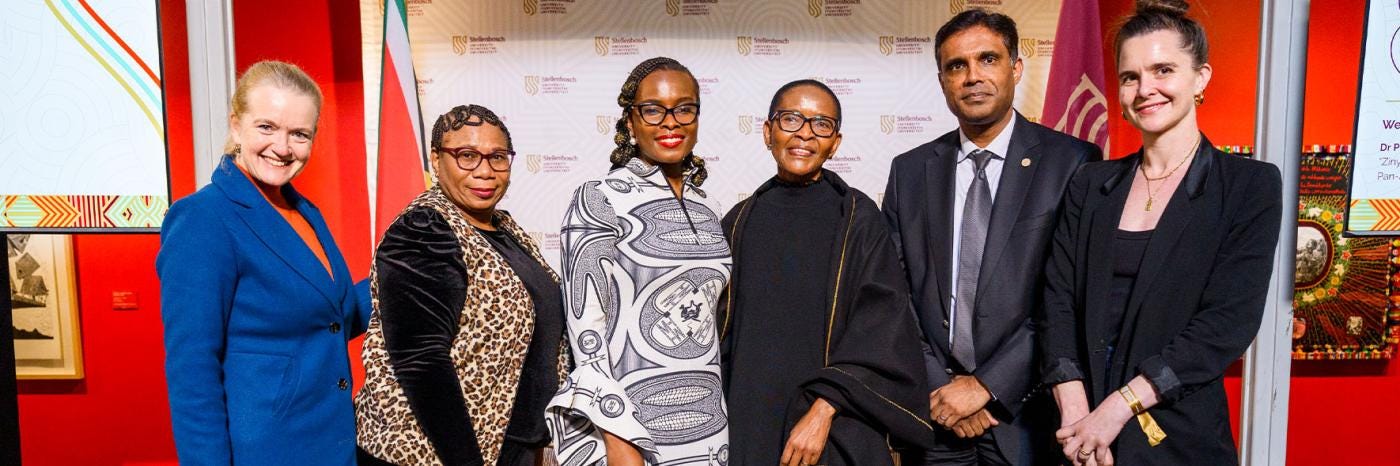
Dr Panashe Chigumadzi, a historian and writer, was the speaker at Stellenbosch University’s 8th Annual Africa Day Lecture.
Chigumadzi serves as rapporteur for the African Union committee of experts on reparations for racialised chattel enslavement, colonialism and apartheid.
Africa Day, celebrated annually on 25 May, commemorates the founding of the Organisation of African Unity (OAU) in 1963.
The enslavement of black Africans was a “world-breaking crime” that continues to shape global inequality, sovereignty and power today – and now is the time to repair its enduring damage.
That was the central argument advanced by historian and writer Dr Panashe Chigumadzi during Stellenbosch University’s (SU) 8th Annual Africa Day Lecture on Wednesday evening (27 May 2026).
Drawing on Nobel laureate Toni Morrison’s 1992 observation that slavery “broke the world in half”, Chigumadzi argued that slavery, colonialism and apartheid should be understood not as separate historical episodes, but as part of a single enduring structure shaping the modern world.
In an address that drew together political philosophy, African intellectual traditions, reparations discourse and historical memory, Chigumadzi challenged the audiences to rethink ubuntu, justice and Africa’s place in the modern world.
Chigumadzi is the author of These Bones Will Rise Again, and is writing a new work The World is Dead: Ubuntu as an ethics of war and conquest under the 1779-1879 Wars of Dispossession. She is also a professor of African History at Brandeis University in the United States.
‘Gravest crime’
She serves as rapporteur for the African Union committee of experts on reparations for racialised chattel enslavement, colonialism and apartheid. She also drafted and conceptualised the AU reparations framework A Crime Does Not Rot: 1441 to Present, which informed Ghana’s landmark 25 March 2026 United Nations resolution declaring the trafficking of enslaved Africans and racialised chattel enslavement “the gravest crime against humanity”.
The resolution explicitly links slavery to ongoing global inequalities and calls for “reparatory justice” – including formal apologies, restitution of stolen cultural property, compensation, rehabilitation, institutional reform and guarantees of non-repetition.
In her lecture at the SU Museum, Chigumadzi argued that the current global order could not be separated from the histories of enslavement and dispossession that shaped it – and that the debt created over 600 years remained unpaid.
High time for reparations
For her, the scale and endurance of these histories required reparations and what she called “radical redistribution” aimed at addressing structural dispossession across generations.
“A crime does not rot,” she said repeatedly throughout the lecture. The phrase also appears in the AU reparations framework and the subsequent UN resolution, which affirm that there is no statute of limitation on crimes against humanity.
Chigumadzi drew direct connections between slavery-era compensation and the accumulation of wealth in the Cape. She noted that when slavery was abolished in the British Empire in 1834, compensation was paid not to enslaved people but to slave owners for the loss of their “property”.
“We very rarely talk about the reparations that were actually paid to enslavers in this country,” she said.
According to Chigumadzi, the British Empire paid £20 million to slave owners across the empire after slavery was abolished in 1834 – approximately £2.7 billion in today’s terms and, at the time, about 40% of the British national treasury.
She noted that the Cape Colony received more than £1.2 million of that amount – nearly R4 billion in today’s terms – with Stellenbosch among the largest beneficiaries because of its extensive slaveholding economy.
Stellenbosch district, she said, held 8,452 enslaved people at emancipation in 1834, second only to Cape Town.
She argued that this capital helped lay the foundations for enduring concentrations of wealth in the Western Cape, including financial and business networks associated with Stellenbosch capital.
‘Radical ubuntu’ reclaimed
One of the lecture’s central interventions was Chigumadzi’s challenge to popular understandings of ubuntu.
She argued that the notion had often been reduced in post-apartheid South Africa to a language of individualised and interpersonal forgiveness detached from the structural histories of conquest, dispossession and structural inequality.
Chigumadzi traced part of this shift to what she described as the “mistranslation” of ubuntu by the Kenyan theologian John Mbiti in his influential 1969 book African Religions and Philosophy, in which he formulated ubuntu as: “I am because we are”.
She argued he did so as an African analogue to French philosopher René Descartes’s famous dictum “I think, therefore I am”, arguing that the modern Western conception of the autonomous individual had emerged alongside the expansion of racialised chattel slavery.
“Although the fullness of African metaphysical worlds cannot be translated into English without loss, the isiNtu language dictum ‘Umuntu ngumuntu ngabantu’ is more accurately rendered as ‘A person is a person through other people’,” she said.
Drawing on oral traditions and more than 500 texts in isiXhosa, isiZulu, seTswana and seSotho recovered from 19th-century black newspapers, Chigumadzi argued that ubuntu was not simply a moral appeal to harmony, but an ethics concerned with sovereignty, accountability and collective obligation.
That is “the radical ubuntu we seek to reclaim tonight,” she said.
South Africa still ‘separated’ from rest of Africa
Chigumadzi argued that apartheid and settler colonialism had historically sought to separate the rest of the continent both politically and psychologically.
She did not explicitly address the current resurgence of xenophobic violence in South Africa during her input, but in an interview afterwards, she was clear: “This is Afrophobia – a centuries-old fear and hatred of black people. It’s the familiar “swartgevaar” (black peril) logic, so to speak.”
Chigumadzi linked anti-migrant sentiment to longer histories of racial exclusion, pass laws and what she described as the historical project of constructing South Africa as a “white man’s country”.
“For black people, there was the notion that you are trespassing on white property,” she said.
She argued that although democracy brought formal inclusion into the nation state, persistent inequality and limited economic redistribution after 1994 had intensified competition over scarce resources.
In the absence of structural reparations and land redistribution, “people are clinging on to that little crumbs afforded to them by citizenship within the nation state,” she said.
“When people feel they are not getting the actual economic benefits of citizenship, black ‘foreign nationals’ become easy scapegoats.”
‘Confront uncomfortable truths’
Prof Pumla Gobodo-Madikizela, Director of AVReQ, facilitated a discussion with the audience. Praising Chigumadzi’s “profound historical clarity”, she said: “You’ve brought this to our attention in such a powerful way.”
In his remarks, SU Rector and Vice-Chancellor Prof Deresh Ramjugernath described the lecture as part of the University’s commitment to creating spaces for difficult but necessary discussion.
“These are not easy conversations. They require a willingness to confront uncomfortable truths,” he said.
“But if universities are serious about their role in society, these are exactly the conversations we must be willing to host and engage in.”
Opportunity to remake the world
For Chigumadzi’s, the stakes of these discussions extend far beyond reflection.
If racialised chattel enslavement was a “world-breaking crime”, she argued, reparations must become a “world-making project”.
“And so this is the opportunity before us,” she concluded: “To rethink fundamentally what kind of world is possible.”
Story by Desmond Thompson first published on the Stellenbosch University website.
©Higher Education Media Services.