


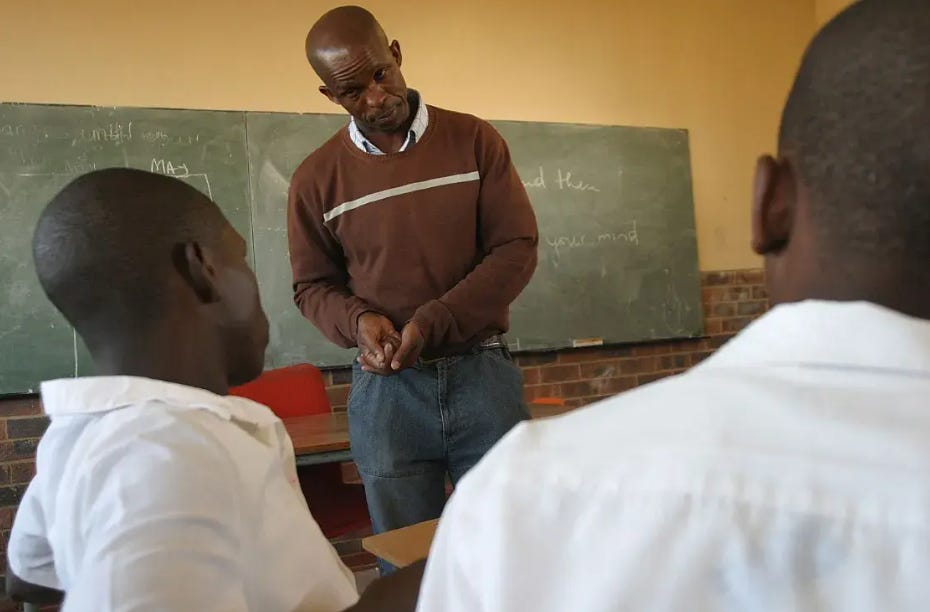
When South Africa’s schools reopened after the COVID-19 disruptions, there was hope that attention could return to learning losses, teacher development and educational recovery. Instead, many schools have become mirrors of the violence, poverty, gangsterism and social breakdown affecting communities across the country.
The numbers tell a disturbing story. According to Statistics South Africa, more than 1.15 million learners experienced some form of violence at school in 2024, with incidents involving both fellow learners and, alarmingly, educators themselves. Teacher-perpetrated physical violence accounted for more reported cases than learner-on-learner physical violence.
Yet statistics alone fail to capture the human cost. Across Gauteng, the Western Cape, KwaZulu-Natal and other provinces, learners are being stabbed, shot, assaulted, robbed and recruited into criminal activity. Schools that should be places of safety increasingly find themselves on the frontline of South Africa’s broader crisis of violence.
Over the past five years, several patterns have become increasingly clear. Violence is becoming more severe. What once centred largely on bullying and intimidation now increasingly involves weapons.
Stabbings have become a recurring feature in headlines involving schools across multiple provinces. Recent years have seen murders, attempted murders and serious assaults reported both on school grounds and in areas surrounding schools. Educational institutions recorded six murders, 26 attempted murders and 335 serious assaults during one recent quarterly crime reporting period.
The issue is not merely indiscipline. It is violent crime. School violence increasingly reflects community violence.
Researchers and provincial education departments repeatedly point to the same conclusion: schools are not generating violence in isolation. They are absorbing violence from surrounding communities.
Gang activity, drug trafficking, family instability, domestic abuse and organised criminal networks are increasingly influencing school environments. Gauteng research identified gang-related violence, substance abuse and criminality around schools among the key drivers of incidents reported over the past five years.
On the Cape Flats, for example, schools frequently operate in communities affected by long-running gang conflicts, meaning learners often move between two dangerous worlds rather than one.
Gangsterism has become a significant education issue. It is not just a policing matter.
Schools have reported hundreds of gang-related incidents. Researchers note that gangs provide vulnerable young people with a sense of belonging, identity and protection, particularly where poverty and weak family support structures exist.
The result is that gang culture increasingly influences behaviour, recruitment, intimidation and violence both inside and outside school grounds.
One of the most disturbing developments is the prevalence of learner-on-learner violence. Learners are often the victims and perpetrators.
Recent incidents across Gauteng, Mpumalanga and the Eastern Cape have involved pupils allegedly stabbing fellow learners to death after disputes or confrontations.
This points to a deeper failure to address conflict resolution, trauma and psychosocial wellbeing among children.
Are current interventions working? The honest answer is only partially.
Government deserves credit for recognising the crisis. The National School Safety Framework has established school safety committees, incident registers and risk assessments.
But despite the framework, school searches and stronger SAPS involvement, more than 1.1 million learners still reported experiencing violence at school in 2024. The problem is not about security. It is social breakdown on a national scale.
The Department of Basic Education and SAPS have also strengthened the Safe Schools Protocol to improve cooperation between schools and police. Gauteng has installed CCTV systems at hundreds of schools and identified high-risk institutions requiring greater support.
These interventions have undoubtedly improved reporting and awareness. But there is little evidence that they have fundamentally changed underlying trends in violence.
Why? Because many interventions focus on responding to incidents rather than preventing them. How does society change from a violent ethos to one that epitomises peace?
Metal detectors may recover knives. Random searches may remove drugs. Police patrols may deter criminals. But none of these measures addresses the underlying causes of violence, namely poverty; gangsterism; substance abuse; trauma; unemployment; family breakdown; and community crime.
As many experts now argue, school safety cannot be separated from community safety.
One of the most recent examples highlighting the intersection between gangs and education comes from Westbury in Johannesburg.
In August 2026, ongoing gang violence left five young people shot, three of whom reportedly died, with the Gauteng Department of Education confirming that one of the victims was a learner at R.W. Fick Secondary School. The violence disrupted teaching, examinations and learner attendance across the area.
Earlier this year, Gauteng also witnessed several fatal stabbings involving schoolchildren, including learners from Forest High School and Daleview Secondary School.
While not all school-related killings are gang-related, they reveal a common reality: many South African children face dangers simply travelling to and from school.
The evidence suggests South Africa cannot police its way out of this crisis.
Security remains essential, especially around identified high-risk schools. But meaningful progress will require stronger psychosocial support services, school-based social workers, anti-gang interventions, greater parental involvement, and community-wide violence prevention initiatives.
Most importantly, school safety must become a whole-of-society project. In the same manner society mobilised against apartheid, there should be an intervention to put education and the safety of children at the top of the agenda.
A child carrying a knife into a classroom is often telling us something about conditions outside the classroom. Until South Africa confronts those realities, schools will continue to reflect the violence around them rather than serving as places of refuge from it. And that should concern every parent, teacher, policymaker and citizen in the country.
South Africa’s school violence crisis is not a failure of education policy alone. It is the most visible symptom of failing communities, and until the country tackles poverty, gangsterism, trauma and youth hopelessness, schools will continue to absorb the violence society creates.
@Higher Education Media Services