


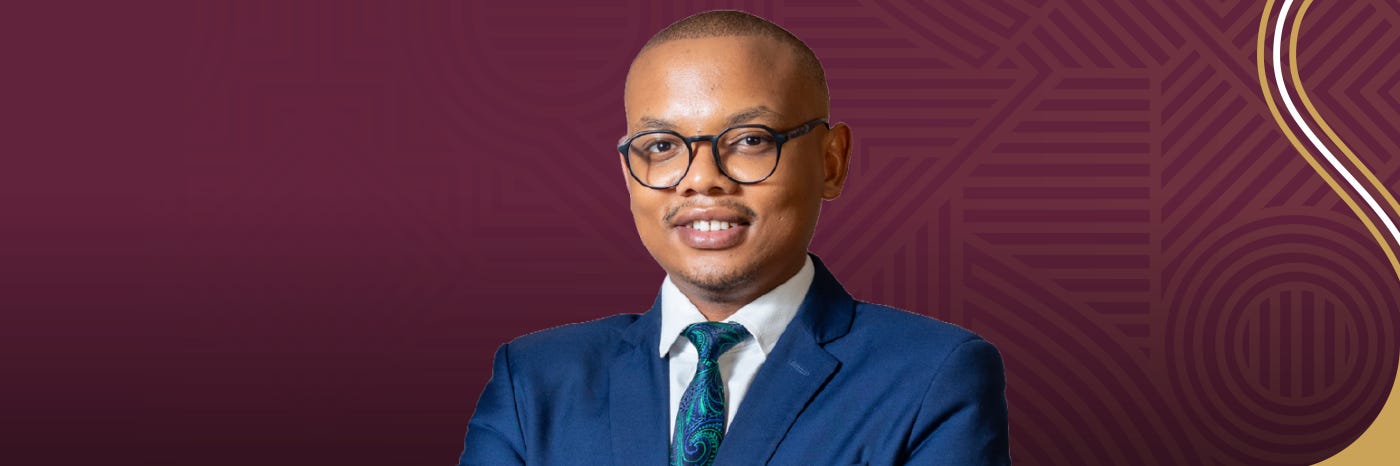
Thembalethu Seyisi is the Head of Law Reform, Advocacy and Institutional Partnerships at SU. He is completing a master’s degree that examines the role of the South African Human Rights Commission in championing social justice. Seyisi was recently selected as one of BPM Global 100 leading black professionals for 2025.
What do you see as the most significant threats to democracy today?
The most profound and underappreciated threat to democracy today is the structural dependency of the Global South on the Global North for financial survival. This dependency is engineered and maintained through the lending architecture of institutions like the International Monetary Fund and the World Bank.
Their debt conditionalities attach strings of austerity, privatisation, and deregulation to every loan, systematically constraining the policy space of borrowing nations. The result is that governments in the Global South, however democratically elected, are effectively unable to govern in the interests of their own people. Sovereignty becomes ceremonial.
For South Africa, this is a particularly acute tension. We are not simply a democracy, we are a constitutional democracy, bound by one of the most progressive constitutions in the world. Our constitution does not merely protect political rights; it enshrines socio-economic rights: access to healthcare, housing, food, water, education, and social security.
These are justiciable rights, meaning citizens can and do take the state to court to enforce them. This is a remarkable democratic foundation. Yet the IMF’s structural adjustment logic, and the broader financial architecture that keeps South Africa tethered to debt markets and investor sentiment, routinely forces fiscal policy choices that directly undermine the realisation of those constitutional rights.
One example is the Social Relief of Distress (SRD) grant that Treasury has not turned into a Basic Income Grant. You cannot have a thriving constitutional democracy and a structurally impoverished citizenry at the same time. The two are in permanent conflict.
The Global South, including South Africa, is trapped in a cycle of systematically manufactured poverty – not through the failure of democracy itself, but through an international economic order that punishes democratic governments for prioritising their people over their creditors. Until that architecture is challenged and transformed, democracy in the Global South will remain aspirational rather than lived.
What happens when trust in democracy erodes, and how can it be rebuilt in polarised and unequal societies?
Trust does not erode in a vacuum or at the whim of one single instance. It erodes over time as institutions fail to deliver on their mandate and promises. In the South African context, that promise is constitutional: the promise of social justice – meaning fairness to all experienced through the equal enjoyment of rights by all people.
The declining trust we are witnessing in government and in political parties is justified. It is the response of a citizenry that has been promised a great deal and delivered very little. When millions of South Africans wake up daily without clean water, adequate housing, quality education or safety, they are not experiencing a political inconvenience. They are experiencing a democratic betrayal.
Rebuilding trust, therefore, will not be or a matter of ‘better’ leadership in polarised countries. It requires collective leadership where elected leaders practice power with rather than power over.
In a deeply unequal societies like ours, this means that democratic institutions and their leadership will regain the trust of the people once their lives are improving and the gap between those who enjoy all the rights and those who are effectively excluded from them is narrowing. The (re)creation of a fair society is therefore crucial.
Young people are often described as disengaged from formal politics, yet active in social movements. How do you interpret this?
The framing of youth as “disengaged” is both patronising and analytically wrong. Young people are not disengaged from democracy — they are disengaged from the particular institutional forms that have consistently failed them.
When the formal political system reproduces inequality, captures public resources and insulates itself from accountability, young people seek more responsive vehicles for change.
Social movements are not a departure from democracy; they are democracy in its most direct expression. Movements like #FeesMustFall, #MeToo, #JusticeFor… (depending on who was wronged or killed at the time) and service delivery protests are not symptoms of democratic failure.
They are mechanisms of democratic pressure. They shine a light on the most pressing issues of our time – inequality, exclusion, and the gap between constitutional promises and lived reality – in ways that formal political processes are too slow, too captured or too timid to do.
What this tells us about the future of democratic participation is that participation itself must be reimagined. Democracy cannot be reduced to a ballot cast every five years.
It must become a living, continuous practice embedded in communities, workplaces, schools, and public spaces. Young people are already building that practice.
The question is whether formal institutions will adapt to meet them or continue to wonder why the youth have “lost faith”.
What gives you hope for the future of democracy?
My hope is grounded in the growing global movement towards a wellbeing economy – an alternative economic framework that places human dignity, ecological sustainability, and genuine quality of life at the centre of policy, rather than GDP growth or debt servicing.
In South Africa, and particularly here at Centre for Social Justice, this work is taking root in meaningful ways. Having developed the Social Justice Impact Assessment Matrix (SIAM), we are subjecting policies, including fiscal policies, to a tool that simulates the future with the idea being to bring to light and inform policy makers whether the policy will have unintended consequences and therefore exacerbate inequality, poverty, unemployment and hunger.
This is not an abstract academic exercise but work that takes seriously our constitutional commitments and our history of exclusion.
Equally inspiring is the Globus People’s Meet partnership with Denmark with the hope of hosting a People’s Meet in South Africa – a growing platform for voices to share strategies and build solidarity across borders.
Democracy is not dying. It is being reimagined from the ground up, by “we, the people” as it was always meant to be.
Each April, South Africa marks Freedom Day on 27 April, commemorating the country’s first democratic elections in 1994 – a defining moment that continues to shape its constitutional order. Against this backdrop, thought leaders at Stellenbosch University (SU), whose work engages questions of governance, rights and accountability, reflect on the state of democracy.This article was first published on SU Website.
©Higher Education Media Services.