


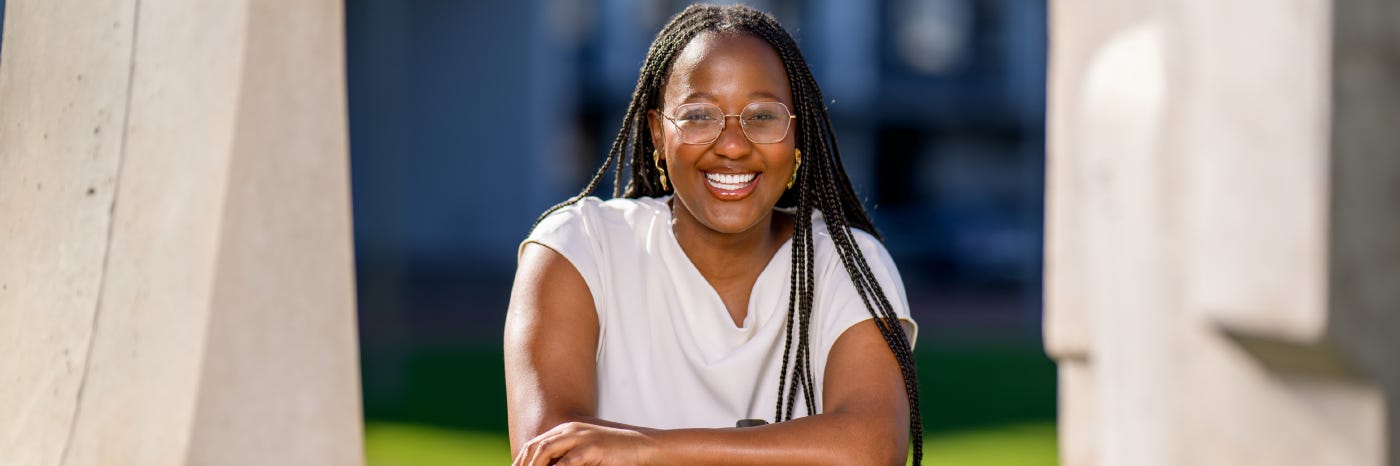
As a little girl growing up with six siblings on a farm in the Eastern Cape, Amohetsoe Shale learnt that curiosity was something to be treasured. Weekday television was off limits. Books filled the shelves. A sense of wonder about the world was celebrated and questions encouraged.
Today the girl who excelled at school has grown into a CEO of her own company, a skilled prosthetist and a biomedical engineer in the making. She still believes the greatest gift a young woman can nurture is the confidence to imagine a different world.
A philanthropist at heart, Shale (23) is now in her second year of a master’s degree in biomedical engineering at SU where she’s dedicating every available second to NAVU Mobility, a company she founded in 2024 to develop affordable prosthetic knee technology for people with limb loss.
Over the past year she made news as NAVU won the prestigious Hult Prize South Africa National Finals (the global finals are scheduled for September 2026 in London) and Shale walked away with the Top Student Womenpreneur Award at the Entrepreneurship Development in Higher Education Awards.
Raised by remarkable women
Three generations of women in Shale’s family challenged convention long before she would come to understand what feminism meant. Her great-grandmother raised her family with fierce independence. Her grandmother divorced at a time when doing so required enormous courage.
Her mother, Dr Naledi Mbude-Mehana, has dedicated much of her career to expanding mother tongue-based bilingual education as Deputy Director-General for Transformation Programmes at the national Department of Basic Education.
“For me Women’s Month means women’s empowerment. I was fortunate to be raised in a culture of empowerment,” Shale says with a smile. “I’ve been so lucky to have a mother who has a lot of experience in breaking down barriers.
“Just looking at the strides that she’s taken and the struggles she overcame have really helped me model how to stand tall and how to do it in a progressive way while still retaining empathy and kindness in a world that sometimes tries to beat that out of you.”
Shale recalls how her mom would always ask her and her siblings questions and helped them deconstruct how they think about things. That mindset eventually evolved into a refusal to accept that social problems are inevitable simply because they have existed for a long time.
Engineering with empathy
Shale first encountered the realities of disability while studying medical orthotics and prosthetics at Walter Sisulu University. Clinical placements exposed her to people whose lives were limited by inadequate prosthetic devices and long waiting lists within South Africa’s public healthcare system. “I remember thinking: Why has everyone just accepted this?”
As a registered clinical prosthetist, she saw talented, ambitious people prevented from returning to work, caring for their families or participating fully in everyday life because appropriate prosthetic technology remained inaccessible.
Rather than accepting those limitations, she began asking whether engineering could provide a better answer. Her innovation, a passive polycentric prosthetic knee, stands out for its cost-effectiveness and superior functionality.
The quest to perfect the design eventually led her to SU, where she is now completing a master’s degree in biomedical engineering under the supervision of Prof Kristiaan Schreve.
Her research focuses on developing an affordable prosthetic knee designed specifically for the realities of South African healthcare. Through NAVU Mobility she hopes to translate that research into technology that improves lives across the continent.
“We’re the only startup developing prosthetic knees in sub-Saharan Africa,” she notes.
Although NAVU attracted national attention after winning the South African leg of the Hult Prize competition, Shale is level-headed about all the recognition. “Sometimes it’s easy to get caught up in hype. We’ve really been trying to keep our heads down and keep building.
“Our dream is for NAVU to become a multinational company that helps millions of people. We’d like to be able to say amputees have been able to go back to work, have been able to play with their children, have been able to go back to school without worrying about how they walk.”
It takes a village
Shale is quick to acknowledge the role of the people who have helped her along the way to achieve success and a growing reputation as an entrepreneur.
Arriving at SU after completing her undergraduate studies elsewhere meant starting again in unfamiliar surroundings. She credits SU’s Innovus Technology Transfer Office and Nadine Price (LaunchLab operations and community officer) with helping her navigate entrepreneurship, while her supervisor and fellow postgraduate students created an environment where she quickly found her feet. Becoming part of the Listen, Live and Learn leadership programme and the SU Postgraduate Network strengthened that sense of belonging. “All of this helps people create community,” she says. “You need to be in spaces where you’re surrounded by people with similar mindsets and wanting to do good in the world.”
Community has always been woven into her life. Growing up with three younger brothers on the autism spectrum, she watched neighbours, friends and extended family rally around her parents whenever help was needed. “My mom had an open-door policy. If someone needed food, they’d help out on the farm for the day, and then they’d get some food.” That generosity was returned many times over. “It genuinely took a village for our family to thrive.”
Shale learned to respond to challenges by reaching out. “Whenever I get pushback, I go to other women to find strength and community.”
Freedom to lead
As Women’s Month invites reflection on the progress women have made, Shale hopes the conversation continues to evolve. She believes women deserve the freedom to lead authentically, to learn continuously and to make mistakes.
“We should remind ourselves how important it is for women to be given the space to make mistakes and to learn,” she insists. “We should stop judging women so harshly. I just want us to be kinder to women, to look at women as humans with flaws and to see the humanity in every woman we encounter.”
When she imagines a young girl sitting in a classroom in a rural town, wondering what her future might hold, Shale returns to the lesson that has guided her own journey. “It’s about nurturing that little girl who has not yet been told that she’s a girl and therefore she can’t. That little girl needs to carry you for the rest of your life, and if you protect her, you have really protected your future.”
©Higher Education Media Services.