

By André Keet and Edwin Naidu

Amid ongoing National Student Financial Aid Scheme (NSFAS) challenges and other sagas, Higher Education and Training Minister Buti Manamela has marked his first year in office with a stark reality. While he inherited a sector burdened by deep structural problems, his own tenure has also been shaped by governance controversies, ongoing crises and mounting pressure to deliver meaningful reform.
Taking office in July 2025 after years serving as deputy minister, Manamela arrived with a rare advantage: an intimate understanding of the post-school education and training (PSET) landscape.
But a year and a month later, the question confronting the sector is whether that institutional knowledge can translate into the sweeping reforms needed to stabilise a system grappling with funding challenges, governance failures and growing demand.
One does not underestimate the scale of the task. Universities, Technical and Vocational Education and Training (TVET) colleges and Community Education and Training (CET) institutions continue to struggle with limited capacity, uneven performance, infrastructure backlogs, student accommodation shortages, graduate unemployment and persistent inequalities.
At the centre of many debates remains the long-standing imbalance between universities and the underdeveloped TVET and CET sectors, often described as South Africa’s “inverted pyramid” challenge. This mismatch has created a paradoxical situation in which graduate unemployment coexists with critical skills shortages across the economy.
Adding to the pressure is a constrained national fiscus, weak economic growth, a challenging political context, and growing concern about governance across institutions. Universities increasingly report being affected by criminal syndicates, extortion networks, procurement interference and factionalism, while many continue to bear the financial burden of compensating for failing municipal services.
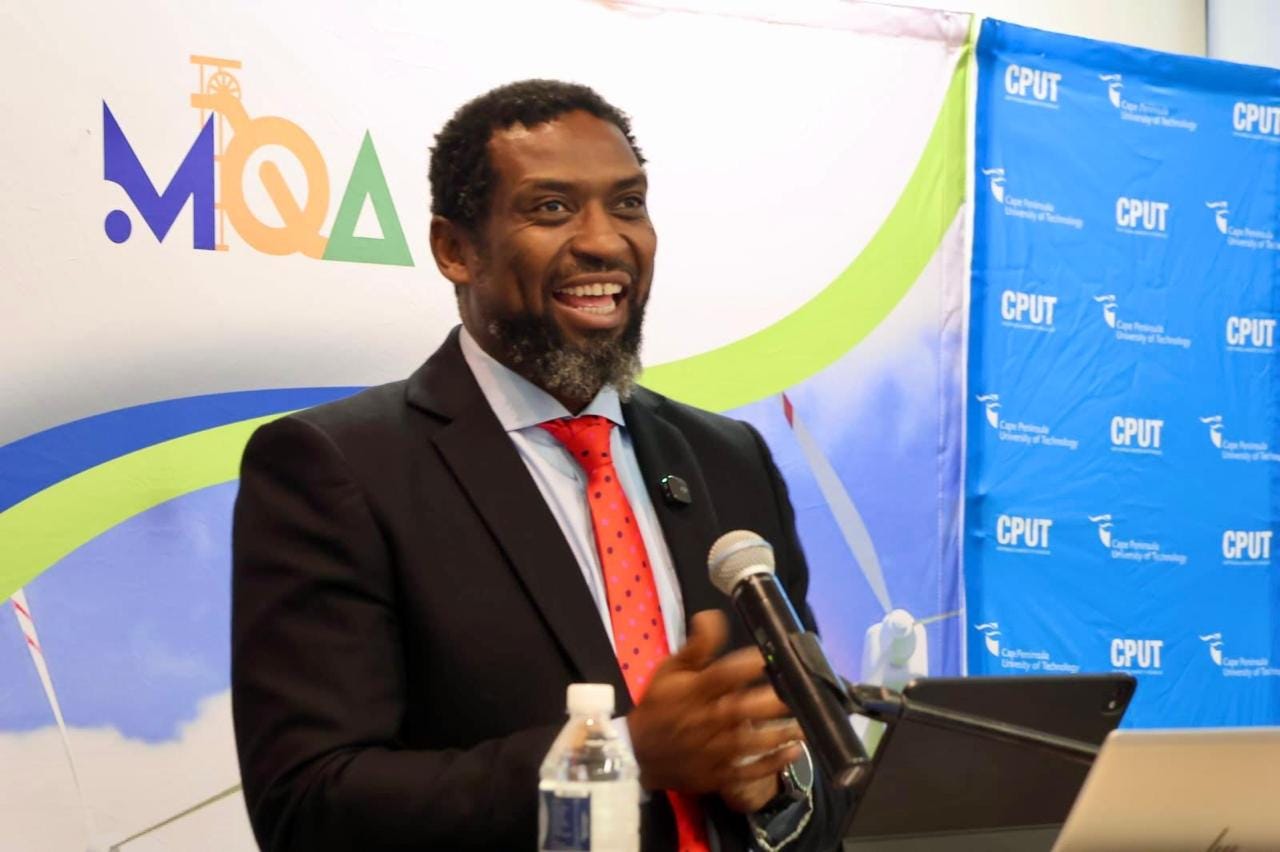
Against this backdrop, observers argue that assessing Manamela’s first year requires balancing his reform agenda against the realities of a distressed system. Manamela inherited a weak higher education and PSET bureaucracy. To his advantage, he arrived in the portfolio with greater institutional knowledge than any of his predecessors could claim. Despite troublesome governance decisions, he leaves his first year in office having made genuine commitments to systemic reform and having been unusually honest about the sector’s failures.
One of the minister’s earliest moves was to set out an ambitious vision for the sector. In his inaugural policy statement in August 2025, he outlined six priorities: creating a more integrated post-school system, expanding equitable access, improving responsiveness to economic needs, strengthening quality, enhancing governance and securing sustainable funding. His longer-term objective, he said, is to “engineer the system for the next 30 to 50 years”.
That vision has won support from many stakeholders, particularly his emphasis on strengthening TVET colleges, improving graduate employability and aligning skills development with economic needs. Those priorities are consistent with Manamela’s own educational journey. Before completing postgraduate studies at the University of the Witwatersrand, he studied at Mamelodi TVET College. This background has informed his long-standing advocacy for vocational education as a driver of economic growth and inclusion.
Yet policy ambition has collided with operational reality. The minister’s first year was overshadowed by controversies involving Sector Education and Training Authorities (SETAs), including disputed appointments and decisions to place some entities under administration. Critics questioned whether proper consultation and governance processes had been followed, while concerns emerged about perceptions of political patronage.
The disputes reignited long-standing debates about accountability and oversight within the skills development system. NSFAS has presented an even greater challenge.
The student funding scheme, which supports more than 800,000 students, remains one of the department’s most influential institutions. While it has dramatically expanded access to higher education for poor and working-class South Africans, it has also been plagued by governance and operational failures, payment delays and recurring instability.
Observers differ on whether NSFAS has improved or deteriorated during Manamela’s first year. What is undisputed is that the institution remains a major source of risk for the sector.
Manamela has publicly acknowledged NSFAS’s shortcomings and signalled the need for substantial reforms. However, analysts argue that the coming years will require more than incremental fixes, potentially including a fundamental rethink of the student funding model itself. The minister needs to fix this and keep an open mind on whether NSFAS is fit for purpose.
Despite these challenges, the broader sector has shown further evidence of governance lapses, as well as examples of positive performance. One notable example is the Chemical Industries Education and Training Authority (CHIETA), which has established Smart Skills Centres across all nine provinces. The impact on rural youth enjoying access to the Fourth Industrial Revolution speaks to impact in a manner few SETAs have managed. At the latest count, more than 90 000 rural youth have visited CHIETA-funded smart centres, developed through partnerships with TVET colleges, industry and community institutions. The centres provide digital training opportunities, career guidance and skills development programmes, particularly in underserved communities.

The initiative is increasingly viewed as a model of how SETAs can deliver measurable impact when governance and strategic direction are aligned. For supporters, one of Manamela’s key strengths has been his willingness to confront uncomfortable truths.
Unlike many political leaders, he has openly spoken about systemic weaknesses in higher education and acknowledged that reform will require difficult choices. His critics, however, argue that leadership is ultimately measured by implementation rather than intention.
Questions remain about departmental capacity, execution of policy priorities and whether governance concerns can be addressed quickly enough to restore confidence in the sector. In addition, the sector seems to lack a diverse, yet coherent, medium-to-long-term social and intellectual direction. The real test lies ahead.
Though Manamela has helped stabilise the sector and demonstrated a serious commitment to reform, he cautions that long-term success will depend on rebuilding institutional credibility and strengthening governance. That may ultimately define the minister’s legacy.
A year and a month into the job, Manamela appears well suited to the portfolio because of his sector knowledge, courage, policy grasp and commitment to structural reform. Yet those strengths alone will not be enough. The PSET system remains beset by crises that require what the minister can offer: decisive leadership, effective administration and tangible results.
For now, the foundations for improvement may have been laid. Whether they can be transformed into lasting change remains the central challenge confronting the minister at the start of his second year in office.
Professor Keet is Research Chair in Critical Studies on Higher Education Transformation, Mandela University. Naidu is head of Higher Education Media Services, publisher of www.ednews.africa
©Higher Education Media Services.