


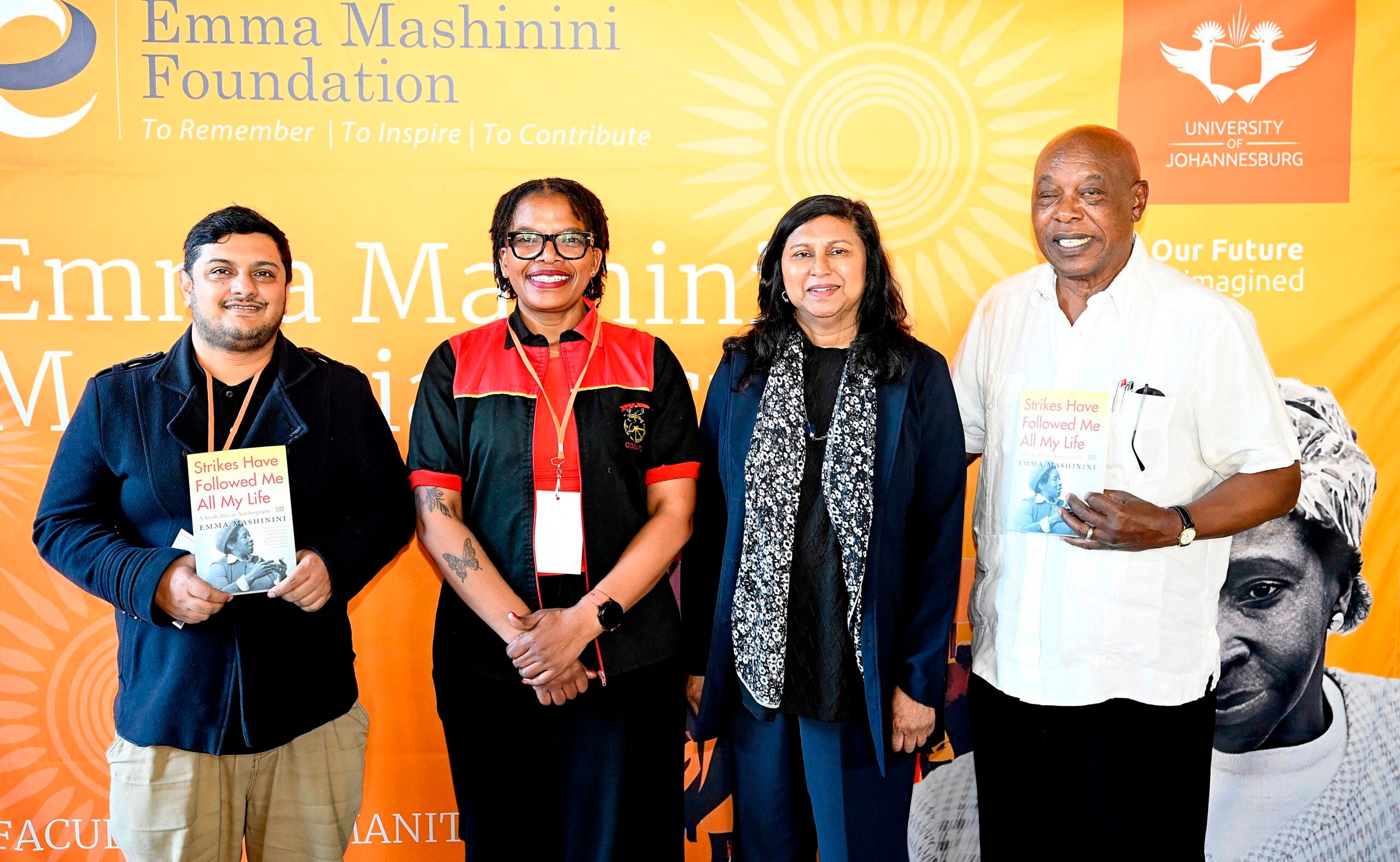
“When we say from protest to power, we are describing mama Emma’s life, and we are also describing our country,” she said in her keynote, reflecting on the theme of the lecture “From Protest to Power: 70 Years of Women’s Struggles for Freedom, Justice, and Democratic Renewal in South Africa.“
This is how Zingiswa Losi, President of the Congress of South African Trade Unions (Cosatu), described the late Emma Mashinini at the second annual public lecture in her name. The event took place on Tuesday, 25 August 2026 at the Sun International Auditorium, Auckland Park Bunting Road Campus.
She continued: “We are describing the difficult journey that you, the young women (and men), must complete. This is not a polite commemoration, Mama Emma did not like polite politics, she liked honest politics, militant politics, working class politics. So today we will not simply praise her, but rather we will ask ourselves, are we worthy of her?”
Forced to leave school at the tender age of 14, Emma Mashinini found herself working on factory floors exposed to discrimination and exploitation.
“That is where Mama Emma found her university. The shop floor taught Mama Emma that exploitation has an address, and that it can be fought. She did not become a leader by appointment, she became a leader by struggling and learning the hard work of organising.”
Losi emphasised the need to honour Emma Mashinini and her contributions to the labour movement in South Africa.
“The clothing unions were the backbone of the South African Congress of Trade Unions (SACTU), a predecessor of Cosatu. SACTU taught us that collective bargaining without national liberation is incomplete, and that national liberation without collective bargaining is a lie.”
Losi questioned the current trade union movement’s commitment to the working class, comparing it to Mashinini’s dedication. She highlighted on the impact of SACTU’s ban and exile on the labour movement and how Mashinini continued to organise on the factory floor.
Losi’s address recounted the historic launch of Cosatu in 1985 and Mashinini’s presence at the event. She emphasised the importance of women in the labour movement and how Mashinini’s advocacy for women’s rights and inclusion was an invaluable part of the movement’s identity.
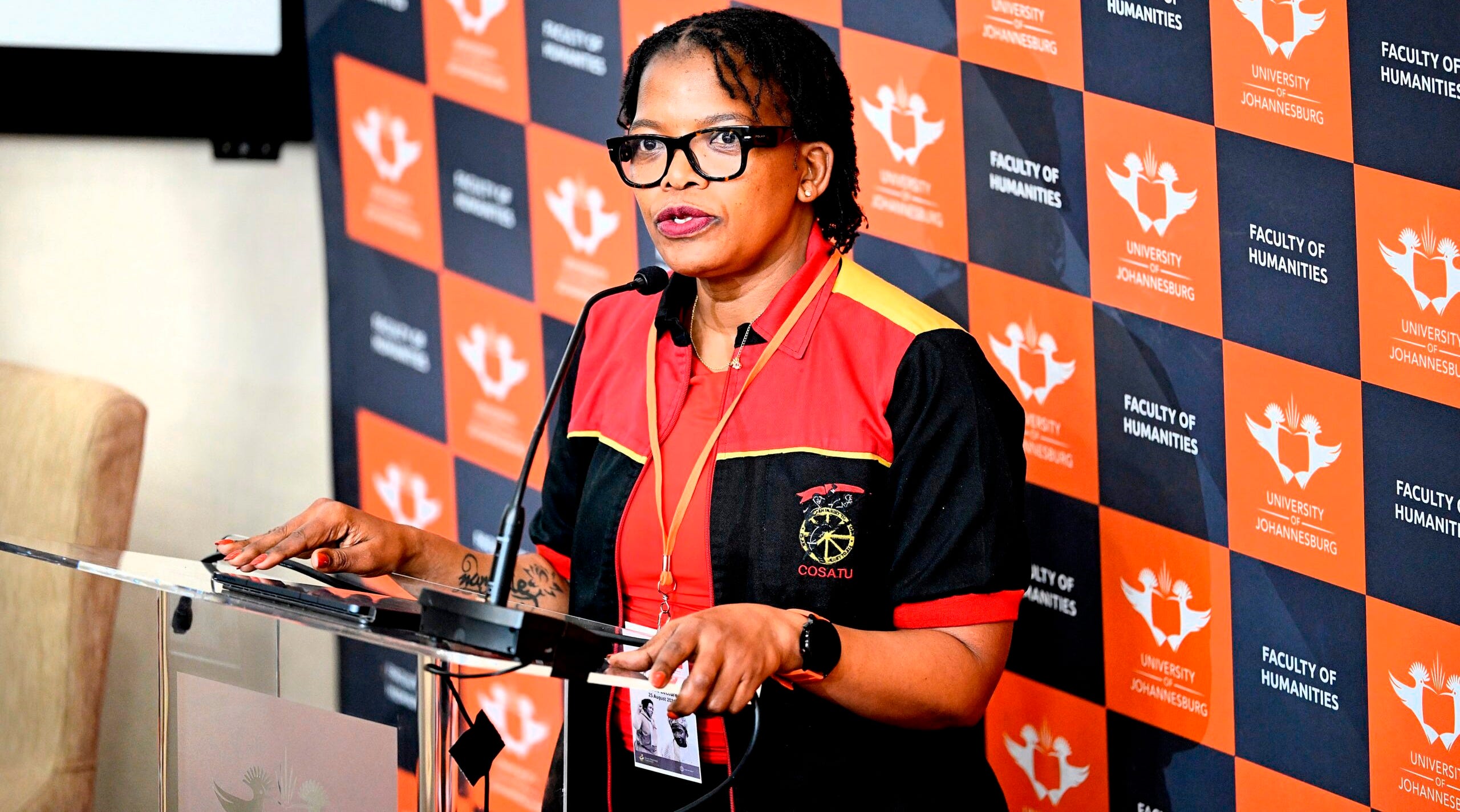
Losi also detailed Mashinini’s founding of the Commercial Catering and Allied Workers Union (today SACCAWU) in 1975, a time of significant repression under Apartheid. Mashinini’s leadership in organising black workers in the retail, hotel and catering sectors was highlighted, including battles against major retail monopolies in securing maternity leave and recognition as a union.
Losi reflected on Mashinini’s detention – a six-month solitary confinement – and the physical and psychological torture she endured. She connected Mashinini’s resilience and commitment to fighting oppression to the democratic breakthrough of the first elections in 1994. Losi outlined the key labour laws and constitutional provisions that were won through the struggle, including the right to form and join a trade union, collective bargaining and the Basic Conditions of Employment Act.
While acknowledging the progress made for women in the labour movement, ongoing challenges of gender- based violence and the fear faced by women in the workplace remain.
Losi called for continued vigilance and action to address these issues.
To address the challenges posed by the fourth industrial revolution and artificial intelligence, Losi said there was a need to create an act to protect workers.
“We need a new labour relations act for the digital age. We need a right to reskill, and we need a tax on machines that are replacing workers to fund the retraining. Mama Emma fought for a non-racial South Africa, and she believed that workers – black and white – have more in common than they think.”
She concluded by calling for the return to the basics of trade unionism, focusing on job security, wages and collective bargaining. She urged a reconnection with student movements and advocated for non-racialism and class solidarity to honour the legacy of Emma Mashinini.
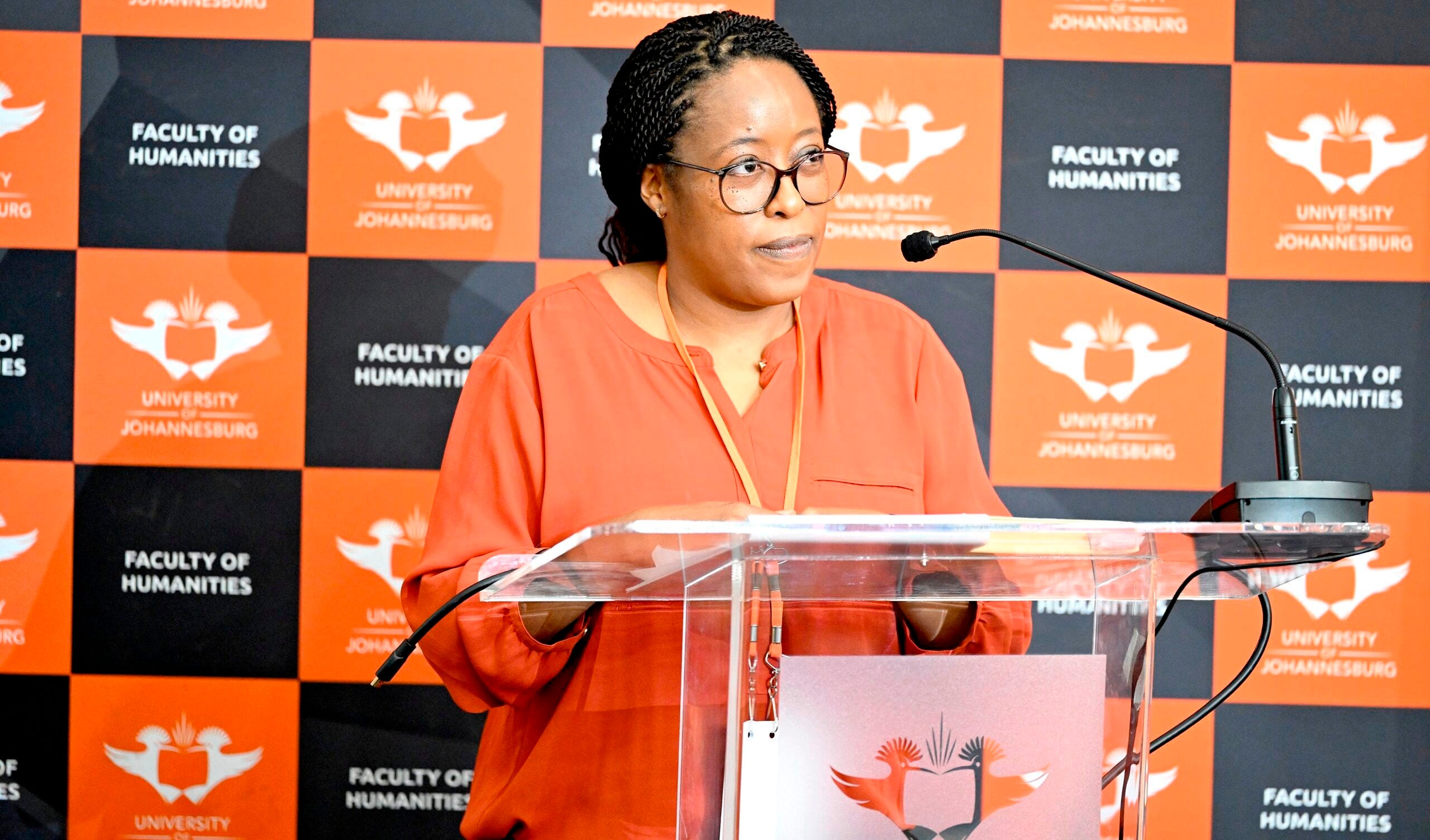
Professor Rirhandu Mageza-Barthel, a distinguished political scientist based at the Center for Conflict Studies at Marburg University in Germany, served as the primary respondent and discussant. Her connection to Mashinini is that of family as she is her granddaughter.
She discussed the complexities of Mashinini’s life, her roles as a mother, trade unionist, and activist and the challenges she faced during apartheid. She also emphasised the intergenerational dialogue encouraged by Mashinini and touched on the historical connections between different social and political movements, particularly the link between 1956 and 1976, and the need for contemporary activists to navigate similar struggles.
Professor Kammila Naidoo, Executive Dean for the Faculty of Humanities, highlighted UJ’s commitment to social justice, educational access, and leadership development, emphasising the need for collective action to address persistent inequalities. The lecture series aims to foster critical dialogue and transformative scholarship, reflecting UJ’s mission to produce knowledge that transforms lives and contributes to South Africa’s democratic future.
“This lecture has reminded us that the freedoms and democratic rights we enjoy today were shaped by generations of women who refused to accept injustice as inevitable. We are posed with the questions – how do we transform courage into institutions, representation into meaningful participation and political freedom into social and economic justice – that is the challenge for all of us. These remain urgent questions for our country.”
The public lecture was organised by the Faculty of Humanities and the Centre for the Study of Race, Gender and Class (CSRGC), in partnership with the Emma Mashinini Foundation.
©Higher Education Media Services.