


Azerbaijan’s ASAN Service and DOST Centres have emerged as two of the country’s most distinctive public sector innovations, transforming the delivery of government and social services through technology, transparency and citizen-focused governance.
Together, they have helped redefine the relationship between citizens and the state by simplifying access to services, reducing bureaucracy and strengthening accountability.
Established in 2012 at the initiative of President Ilham Aliyev, ASAN Service was introduced as part of wider institutional reforms aimed at modernising public administration. Built on a one-stop-shop concept, ASAN enables citizens to access a broad range of government services in a single location, eliminating the need to visit multiple offices and navigate complex procedures.
Today, ASAN centres provide more than 400 services delivered by 15 public institutions and 30 private organisations. The network has expanded to 28 centres across Azerbaijan, processing more than 91 million applications since its inception. Citizen satisfaction stands at 99.8%, reflecting the system’s emphasis on efficiency, accessibility and service quality.
At the heart of ASAN’s success is its role in Azerbaijan’s anti-corruption strategy. The model significantly reduces opportunities for bribery and informal payments by limiting direct contact between citizens and officials.
All service fees are paid electronically through online systems or automated terminals, eliminating cash transactions between the public and government employees.
Transparency is embedded throughout the system. Service processes are digitally tracked, queue-management technologies monitor service delivery, and centre designs incorporate glass-walled layouts that allow for public visibility.
These measures are complemented by innovative technological platforms developed to manage and improve operations, including electronic document management, business intelligence reporting, human resources systems, monitoring and evaluation tools, the ASAN Payment System and the ASAN Appeal System.
Recognising that some citizens live far from permanent service centres, the State Agency for Public Service and Social Innovations (SAPSSI) introduced mobile ASAN Service units. Operating through ten specially equipped buses, these mobile centres travel to remote regions according to predetermined schedules, bringing essential government services directly to underserved communities.
Beyond direct service delivery, SAPSSI has expanded its public engagement efforts through ASAN Radio and ASAN TV. These dedicated media platforms promote transparency, raise awareness of public services and encourage greater civic participation.
Over time, ASAN Service has developed into what Azerbaijani officials describe as a national intellectual product. Its reputation has grown internationally, attracting interest from governments seeking more effective ways to deliver public services. SAPSSI has signed more than 30 memoranda of understanding and cooperation agreements with countries and international organisations interested in learning from or adapting the model.
Partnerships have been established with institutions in countries including Romania, Türkiye, Indonesia, Pakistan, Ethiopia, Montenegro, Morocco, Uganda, Uzbekistan, Kyrgyzstan, Kazakhstan, Senegal, the United Arab Emirates, the Republic of Korea and Guinea-Bissau. Several countries, including Uganda, Uzbekistan, Afghanistan, Indonesia and Ethiopia, have already adopted elements of the ASAN model to improve public service delivery.
The Kingdom of Eswatini has also expressed interest in receiving technical assistance and expertise for establishing ASAN Service and DOST Centres. Such cooperation highlights growing international recognition of digital governance solutions that improve efficiency and accessibility in the public sector.
In this connection it is fitting to point out that lack of technology means that most African countries and economies cannot advance. That’s why Africa needs more than just aid, the economies of many African countries have remained stagnant because of lack of skilled labor and relevant technology meant to fast track development. Azerbaijan has engaged in some of the most advanced projects aimed at bridging the digital gap and improving public service efficiency in Africa. Through Azerbaijan’s ASAN xidmat, Azerbaijani for “easy service”, the country has been assisting African countries in streamlining services in the public sector.

ASAN xidmat is a pioneering public service, an initiation of Azerbaijan, committed to good governance, citizen centric easy access in public services. It is also meant to improve governance and improve efficiency in the public sector.
ASAN Service has received significant international acclaim. It won the United Nations Public Service Award in 2015 and the UN Special Award for Promoting Innovation in Public Services in 2019. At the 10th World Government Summit in Dubai, it was also recognised as the “Best Government Service in the World”.
Its influence extends beyond awards. The United Nations Human Rights Council adopted resolutions in 2018 and 2023 titled “Promoting Human Rights and the Sustainable Development Goals Through Transparent, Accountable, and Efficient Public Services Delivery”. These resolutions underscored the importance of models such as ASAN Service in advancing transparency, accountability and sustainable development.
To maintain standards across government services, Azerbaijan introduced mechanisms such as the Electronic Register of Public Services and the ASAN Service Index. These tools assess service quality, accessibility and transparency based on factors including legality, timeliness, citizen satisfaction and digitalisation. The result is a continuous system of monitoring and feedback aimed at preventing bureaucratic abuse and promoting better performance.
One of the most prominent extensions of the ASAN model is ASAN Visa, launched under a presidential decree in 2016. The platform enables foreign citizens to obtain Azerbaijani visas through a fully digital process without intermediaries or face-to-face interaction with officials.
From application and payment to approval, every step is conducted electronically. This approach ensures transparency, equal treatment and the elimination of discretionary decision-making. By September 2025, more than four million applications had been processed through the system, reinforcing its reputation as a model of efficient digital governance.

The ASAN Appeal System further strengthens accountability by giving citizens and businesses an accessible channel for submitting complaints, appeals and feedback. Appeals are automatically registered, tracked and reviewed within fixed timeframes, helping ensure fairness, consistency and transparency.
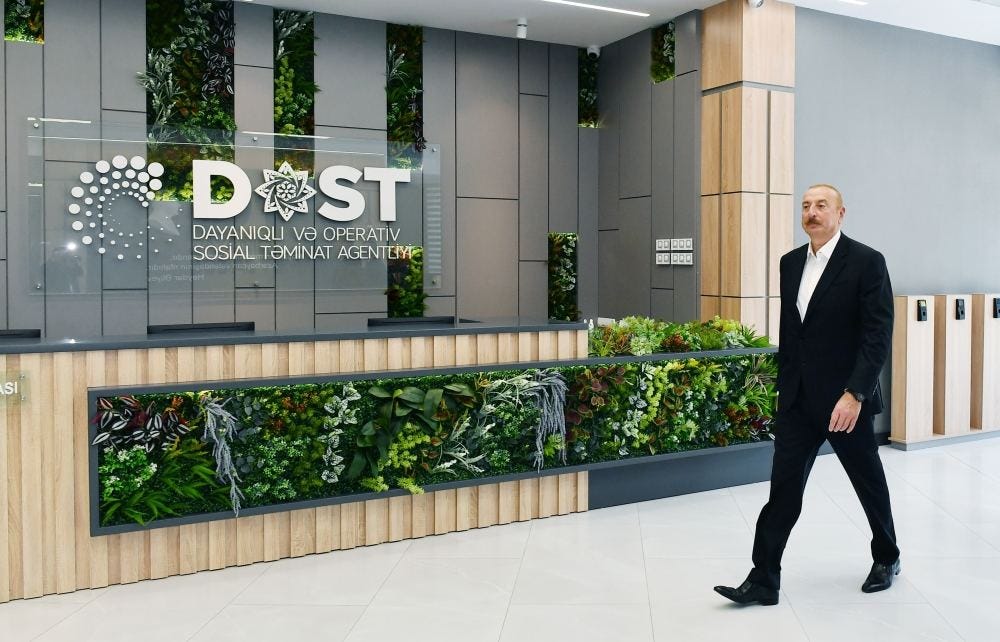
The success of ASAN Service laid the groundwork for another major reform initiative: the DOST Agency. Established in 2018, DOST was designed to apply the same principles of transparency and efficiency to social protection services.
Historically, the administration of pensions, disability benefits and employment services was vulnerable to inefficiencies and institutional fraud. DOST was created to address these challenges through a single-window approach to social service delivery.
The Agency for Sustainable and Operative Social Provision, known as DOST, provides services through dedicated DOST Centres operating under a framework determined by the President of Azerbaijan. The system standardises more than 160 social protection and labour-related services, reducing paperwork and limiting opportunities for abuse.
DOST is responsible for managing, monitoring and evaluating the activities of its centres and coordinating services linked to employment, labour and social protection under the Ministry of Labour and Social Protection of Population. The agency also works with government institutions, local authorities, trade unions, international organisations, non-governmental organisations and private individuals.
The agency’s mandate extends beyond service delivery. It conducts surveys among people requiring social protection, studies their concerns, develops proposals aimed at protecting their rights and participates in drafting legislation relevant to its field. It also reviews appeals submitted under laws governing citizens’ appeals, administrative proceedings and access to information.
The overarching objective is to ensure that services are delivered according to principles of efficiency, transparency, responsibility, courtesy, convenience and citizen satisfaction.
Together, ASAN Service and DOST Centres represent a comprehensive effort to modernise governance in Azerbaijan. By combining technology, transparency and citizen-centred design, the two initiatives have streamlined public administration, strengthened accountability and expanded access to essential services.
In doing so, they have become national brands and internationally recognised examples of how public service reform can transform the relationship between citizens and the state.
©Higher Education Media Services.