


What does it mean to decolonise a university, and who gets to define what counts as African knowledge? Drawing on the turbulent years of South Africa's student movements and the debates they unleashed, a thought-provoking new book by Prof. Srila Roy at the University of the Witwatersrand explores the intersections of curriculum reform, identity, representation, belonging, and power in higher education.
Through vivid classroom encounters, student activism, and scholarly reflection, it reveals how demands for decolonisation opened deeper questions about race, nationality, citizenship, feminism, xenophobia, and the politics of knowledge itself.
Rather than offering easy answers, Roy navigates the tensions between Africanisation, inclusion, and intellectual freedom, challenging readers to rethink what a truly transformative university might look like.
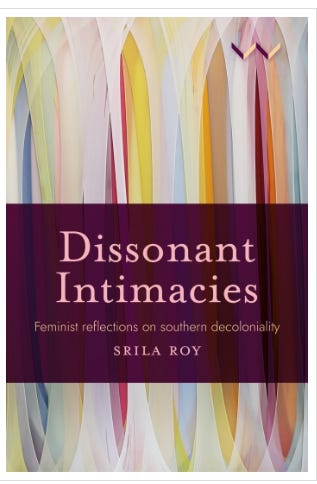
In Dissonant Intimacies: Feminist Reflections on Southern Decoloniality, Srila Roy offers a deeply personal and intellectually provocative exploration of the possibilities and tensions of decolonial feminist politics in the Global South.
Drawing on her experiences as a South Asian scholar working in South Africa, Roy reflects on efforts to build new forms of knowledge, solidarity and resistance across lines of gender, race, caste, geography and history.
Published by Wits University Press on 1 October, Roy offers a personal and intellectually provocative exploration of the possibilities and tensions of decolonial feminist politics in the Global South.
Engaging with pivotal contemporary movements, including South Africa’s Fees Must Fall protests, India’s #MeToo movement and global solidarity campaigns around Palestine, the book interrogates both the promise and the complexity of transnational feminist collaboration. Rather than presenting the Global South as a unified political project, Roy reveals it as a site of productive tension, disagreement and possibility.
In the book, she addresses the controversy around her tweet, which went viral in February 2026 and triggered a major backlash, resulting in her suspension and removal as head of the sociology department at Wits. Reflecting on the incident, which she says also made her a political target, Roy accepts full responsibility, acknowledges that the tweet reinforced harmful racial stereotypes, and apologises unequivocally, recognising the hurt and damage caused to colleagues, students, the university, and the wider public.
She says that the tweet emerged in the context of growing xenophobic hostility towards foreign academics in South African universities. At the time, public debate on social media focused on claims that international academics, particularly from countries such as Zimbabwe, Malawi and Nigeria, were taking jobs from South Africans or were less qualified.
Roy writes that the tweet was intended as an ironic response to xenophobic narratives and as a defence of African scholars work ing in South Africa. However, the attempt at provocation failed because the words themselves overshadowed the intended message and were interpreted within South Africa’s history of racial stereotypes and inequality.
Looking back, the author notes that the controversy sparked debates about academic freedom, social media conduct and racism, while drawing relatively little attention to the xenophobic environment that had prompted the tweet. The episode coincided with increasing anti-migrant rhetoric and violence in South Africa, which the author describes as a growing political force.
“Ultimately, the experience led to the loss of professional standing and trust, but also prompted deep reflection about solidarity, migration and social justice. The author concludes that solidarity across race, nationality and identity remains an unfinished and ongoing project, and dedicates the book to supportive students whose compassion helped during the fallout,” she writes.
Drawing on her experiences as a South Asian scholar working in South Africa, Roy reflects on efforts to build new forms of knowledge, solidarity and resistance across lines of gender, race, caste, geography and history.
Roy was a professor of sociology at the University of the Witwatersrand (Wits) in Johannesburg. Engaging with pivotal contemporary movements, including South Africa’s Fees Must Fall protests, India’s #MeToo movement, and global solidarity campaigns around Palestine, the book interrogates both the promise and the complexity of transnational feminist collaboration.
But rather than presenting the Global South as a unified political project, Roy reveals it as a site of pro ductive tension, disagreement and possibility. At once scholarly and deeply reflective, this timely work challenges readers to rethink decoloniality, knowledge production, and solidarity in a fractured world, while making a compelling case for new intellectual and institutional infrastructures rooted in the South.
Drawing on the turbulent years of South Africa’s student movements and the debates they unleashed, this thought-provoking chapter from Roy’s book explores the intersections of curriculum reform, identity, rep resentation, belonging, and power in higher education. Through vivid classroom encounters, student activism, and scholarly reflection, it reveals how demands for decolonisation opened deeper questions about race, nationality, citizen ship, feminism, xenophobia, and the politics of knowledge itself.
Rather than offering easy answers, she navigates the tensions between Africanisation, inclusion, and intel lectual freedom, challenging readers to rethink what a transformative university might look like.
Excerpt
“Even before the eruption of these movements at Wits, students refused to read white authors and walked out of classrooms which they felt were not sufficiently decolonised. What did they mean? That the course did not include African perspectives or concepts and remained mired in coloniality or Eurocentrism; or, as one political science student put it, ‘wherein Western philosophical thought is not the only point of reference, and where non-Western scholars are studied and celebrated’ (Wits Politics Postgraduate Students 2014). Postgraduate students in the politics department at Wits shared a ‘transformation memo’ which called for ‘a decolonisation of the curriculum, an increase in the number of black academic staff, and a shift towards embracing the political, philosophical, and historical intellectual traditions of Africa and the African diaspora in order to build a truly post-colonial African university’ (Naicker 2016, 54; see also Swartz et al. 2018; Dlakavu 2014). Students were shocked by the lack of black African staff in a premier politics department. Concerns that began with issues of demographics and representation moved to questions around the curriculum and content and type of research conducted and supervised. Why was only western political theory being taught, they asked? Why was it always Foucault?
We see a convergence of questions around knowledge and epistemology, on the one hand, and ones around representation and deracialisation, on the other. In Pillay’s terms (2024), the first pertains to bodies of knowledge and thought that have been historically marginalised or discriminated against – epistemic in/justice – and the second to actual bodies (racialised and gendered) who have suffered employment discrimination, or what he terms ‘demographic in/justice’. I will return to questions of demographics in the next section, but for the moment let me note that these are hard to separate. The fallist demand to centre local African realities implied being taught by someone who could relate to – even mirror – that experience. The relationship between a teacher’s identity and curriculum content, thus, became key.
During the student movements, many an open letter – like the one I received – circulated, and many a student expressed disgust over having to engage a western canon. ‘We don’t want to read colonial texts,’ students would often say. ‘How is Marx relevant to the township?’, one of our own sociology students asked. The curriculum appeared to be designed for another, just as the university itself felt hostile and not hospital to them: ‘… many black South African students felt that course materials were designed for someone other than them’ (Sebidi and Morreira 2017, 34).
This sense of alienation appeared key to the students’ demand that they should be able to ‘see themselves in the curriculum’ (Jansen and Walters 2022, 27; see also 99). The desire to see themselves was even echoed in institutional rhetoric. Anye-Nkwenti Nyamnjoh (2022, 104) quotes a deputy vice-chancellor at UCT as saying:
We want a student and staff body that is more representative of the profile of country and continent, and for students and staff to see themselves – their cultures, values, heritage and knowledge systems – reflected at the university. (Emphasis added)
In many such cases, decolonisation is equated with Africanisation. For #RMF, to Africanise was not to merely add something African into an existing mix, but to centre knowledge on and from Africa, as a way of countering coloniality/Eurocentrism: ‘By this we mean treating African discourses as the point of departure – through addressing not only content, but languages and methodologies of education and learning – and only examining western traditions in so far as they are relevant to our own experience’ (RMFM 2015, 3). As evident in the deputy vice-chancellor’s words, universities took up student demands for decolonisation as an opportunity to ‘re-affirm an African orientation institutional and epistemological self-styling’ (Nyamnjoh 2022, 6).
But what counts as African knowledge and who or what is African? Who defines these categories and marks their scope or bounds? Are they pre-given and stable definitions or subject to negotiation, change and contestation? For Nyamnjoh (2022, 2023), these are questions that reveal many underlying struggles and contradictions, especially when it comes to issues of identity, inclusion and belonging. He shows that the ‘African’ of a decolonisation-as-Africanisation discourse is deeply contested, especially ‘along configurations of race, class, nation and indigeneity’ (2023, 350). One of the students whom he interviews […] expressed at least two contestations, namely, ‘who is African (the authentic subject) and how this subject relates to non-African others (intellectuals, scholarly traditions, theories, concepts etc.)’ (2023, 352). The student’s words also reveal how decolonisation comprised a new register for interpellation and belonging, leaving those who were unequally included into apartheid South Africa – as Indian, for instance – to question whether they did in fact belong to a decolonial fallist future-in-the-making.
[…]
Wahbie Long (2018, 21) recalls the ‘racial provincialism’ of some decolonial supporters, including insinuations that Africans were ‘blacker’ than coloureds and Indians, that ‘coloured’ did not count as black, and that black students were better off being mentored by black staff. Given the middle-class background of student activists and their supporters, Long finds them less drawn to a materialist analysis of academic inequalities than to decolonisation as ‘epistemic violence, a term that refers – broadly speaking – to the subjugation of indigenous epistemologies, methodologies and knowledges’ (2018, 23). Decolonisation then becomes an easy politics and practice of replacement. Since the student movements and the wider decolonisation turn, it has become extremely common for students and scholars alike to use terms like ‘indigenous’ and ‘indigeneity’ as a shorthand for ‘an uncontaminated and pure “African” culture’ (Smith and Lester 2022, 159). As Michael Smith and Claire-Anne Lester note, this move is tricky for queer and feminist scholarship and politics, given how non-normative gender and sexual identities are typically suppressed to constitute an idea of shared values and culture. A student is quoted as suggesting an alternative, ‘Instead of essentializing African knowledge systems, we should be engaging critically and thinking more of synergies. Instead of seeing the “Western” as something pure and external to us, understanding that we’re also part of that. We have to understand that we are part of the world, part of “us” is out “there”’ (in Platzky Miller 2020, 224).
Pillay agrees. Warning against an earlier tradition of Africanisation that amounted to nationalism, the project of decolonising knowledge today must engage ‘a diverse set of intellectual traditions that are neither discrete nor static but, rather, entwined and dynamic’ (2024, 105). For Jonathan Jansen and Cyrill Walters (2022), this has not come to pass. Student desire to see themselves in the curriculum has often been met with the simple and shallow inclusion of local African names, examples and content into what they term the settled or institutional curriculum. This has both institutional and epistemic consequences. As Pillay argues, countering Eurocentrism is more than addressing the ‘national origin or epidemiology of an author’, as ‘it is possible to have an entirely Eurocentric course, even if it is filled with African authors’ (Jansen 2024, 101).
South African colleagues I interviewed were hardly unaware of these tensions and actively struggled with them, even before the movements broke. A former student activist and early career academic echoed many of the reservations around decolonisation as Africanisation, arguing for the need to move beyond nation-states and borders, which are themselves colonial in origin, she stressed. In her own teaching, she used terms like ‘people who live in South Africa’, rather than South Africans, to be more inclusive. Another similarly placed lecturer, who also happened to be an African migrant to South Africa, insisted on telling her students about her own migrant status, and raised questions like ‘how do we make sense of African feminism in the context of nationalism and xenophobia?’. Another young lecturer explained how, within the country itself, being South African was hardly one thing, describing herself as a ‘good black in historically white institutions’. She noted the moments when the reflective visuality that students desired – to see themselves in staff and syllabus – failed (see Dave 2012). Some students felt disappointed when she, the teacher, did not turn out as radical as they expected or wished. In the same vein, teachers, too, felt disappointment when students did not reflect who they wished them to be. In my department, a tutor experienced pushback from an Indian student who claimed that the entire sociology curriculum erased Indian South African identity and experience. The tutor found the student’s feedback dispiriting for how it presumed that ‘black’ did not include Indian. Inspired by black consciousness, the teacher operated with a capacious notion of blackness while the student seemed to embody the taxonomical logic of apartheid. ”
This excerpt was reprinted with the permission of Wits University Press.
©Higher Education Media Services.