


South Africa’s universities face a challenge far greater than balancing budgets or climbing global rankings. They must decide what they exist to sustain and whose futures they are helping to create.
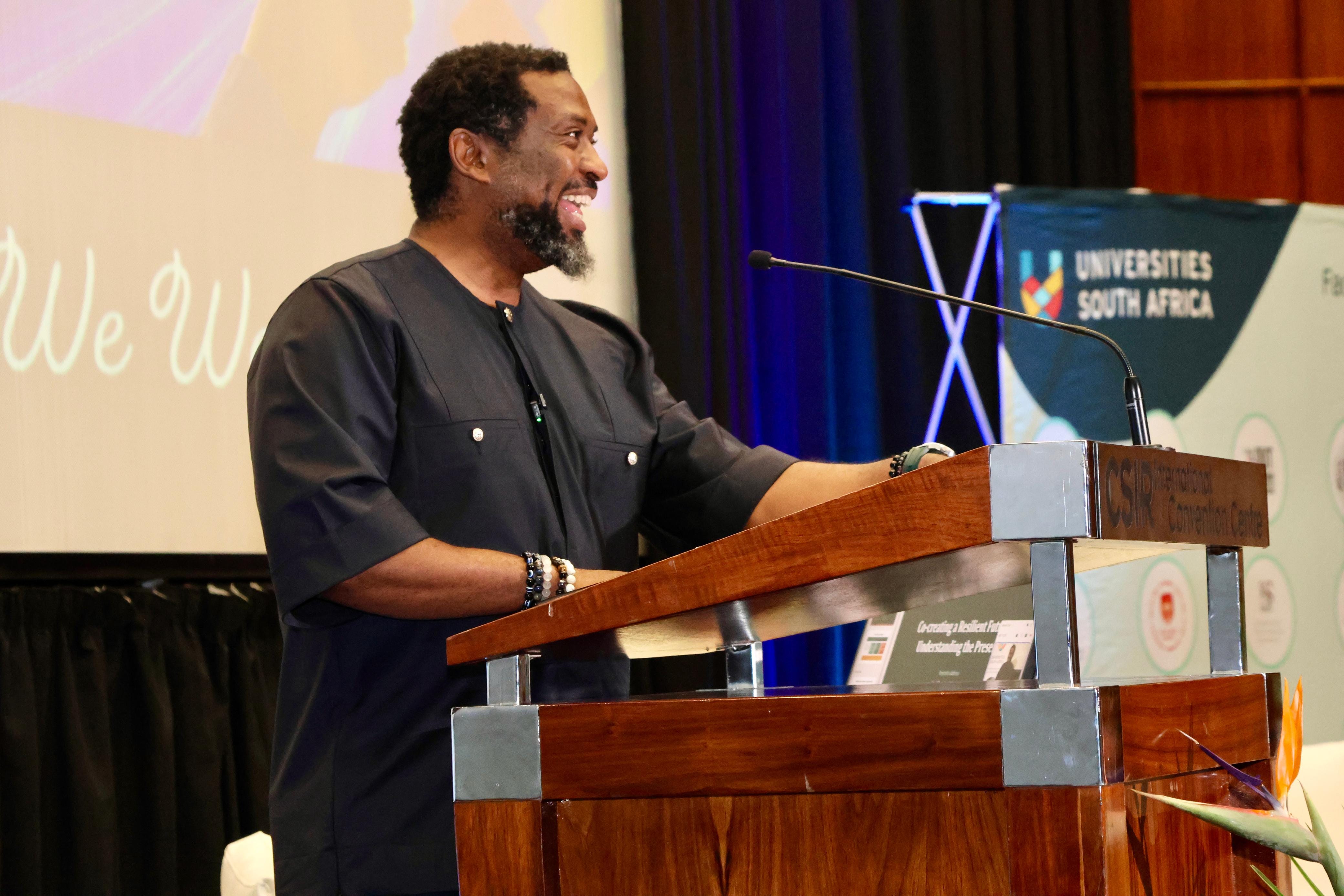
That was the central message from Mr Buti Manamela, Minister of Higher Education and Training, in his keynote address at the 4th Universities South Africa (USAf) Higher Education Conference held at the CSIR Convention Centre under the theme,“Co-creating a Resilient Future”.
The Minister challenged higher education leaders to think beyond institutional resilience and focus on the public purpose of universities in a rapidly changing society.
“Before we ask how resilient our universities are, we should ask what we are asking them to sustain,” Manamela said, posing questions about whether universities are preserving inherited institutional models, expanding access to knowledge, or strengthening society’s ability to solve problems and imagine alternative futures.
The Minister argued that resilience cannot be separated from purpose. “A university that cannot pay its bills cannot fulfil its purpose. But a university that balances its books while losing its public purpose has also failed.”
Throughout his address, Manamela returned to three interconnected themes that he believes will shape the future of higher education: financing, governance and the development of knowledge and human capability in an era of accelerating technological change.
The weight of history
Reflecting on South Africa’s higher education history, the Minister noted that universities emerged within colonial and apartheid structures that distributed opportunity, resources and recognition unevenly. Funding models, governance arrangements and curricula often reflected and reinforced these inequalities.
At the same time, universities were also sites of resistance and intellectual challenge. “We should neither romanticise the university as a permanent home of freedom nor reduce it to an instrument of domination,” he said.
According to Manamela, the democratic era required more than changes in institutional leadership. It demanded the transformation of a fragmented higher education system into a national resource capable of promoting equity, development, knowledge production and democratic participation.
A key lesson from this history, he argued, is that access to higher education must mean more than admission. Drawing on the work of education scholar Wally Morrow, the Minister emphasised that students can be formally enrolled yet remain excluded from meaningful learning through poverty, hunger, inadequate preparation or insufficient academic support.
Funding institutions, not only students
The Minister acknowledged the significant expansion of access to higher education since 1994 but warned that the promise of access is undermined when institutions lack the resources to support student success.
“Getting NSFAS to work reliably is essential,” he said. “It does not, on its own, repair a laboratory, renew a library, support a research programme or reverse years of deferred maintenance.”
Manamela argued that debates about student funding and institutional funding must be considered together, noting that a funded student still requires a functioning institution in which to learn.
He called for a more honest conversation about the full cost of academic success, greater accountability in the use of resources, and funding models that recognise the vastly different starting points of institutions across the sector.
Governance under pressure
On governance, Manamela strongly defended institutional autonomy and academic freedom, stressing that universities cannot fulfil their mission if research outcomes are shaped by political interests, donors or institutional factions.
“As Minister, I must defend the right of universities to produce evidence and arguments that government may find inconvenient,” he said.
At the same time, he warned that autonomy must not become a shield for poor governance. Councils, senates, executive leaders, staff and students each have distinct responsibilities that must be exercised with integrity and accountability.
Leadership instability, weak oversight and unresolved governance disputes, he cautioned, ultimately undermine teaching, research and public trust.
AI and the future university
A significant portion of the address focused on artificial intelligence and its implications for teaching, learning and knowledge creation.
Manamela argued that universities must prepare graduates not only to use AI tools, but also to interrogate them critically. While AI systems can generate information rapidly, they cannot replace human judgement, ethical reasoning or an understanding of social consequences.
For South Africa, the challenge goes beyond student use of AI. It includes questions about who develops the technology, which languages and experiences are represented in datasets, who owns the infrastructure, and who benefits from technological innovation.
The Minister called for investment in African language technologies, research capacity, shared computing resources and interdisciplinary collaboration involving both the humanities and scientific disciplines.
A call for collective responsibility
Concluding his address, Manamela urged universities, government, industry, labour and students to move from debate to action.
“The future is already taking shape in decisions about budgets, appointments, curricula and partnerships,” he said.
He challenged delegates to build universities that are financially sustainable, academically free and socially responsive.
“The past shows us that universities can reproduce an unjust society and help to change it,” he said. “The present requires us to confront the distance between the opportunities we promise and the conditions we provide. The future asks whether we have the courage and discipline to close that distance.”
For the Minister, resilience is ultimately not about institutional survival, but about sustaining the public purpose of higher education and ensuring that universities remain powerful engines of knowledge, opportunity and societal transformation.
©Higher Education Media Services.