


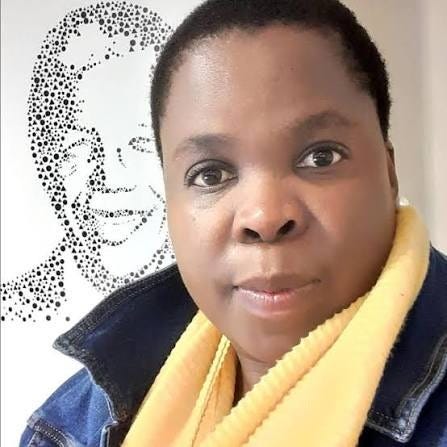
Brightness Mangolothi’s journey begins in Mofolo South, Soweto, where township realities shaped her resilience, social consciousness and belief in education as liberation.
Today, she stands as one of South Africa’s most influential voices in diversity, inclusivity and social change, serving as Director of the Centre for Diversity, Inclusivity and Social Change (CDISC) at the Cape Peninsula University of Technology (CPUT).
Her rise from Morris Isaacson High School, the historic site of the June 16 uprising, to executive transformation leader is a testament to grit, courage and purpose.
Raised by parents who taught her discipline, empathy and the power of speaking up, Brightness learned early that leadership is not a title but a responsibility. Her schooling sharpened her awareness of inequality and opportunity.
Morris Isaacson was more than a school; it was a space of empowerment. Learners studied in classrooms with no windows, no furniture and no books, yet were taught they could thrive irrespective of race. Witnessing the filming of Sarafina reinforced the devastating impact of apartheid on Black communities and deepened her commitment to justice.
Brightness excelled academically, consistently ranking among the top five students. Although placed in science classes, she felt drawn to history and the human story. She exercised her voice early, asking the principal to move her to the history class. When the class was left without a teacher for a month, she led a march demanding a replacement — “short, petite, and the youngest, but determined to say enough is enough.”
Her family remains her greatest support system. Her father, a respected community leader in soccer and netball, believed deeply in education and community building. Strict, disciplined and unwavering, he instilled in her courage and conviction.
Her mother nurtured her with humility, love and the spirit of sharing:
“Bana ba motho ba kgaogana tlhogwana ya tsie” — teaching her to speak up against injustice.
Her grandmother, stylish and self‑sufficient, taught her that people will always talk, and that their talk is often a sign of impact. Her children, Lwazi and Thando, now serve as her sounding board, offering wisdom that keeps her grounded and self‑aware.
Brightness’s support systems extended beyond family. A Christian youth group led by women teachers encouraged her to reach levels they themselves never dreamt possible.
At university, colleagues and comrades provided emotional support as she navigated discrimination and exclusion. These diverse networks — spanning races, genders and ages — shaped her worldview and leadership.
She went on to serve as Director of HERS‑SA, Head of Department at Nelson Mandela University, Head of Programme at IIE AdvTech, and founder of her own consultancy before joining CPUT as Director of CDISC.
Q & A
Beginnings
Tell us about your upbringing?
I was born in Mofolo South, Soweto, Gauteng, and raised by both parents in a township environment that instilled resilience and awareness of social realities.
I attended Isiseko Primary School, Dlambulo High School and Morris Isaacson High School, a historic site of the June 16 uprising. Studying there meant we were mentally prepared to confront oppression and strengthened to face life’s challenges.
Being considered one of the “model Cs” of the township sharpened my awareness of inequality and opportunity. I completed matric at Morris Isaacson High School, where the 1976 June 16 march began. The school was more than a place of learning; it was a space of empowerment.
Our teachers instilled in us the importance of fighting for our rights and the emancipatory power of knowledge. I was consistently among the top five students, automatically placed in science classes.
Family: I am single, with two children, Lwazi (son) and Thando (daughter), who inspire my commitment to building inclusive futures. Today, my children have become my sounding board. They help me see my blind spots, sometimes sharing bitter truths that I’ve learned to swallow and appreciate. Their wisdom, though they're young, continues to shape me.
Life growing up: My parents are my greatest support system. Their prayers, wisdom, and encouragement gave me the strength to say, *“I can.”
My father believed deeply in the power of education and community building. Though he never had the chance to attend university, he held numerous leadership positions in soccer and netball and mentored many. He led from the front, very strict, respected, and unwavering in his conviction that education was the path forward. He instilled in me discipline, faith, and the courage to lead.
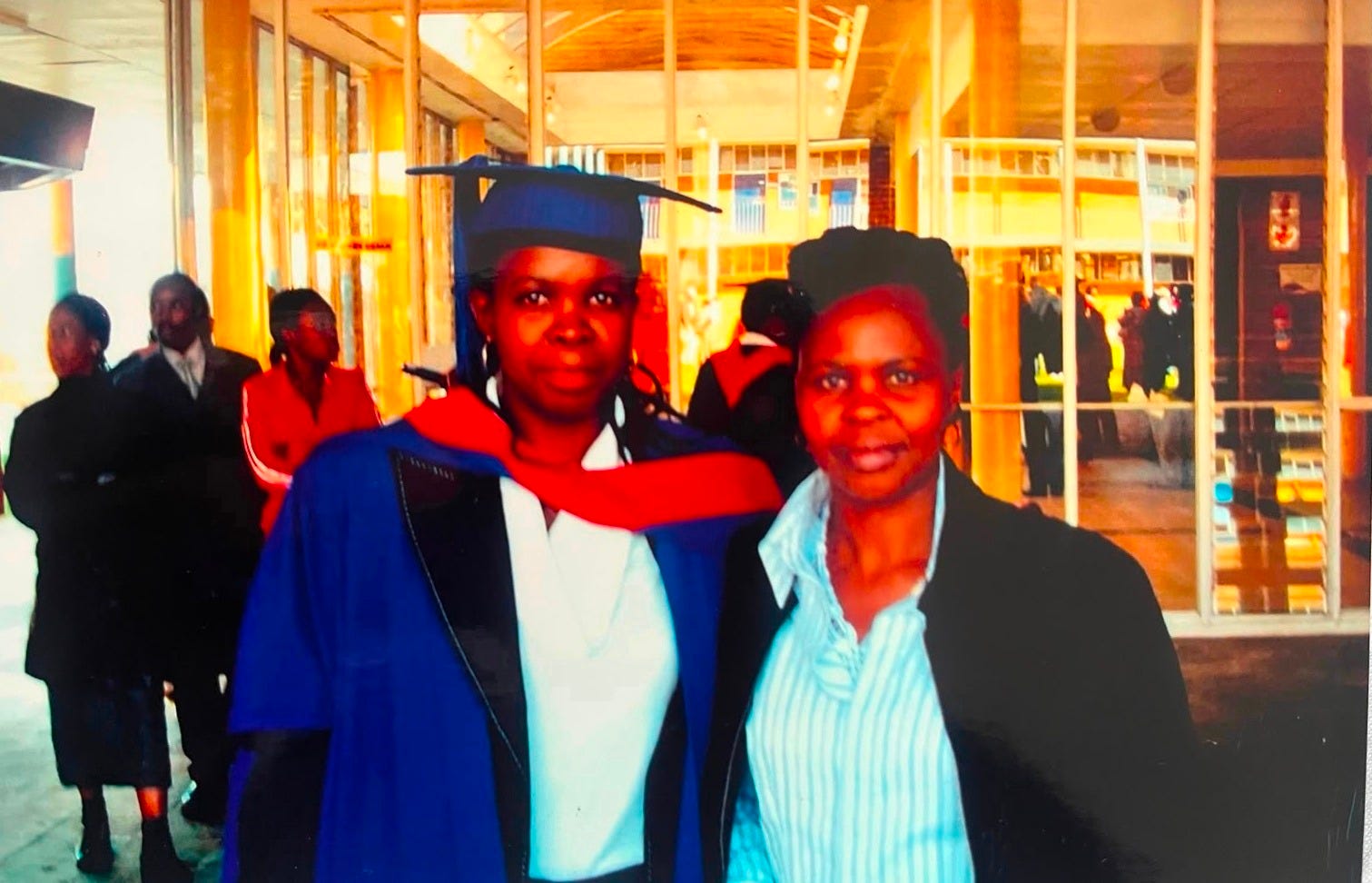
My mother nurtured me with love, humility, and the spirit of sharing. She led from behind, planting seeds of wisdom that often revealed themselves later. She taught me to speak up against injustice, not only for myself but for others. Her mantra was: *“Bana ba motho ba kgaogana tlhogwana ya tsie”— the spirit of sharing, no matter how little you have.
My maternal grandmother, may her soul rest in peace, was a feminist of her time; staunch, self‑sufficient, and stylish. She designed her own clothes from cloth to final product, loved looking good, and taught me that people will always talk. Their talk, she said, should never stop you from your journey of self‑rediscovery. Instead, it is a sign that you are making an impact.
My father, interestingly, could pray but rarely stepped into a church. Yet he insisted I attend, even arranging for a church elder to take me along.
My mother, brilliant and humble, believed in self‑love and sharing. I often wonder what she might have achieved had she been given the same opportunities as her brothers.
My support systems have always been diverse—spanning races, genders, and ages. The older ones offered maps of life, allowing me to stand on the shoulders of giants. The younger ones gave me fresh perspectives, helping me see life anew through their eyes.
Where and what did you study after school?
After matric, I pursued my tertiary studies at the Vaal University of Technology (VUT), where I completed a National Diploma in Public Relations Management. Building on this foundation, I advanced to a BTech in Public Relations and a BTech in Post-School Education, which deepened my expertise in both strategic communication and educational development.
My National Diploma and BTech in Public Relations provided the foundation for understanding communication as both a science and a practice. These qualifications sharpened my ability to design campaigns, manage relationships, and influence attitudes—competencies indispensable to transformation and DEIB leadership.
This qualification equipped me to design and facilitate developmental programmes, create inclusive learning opportunities, and support capacity‑building initiatives. It also strengthened my ability to manage group dynamics, navigate conflict, and facilitate negotiation processes, all central to building inclusive institutional cultures.
The MBA broadened my perspective on organisations as interconnected systems and deepened my knowledge of leadership, governance, and change management.
Beyond formal qualifications, my lived experience as a union leader gave me practical knowledge of labour relations and dispute management. Leading in spaces where workers’ rights were contested taught me how to balance advocacy with negotiation, manage disputes constructively, and use dialogue as a tool for justice.
Hobbies and relaxation: I love nature! Game drives, stargazing, watching the sunrise and sunset, enjoying outdoor life, beaches, and scenic views and reading (although I seem to be buying more books than reading them lately).
Keeping up with trends: I stay current by reading journal articles, attending and presenting at conferences, and engaging with transformation networks. Overall, the circle of friends I keep provides an enriching space to see life through a different lens, and this alone renews how I see life.
Career beginnings: My journey began as a student health editor for the Tricom Student Newsletter. Interviewing health professionals exposed me to the disproportionate illnesses affecting Black communities, rooted in limited access to information and education. One of my most impactful early articles was on the benefits of Pap smears. It drew wide readership, sparked dialogue, and made me realise—this was the moment when my advocacy and commitment to social justice were truly cemented.
During my internship, I encountered another defining experience. An event was scheduled while strikes were unfolding. The majority of my team, who were white, insisted the event should continue. I stood my ground, sharing my lived understanding of how strikes unfold: “No one wants to be served food when all they want is a fair salary.” It was the bravest thing I could do at the time. They persisted, but later returned to acknowledge that I had been right. From then on, they knew they had to consult and seek holistic perspectives on cultures they were unfamiliar with.
That moment taught me a critical lesson: my power is in my voice. Silence would have left me complicit, but speaking up created change. Since then, I have consistently used my voice—not only for myself, but for others. This conviction has propelled me into leadership roles in both community and workplace settings, even leading a union.
Early challenges: I encountered subtle but stinging discrimination in a white Afrikaans‑dominated workplace. This experience pushed me to return to university to further my studies and strengthen my voice in transformation work.
Career
Current role: Director, Centre for Diversity, Inclusivity and Social Change (CDISC), Cape Peninsula University of Technology.
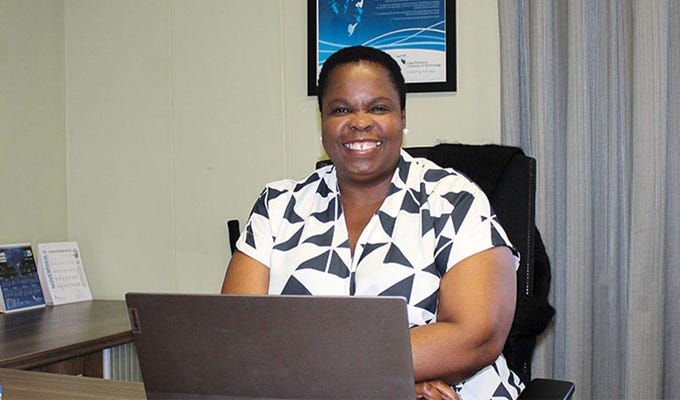
Tenure: Serving in this role since December 2024. Previously, I was a Director for HERS-SA, Head of Department at NMU, Head of Programme at IIE AdvTech, and ran my consultancy.
Day‑to‑day work: No two days are alike. I may be:
Addressing disability issues
Supporting students transitioning into staff roles
Collaborating with social justice activists to co‑create inclusive spaces
Training on inclusive work and learning environments
Leading capacity‑building initiatives on transformation
Sitting on senior leadership interview panels, promotion committees, or Senate structures to ensure policy frameworks are implemented
Partnering with international organisations to advance inclusive workplaces
Most loved aspect: Seeing even one life change, or hearing “thank you, your efforts were not in vain.”
Career path: From lecturing and departmental leadership to executive transformation roles, including Director/CEO of HERS‑SA.
Dream career: I once dreamt of being an architect, but township realities required a portfolio I didn’t have. Today, I see myself as an “architect of inclusive spaces.”
Highlights:
Founding the Higher Education Women Leaders Awards to recognise women’s remarkable contributions in higher education.
Watching students bloom and win awards across sectors, especially those who initially felt invisible and that they did not belong,
Delivering keynote addresses at St. Cloud University (2013) and University of Leeds (2023),
My first co-edited book in 2023, and,
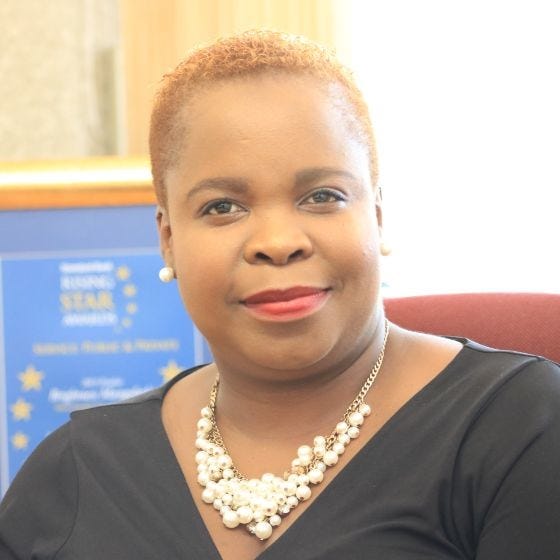
Being nominated as Woman of Substance by Sunday World in 2025 for contributions to higher education.
Pros & Cons
Best parts:
Driving systemic social change, more so when you see people coming out of their cocoon, claiming their voices and showing up in their authentic self.
Influencing institutional culture and policy
Empowering individuals and communities
Building inclusive, equitable spaces
Challenges:
Lack of investment in transformation work—financially and in human capacity
Resistance to change and subtle discrimination, even worse when those who need to be set free do not see it like that – but that is where resilience and persuasive communication play a critical role
Managing unrealistic expectations from those who may not see the hidden complexities of transformation
Personality fit: Empathetic, resilient, strategic, and communicative individuals thrive here.
Compensation: Executive roles in higher education are well‑remunerated with strong benefits.
Global mobility: Transformation leadership is transferable internationally.
Education/training: Communication, education, leadership, and social sciences provide strong foundations.
Helpful matric subjects: Social sciences, history, languages, and business studies.
Training duration/cost: Several years of study; bursaries, loans, and scholarships are available.
Ongoing training: Essential through CPD, conferences, and research.
Study options: Universities offering BA qualifications in Communication Studies, Gender Studies, Higher Education, and Social Studies. When you want to move to a senior-level position, an MBA or any leadership qualification will stand you in good stead. Ideally, get a Master’s; the work requires systematic evidence – lots of research done as part of baseline assessment and also ongoing monitoring and evaluation.
Advice for Young People
Guidance: Transformational leadership requires a heart to love against all odds. Expect challenges but embrace them as part of the journey.
Shortage: There is a growing demand for transformation leaders in South Africa and globally.
Similar jobs: Diversity officers, equity specialists, organisational development consultants, social justice advocates.
Reflection: I would have invested more time in writing earlier to document and share the transformation journey more widely.
Mentorship: Teachers and mentors who emphasised the power of language and communication inspired me deeply. Their guidance reinforced my belief that words can transform societies.
©Higher Education Media Services. – www.ednews.africa