



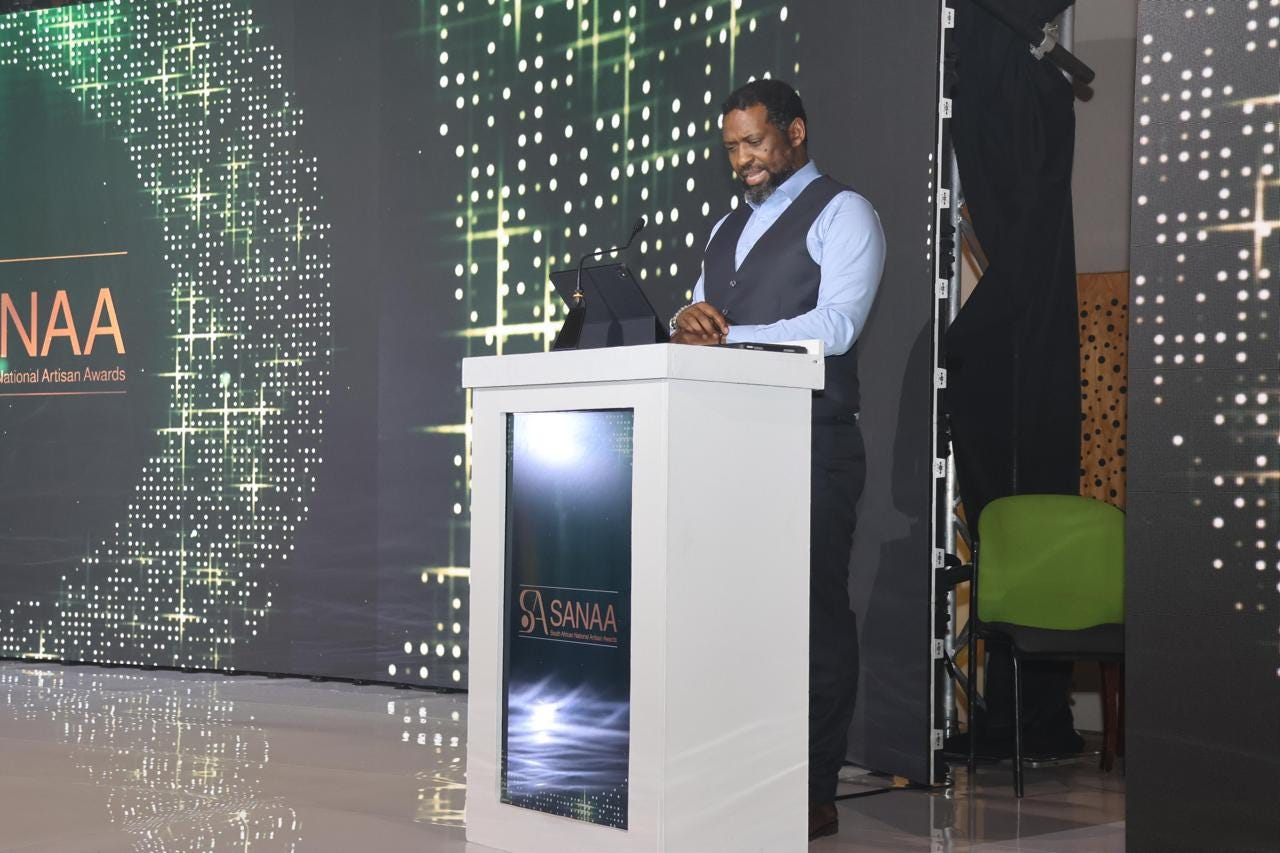
At the 2nd Annual South African National Artisan Awards (SANAA), Higher Education and Training Minister Buti Manamela delivered a powerful message: South Africa’s future depends on the artisans who keep its infrastructure functioning, its industries productive and its communities moving.
Speaking at the Radisson Blu Hotel near OR Tambo International Airport, the Minister honoured 34 finalists across 13 priority trades and issued a national call to rebuild the country’s artisanal skills pipeline.
Manamela opened by reminding the audience that artisans are central to the functioning of any modern economy. They maintain factories, repair transport networks, safeguard water systems, build homes and public infrastructure, and solve the practical problems that underpin industrialisation.
For too long, he said, South Africans have been taught that success is synonymous with a university degree. “That is wrong,” he argued. “A qualified artisan carries advanced applied knowledge, judgement, discipline and the ability to make things work.”
He reiterated a line that has become a signature of his public messaging: a country that cannot produce its own plumbers, welders or cobblers “does not have the luxury of dreaming about sending people to Mars.” Ambition, he said, must stand on capability — and capability requires a skilled workforce.
From Recognition to a Functional Skills Pipeline
The awards follow immediately after TVET Month, during which the department encouraged young people to physically visit colleges, see workshops, meet lecturers and understand the pathways into trades. Manamela stressed that recognition alone is not enough. South Africa must build a complete and coherent skills pipeline: career guidance, enrolment in credible programmes, modern workshops, lecturers with current industry knowledge, structured workplace learning, fair trade testing, certification, and finally employment or enterprise.
He noted that recent campus visits revealed a consistent message: South Africans have talent and determination, but the system often forces them to carry the cost of fragmented planning, outdated equipment, slow certification processes and limited workplace opportunities. “The classroom, the workshop and the workplace must operate as one learning system,” he said. “When they are disconnected, the student pays. When they are aligned, the country gains a capable artisan.”
Driving Reform: Quality, Workplace Learning and Accountability
The National Development Plan sets a target of producing 30,000 qualified artisans annually by 2030. Manamela warned that this target will not be met by counting registrations or signing memoranda of understanding. Instead, the country must count completions, qualifications, workplace absorption and sustainable enterprises.
He outlined several reforms: completing the transition to credible occupational qualifications, ensuring programmes respond to real economic needs, modernising college workshops and simulators, strengthening lecturer development and industry exposure, and protecting the integrity and turnaround times of assessment and certification.
But the central bottleneck, he said, remains workplace learning. Government can fund training and colleges can teach theory, but apprentices cannot become competent artisans without real-world exposure under qualified mentors. Employers must stop “standing at the edge of the skills system” and instead help design programmes, open workplaces, provide mentors, verify competence and absorb graduates.
SETAs and the National Skills Fund must support this through coherent funding, common standards and transparent tracking. Funding must follow the learner through the entire pathway, not create disconnected projects. The measure of success, Manamela said, is simple: “week by week, the system must move more apprentices into workplaces, more candidates through trade tests and more qualified artisans into productive work.”
He also emphasised inclusion. Women, persons with disabilities and young people from rural and township communities must be able to enter, qualify and lead in every trade. Inclusion requires safe training environments, fair assessment, competent mentorship and visible routes into employment and ownership.
Building One National Platform for Artisan Excellence
Manamela called for SANAA to become the single national platform for recognising artisan excellence — not one of several parallel ceremonies competing for attention. Recognition must be coordinated, credible and governed with integrity. Adjudication must be transparent, data verified, and finalists supported beyond the awards evening.
The inaugural SANAA focused on Centres of Specialisation. This year, the awards expanded to all 50 public TVET colleges. From 2027, the platform should include public and private artisan-training institutions while maintaining a unified national standard.
The partnership with Allan & Gill Gray Philanthropies South Africa and Allan Gray Makers adds an entrepreneurial dimension. A qualified artisan should not be limited to searching for vacancies. With technical mastery, commercial support and access to markets, artisans can establish enterprises, train apprentices, employ others and strengthen local economies.
©Higher Education Media Services.