


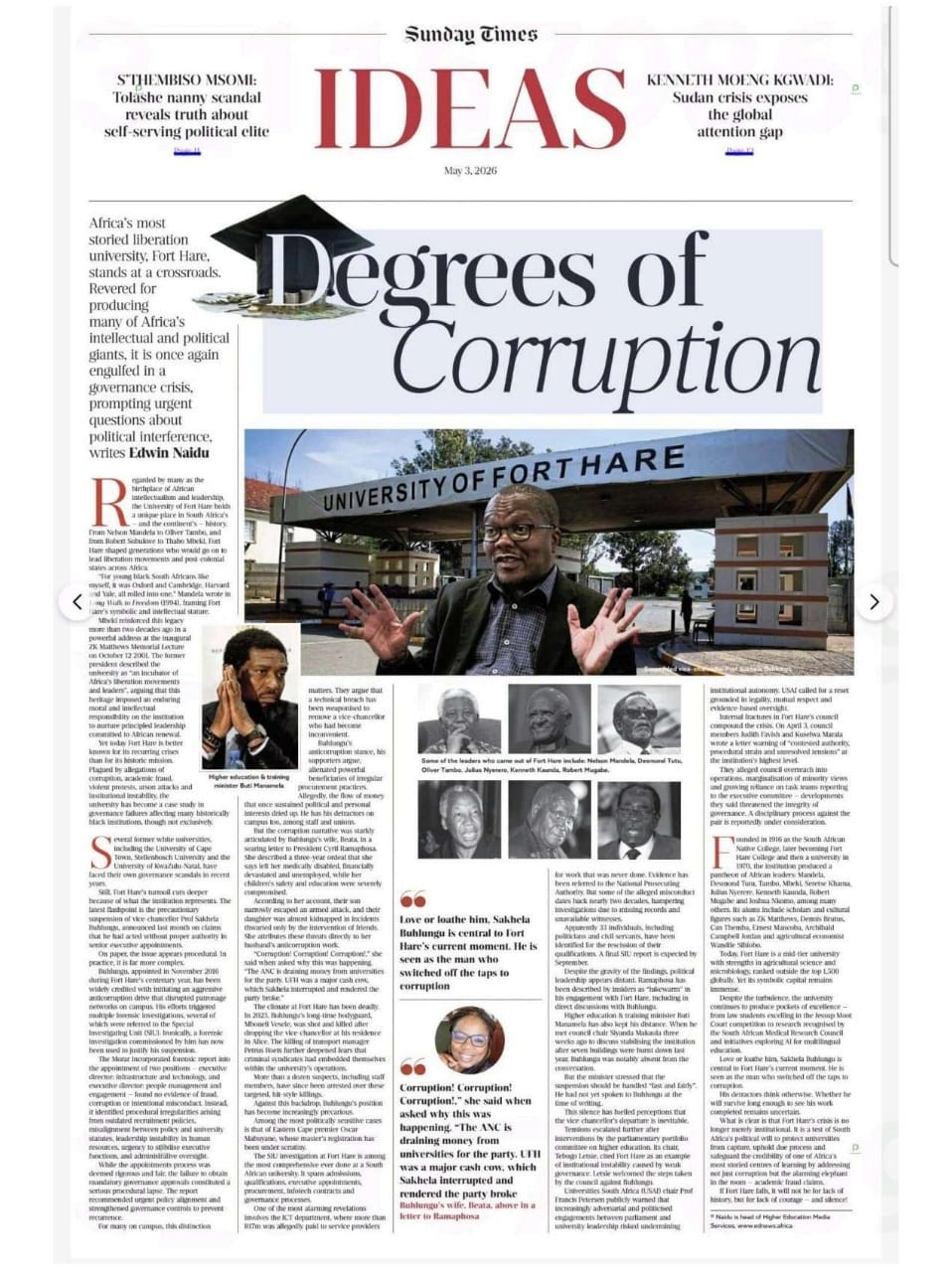
Regarded by many as the birthplace of African intellectualism and leadership, the University of Fort Hare holds a unique place in South Africa’s — and the continent’s — history.
From Nelson Mandela to Oliver Tambo, and from Robert Sobukwe to Thabo Mbeki, Fort Hare shaped generations who would go on to lead liberation movements and post-colonial states across Africa.
“For young black South Africans like myself, it was Oxford and Cambridge, Harvard and Yale, all rolled into one,” Mandela wrote in Long Walk to Freedom (1994), framing Fort Hare’s symbolic and intellectual stature.
Mbeki reinforced this legacy more than two decades ago in a powerful address at the inaugural ZK Matthews Memorial Lecture on October 12 2001. The former president described the university as “an incubator of Africa ’s liberation movements and leaders”, arguing that this heritage imposed an enduring moral and intellectual responsibility on the institution to nurture principled leadership committed to African renewal.
Yet today Fort Hare is better known for its recurring crises than for its historic mission. Plagued by allegations of corruption, academic fraud, violent protests, arson attacks and institutional instability, the university has become a case study in governance failures affecting many historically black institutions, though not exclusively.
Several former white universities, including the University of Cape Town, Stellenbosch University and the University of KwaZulu-Natal, have faced their own governance scandals in recent years. Still, Fort Hare’s turmoil cuts deeper because of what the institution represents.
The latest flashpoint is the precautionary suspension of vice-chancellor Prof Sakhela Buhlungu, announced last month on claims that he had acted without proper authority in senior executive appointments.
On paper, the issue appears procedural. In practice, it is far more complex. Buhlungu, appointed in November 2016 during Fort Hare’s centenary year, has been widely credited with initiating an aggressive anticorruption drive that disrupted patronage networks on campus. His efforts triggered multiple forensic investigations, several of which were referred to the Special Investigating Unit (SIU). Ironically, a forensic investigation he commissioned has now been used to justify his suspension.
The Morar Incorporated forensic report into the appointment of two positions — executive director: infrastructure and technology, and executive director: people management and engagement — found no evidence of fraud, corruption or intentional misconduct. Instead, it identified procedural irregularities stemming from outdated recruitment policies, misalignment between policies and university statutes, leadership instability in human resources, and the need to stabilise executive functions and administrative oversight.
While the appointments process was deemed rigorous and fair, the failure to obtain mandatory governance approvals constituted a serious procedural lapse. The report recommended urgent policy alignment and strengthened governance controls to prevent recurrence.
For many on campus, this distinction matters. They argue that a technical breach has been weaponised to remove a vice-chancellor who had become inconvenient. Buhlungu ’s anticorruption stance, his supporters argue, alienated powerful beneficiaries of irregular procurement practices. Allegedly, the flow of money that once sustained political and personal interests dried up. He has his detractors on campus, too, among staff and unions. But the corruption narrative was starkly articulated by Buhlungu’s wife, Beata, in a searing letter to President Cyril Ramaphosa. She described a three-year ordeal that she says left her medically disabled, financially devastated and unemployed, while her children ’s safety and education were severely compromised.
According to her account, their son narrowly escaped an armed attack, and their daughter was almost kidnapped in incidents thwarted only by the intervention of friends. She attributes these threats directly to her husband’s anticorruption work.
“Corruption! Corruption! Corruption!,” she said when asked why this was happening. “The ANC is draining money from universities for the party. UFH was a major cash cow, which Sakhela interrupted and rendered the party broke.”
The climate at Fort Hare has been deadly. In 2023, Buhlungu’s long-time bodyguard, Mboneli Vesele, was shot and killed after dropping the vice-chancellor at his residence in Alice. The killing of transport manager Petrus Roets further deepened fears that criminal syndicates had embedded themselves within the university’s operations.
More than a dozen suspects, including staff members, have since been arrested over these targeted, hit-style killings. Against this backdrop, Buhlungu’s position has become increasingly precarious.
Among the most politically sensitive cases is that of Eastern Cape premier Oscar Mabuyane, whose master’s registration has been under scrutiny. The SIU investigation at Fort Hare is among the most comprehensive ever done at a South African university. It spans admissions, qualifications, executive appointments, procurement, infotech contracts and governance processes.
One of the most alarming revelations involves the ICT department, where more than R17m was allegedly paid to service providers for work that was never done. Evidence has been referred to the National Prosecuting Authority. But some of the alleged misconduct dates back nearly two decades, hampering investigations due to missing records and unavailable witnesses.
Apparently, 33 individuals, including politicians and civil servants, have been identified for the rescission of their qualifications. A final SIU report is expected by September. Despite the gravity of the findings, political leadership appears distant. Ramaphosa has been described by insiders as “lukewarm ” in his engagement with Fort Hare, including in direct discussions with Buhlungu.
Higher education & training minister Buti Manamela has also kept his distance. When he met council chair Siyanda Makaula three weeks ago to discuss stabilising the institution after seven buildings were burnt down last year, Buhlungu was notably absent from the conversation. But the minister stressed that the suspension should be handled “fast and fairly”. He had not yet spoken to Buhlungu at the time of writing..
This silence has fuelled perceptions that the vice-chancellor’s departure is inevitable. Tensions escalated further after interventions by the parliamentary portfolio committee on higher education. Its chair, Tebogo Letsie, cited Fort Hare as an example of institutional instability caused by weak governance. Letsie welcomed the steps taken by the council against Buhlungu.
Universities South Africa (USAf) chair Prof Francis Petersen publicly warned that increasingly adversarial and politicised engagements between parliament and university leadership risked undermining institutional autonomy. USAf called for a reset grounded in legality, mutual respect and evidence-based oversight.
Internal fractures in Fort Hare’s council compound the crisis. On April 3, council members Judith Favish and Kuselwa Marala wrote a letter warning of “contested authority, procedural strain and unresolved tensions” at the institution’s highest level.
They alleged council overreach into operations, the marginalisation of minority views, and a growing reliance on task teams reporting to the executive committee — developments they said threatened the integrity of governance. A disciplinary process against the pair is reportedly under consideration.
Founded in 1916 as the South African Native College, later becoming Fort Hare College and then a university in 1970, the institution produced a pantheon of African leaders: Mandela, Desmond Tutu, Tambo, Mbeki, Seretse Khama, Julius Nyerere, Kenneth Kaunda, Robert Mugabe and Joshua Nkomo, among many others. Its alums include scholars and cultural figures such as ZK Matthews, Dennis Brutus, Can Themba, Ernest Mancoba, Archibald Campbell Jordan and agricultural economist Wandile Sihlobo.
Today, Fort Hare is a mid-tier university with strengths in agricultural science and microbiology, ranked outside the top 1,500 globally. Yet its symbolic capital remains immense. Despite the turbulence, the university continues to produce pockets of excellence — from law students excelling in the Jessup Moot Court competition to research recognised by the South African Medical Research Council and initiatives exploring AI for multilingual education.
Love or loathe him, Sakhela Buhlungu is central to Fort Hare’s current moment. He is seen as the man who switched off the taps to corruption. His detractors think otherwise. Whether he will survive long enough to see his work completed remains uncertain.
What is clear is that Fort Hare’s crisis is no longer merely institutional. It is a test of South Africa’s political will to protect universities from capture, uphold due process and safeguard the credibility of one of Africa’s most storied centres of learning by addressing not just corruption but the alarming elephant in the room — academic fraud claims.
If Fort Hare falls, it will not be for lack of history, but for lack of courage — and silence!
This was published in the Sunday Times.
©Higher Education Media Services.