


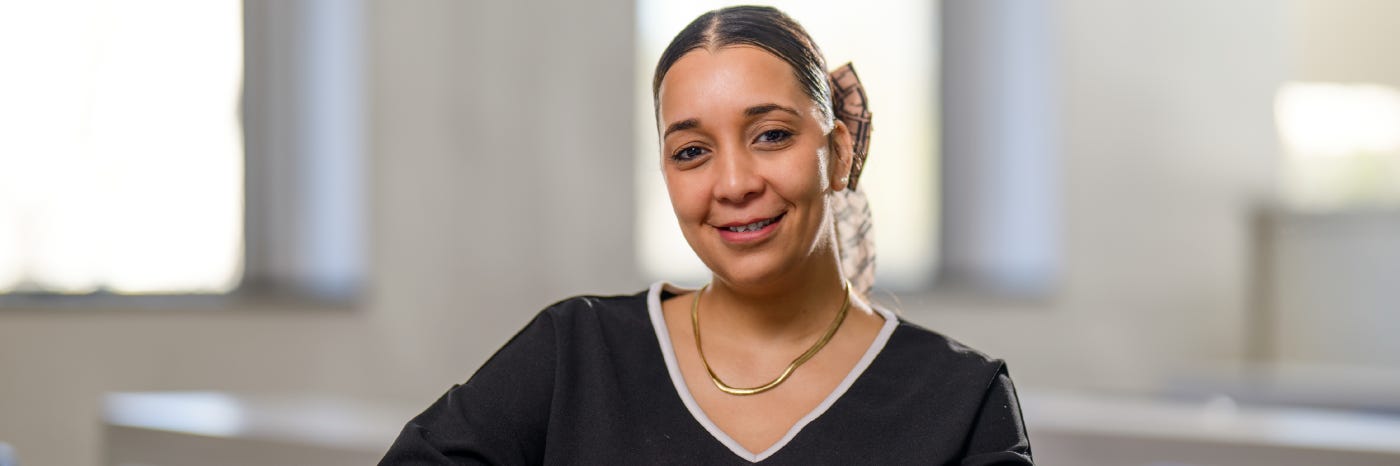
Delecia Davids is still flustered when she shares the big news: She has become the first South African academic to receive the prestigious Einstein Fellowship, an honour she describes as a “once in a lifetime” opportunity. “It has not fully sunk in yet,” she says in disbelief.
The fully funded fellowship, offered by the Einstein Forum in collaboration with the Wittenstein Foundation, supports exceptional young intellectuals pursuing interdisciplinary work beyond their previous specialisation, following the example set by Albert Einstein. Davids will live and work in the garden cottage of Einstein’s summer house in Caputh, Germany.
Her selection recognises her as one of SU’s brightest emerging academic stars. An early-career researcher, lecturer and teacher educator in the Department of Curriculum Studies, Davids works across critical educational technology studies, digital agency, emerging technologies and assessment.
At the Faculty of Education, she is known for using digital “escape rooms” to explore new teaching methods for education students. She is also the founder and academic lead of SU’s Digital Agency Studio, a social impact initiative funded by the Centre for the Advancement of Social Impact and Transformation (CASIT), where students, academics and young people examine how technology shapes learning.
A once-in-a-lifetime opportunity
Davids’s Einstein fellowship project, titled “Reparative storytelling, memory, and identity”, will examine the stories of people who identify as coloured in South Africa and places them in conversation with Germany’s practices of public remembrance.
The project grew from personal loss. Her father died in 2023, just as she began her PhD. “I realised there was so much I didn’t know about him and his history and where he came from,” she says. “You don’t really ask until it’s too late.”
Those questions intersected with experiences that had already shaped her: her work as a Mandela Rhodes Scholar on reconciliation, her role in the Wilgenhof residence facilitation team with Prof Pumla Gobodo-Madikizela and Dr Wilhelm Verwoerd, and her involvement in the Khampepe Commission. There, she says, “the intensity and the urgency” of reparative work became impossible to ignore.
Her project will begin with ten families. Starting with students from her own generation, she plans to trace their stories through families and communities, documenting “the challenging stories, but also the joyful heritage we have”.
“I don’t know where the research is going to go,” she says, “but it feels like something important for me, and also for a larger narrative that we’ve not really dealt with.”
Reimagining teaching through technology
Davids grew up in Delft, attended an ex-model C school in Parow and arrived at SU in 2012 as a first-year student in Irene residence. She describes her educational journey as “an evolution of consciousness”. Student leadership, the #FeesMustFall period and later work on gender-based violence deepened her understanding of institutions, belonging and transformation.
“I’ve always made an effort to not just critique non-transformation from the outside,” she notes. “I want to be part of the transformation journey and be able to say we tried this and failed, or this part worked. To some degree, we’re always complicit in what stays intact and what doesn’t.”
She initially expected to become a maths and science teacher but became drawn to teacher education and its wider influence. “When I thought about one class and impacting 30 kids versus being able to impact all the aspiring teachers who will be standing in front of 30 or 40 kids one day, that difference in scale seemed significant.”
Her PhD, now in its final stages under the supervision of Prof Jonathan Jansen, explores how final-year preservice teachers understand technology use and how those views have been shaped over their lives. Using an ethnographic approach, she has spent time with students in their homes and traced their histories with technology.
Under Jansen’s guidance, she has presented at major international conferences such as the Comparative International Education Society and the American Educational Research Association.
Driving responsible innovation
Davids resists the assumption that educational technology problems can be solved through infrastructure alone. “We say access is the problem and think we just need to add more infrastructure and the problem is solved. In South Africa, it’s much more nuanced than that.”
Her teaching reflects that conviction. Davids has developed “escape room” activities that ask education students to solve problems collaboratively, think critically and engage with course material in unfamiliar ways. A visit to Stanford University, where she met researchers behind educational escape rooms, placed her experiments within a wider international conversation about innovation.
Her approach to artificial intelligence is similarly questioning. She worries about “cognitive offloading”, where students produce polished work without the struggle and uncertainty through which learning happens. She also raises concerns about consent, data sovereignty and digital tools bought “off the shelf” by institutions. “There’s a facade of innovation that might actually harm us more than it will save us,” she warns.
Yet she does not reject AI. Her central question is one of agency: What should be delegated to technology, and what must remain human? Through the Digital Agency Studio and a Youth Advisory Council, she is building spaces where young people help shape research about digital life.
Making the university feel possible
For Davids, innovation is inseparable from belonging. Her master’s research on place attachment explored why some student leaders, particularly students of colour, remain deeply invested in SU while others disconnect.
Exposure, she argues, can change a young person’s sense of what is possible. Visiting a campus or meeting someone who represents the university can make an intimidating institution feel within reach.
As an academic, she tries not to reproduce academia’s “hidden curriculum” – the unwritten rules that protect privilege. “I’m trying to help whoever wants to know how to demystify what’s going on in academic spaces.” She works with fourth-year, honours and master’s students as co-facilitators and co-designers, giving them opportunities to lecture, host and lead.
As curator of TEDx Stellenbosch, she has also helped turn it into what she calls “a public engagement platform for research at the university”, foregrounding postgraduate students, alumni and community voices.
That work led to a scholarship to attend the Skoll World Forum in Oxford, where she hosted a session on digital innovation and youth. It strengthened her belief that academic work and social entrepreneurship need not exist in separate worlds.
A teacher at heart
On the homefront, Davids is grounded by her family and husband whom she describes as “really, really precious. Everyone tells me I’m very lucky to have married him.” A pair of cats moved in with them in Harmonie residence, where she now serves as Residence Head.
She jokes about being called a “meta-human” by one of her students but is frank about the realities of sacrifice – from postponed decisions about having children to the ongoing struggle for sustainable rhythms of work, community and rest.
Cooking and hosting dinners have become one of her practices of care. She loves curating who sits around the table, mixing students, colleagues and visitors so that conversation stretches beyond institutional lines. “The conversation is never just about work,” she says. “We talk about a million things.”
During those evenings, in advisory councils and classrooms, in residences and research proposals, Davids keeps returning to the same belief: that people, especially young people, must be active participants in shaping the institutions and technologies that shape them. “If you are not changed in some way by your experience here,” she tells her students, “you’ve wasted your money.” For her, the true work of the university is mutual transformation – of people, of places, and of the systems that have long decided who belongs.
“I’m a teacher at heart,” she concludes with a big smile.
©Higher Education Media Services.