


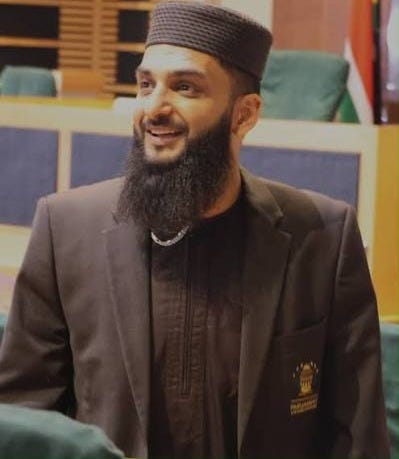
South Africa’s newly-appointed Deputy Minister of Higher Education and Training has pledged to build a post-school education system that is more responsive to the needs of students, describing his role as “deeply personal” and rooted in a lifelong belief that education is the pathway to dignity and opportunity.
Speaking the National Press Club in Pretoria, DM Yusuf Cassim outlined a leadership philosophy centered on listening, acting with urgency, and removing barriers that prevent students from succeeding.
“Talent is universal, but opportunity is not,” he said, recalling how his father’s sacrifices and limited opportunities under apartheid shaped his own commitment to expanding access to education.
Cassim emphasised that higher education is not simply another government function, but a portfolio that touches the hopes of millions. He argued that freedom must be given practical meaning through education and skills development.
“Higher education is where freedom becomes opportunity, and where opportunity becomes dignity,” he said.
Since taking office on 1 July, he has focused on listening to students through platforms such as the Deputy Minister’s Helpdesk, oversight visits, and direct engagement with institutions.
During a recent visit to UNISA, more than 400 students responded to his call for feedback, raising concerns about delayed allowances, unresolved funding queries, and accommodation challenges.
“Students experience government as one system,” he noted. “When an allowance is delayed or an appeal remains unresolved, they experience government. Students simply want government to respond.”
With more than 1.24 million students relying on NSFAS for funding, Cassim acknowledged the scheme’s critical role in bridging the gap between poverty and opportunity. He highlighted concerns about delays in resolving GAP funding investigations, call centre responsiveness, and coordination between NSFAS and institutions.
“These may sound like administrative matters, but to a student they are deeply personal - determining whether they can register, eat, have transport or accommodation, or continue their studies,” he said.
He welcomed commitments from NSFAS Administrator Professor Hlengani Mathebula to accelerate progress, but stressed that responsiveness must become the defining standard of success.
One initiative he singled out was the digitisation of the Deputy Minister’s Helpdesk, inherited from his predecessor Dr Mimmy Gondwe. Working with partners such as MICT SETA, the Helpdesk is being transformed into a faster, more accessible platform. More importantly, he said, it should serve as government’s “listening post,” identifying systemic challenges and informing policy.
“Good government begins by listening,” he added.
Cassim also addressed the Islamophobia, xenophobia, and racial prejudice he faced following his appointment. He reflected on his upbringing in Kariega, where his family lived in a community classified under apartheid’s racial laws, and where he grew up alongside friends from diverse backgrounds.
“South Africa’s diversity is not something to fear,” he said. “Our shared humanity is always greater than the labels others seek to place upon us. Leadership carries a responsibility not to deepen divisions, but to build bridges.”
He rejected attempts to pit communities against one another, insisting that South Africa’s future depends on recognising shared prosperity and success.
Throughout his address, Cassim returned to the theme of student advocacy. As a former SRC President at Nelson Mandela University, he recalled initiatives to improve transport, establish a student bailout fund, and create prayer facilities. Those experiences, he said, taught him that leadership is measured not by position, but by whether lives are improved.
“I am not here to cut ribbons,” he concluded. “I am here to stand with students, to push student issues, and to ensure they remain at the centre of everything we do. If, at the end of my tenure, students can honestly say that government became easier to reach, quicker to respond, and more committed to removing barriers, then I will consider my service worthwhile.”
©Higher Education Media Services.