


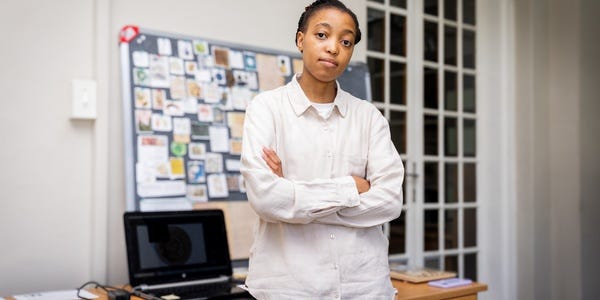
Poet and visual artist Dr Tebogo Matshana has begun a groundbreaking nine‑month ArtSci4Innovation Postdoctoral Fellowship at the Sydney Brenner Institute for Molecular Bioscience (SBIMB), becoming the first artist to take up residence inside the genomics research hub at Wits University.
The fellowship—an initiative of the Wits Innovation Centre (WIC)—places artists inside science and engineering laboratories to foster new forms of dialogue between creative practice and scientific research.
For Matshana, the residency offers a rare opportunity to explore how genomics in South Africa can inspire poetic storytelling, visual interpretation and new ways of understanding memory, ancestry and change within the human body.
Emotion enters the lab
SBIMB, known for its work on African genetic diversity, disease risk and environmental factors, has never before hosted an artist. The arrival of Matshana signals a shift towards broadening how science is experienced and shared.
As a visual artist who works with poetry, data and metaphor, Matshana is particularly drawn to the Institute’s extensive biobank of DNA and blood samples collected across the continent. For her, these samples are not only biological data but carriers of cultural memory, story and intimate histories.
She plans to immerse herself in conversations with genomic scientists, letting fragments of dialogue become emotional and artistic entry points.
A practice guided by curiosity
Matshana approaches the project through practice-based research, allowing creation and reflection to unfold in a looping, intuitive rhythm. She describes her process as stream‑of‑consciousness, letting each mark or idea reveal an underlying “why” before following it deeper.
Poetry remains central to how she accesses scientific ideas. Terms such as “DNA repair” prompt not only technical understanding but emotional imagery: stitching, mending, healing. She links this to artists like Louise Bourgeois, who saw sewing as an act of emotional repair.
While still exploring possible themes, Matshana is drawn to DNA repair, gene conversion, heritability and the notion of the body remembering. She is fascinated by how environment shapes cells, how illness is lived, and how scientific mechanisms intersect with personal and collective experience. She references the work of writer Stacey Hardy, who documents tuberculosis from an intimate, human perspective.
Visually, Matshana gravitates toward layered images and time. She uses “onion-skin” layers in Photoshop and draws inspiration from artists such as Geraldine Ondrizek, whose translucent chromosome prints allow viewers to see generations at once. For Matshana, this evokes transparency, memory and the persistence of lineage.
Science meets sensibility
SBIMB Director Professor Michèle Ramsay says the residency invites scientists to see their work through a different lens. “Artists and scientists are very alike in that they’re both driven by curiosity and a desire to investigate the unknown,” she says. Having an artist in the institute allows science “to be interrogated emotionally,” with Matshana’s interpretations offering new ways to think about genomic research and its impact.
WIC Director Professor Christo Doherty adds that the scientific setting will deepen the rigour of Matshana’s metaphors and help her develop ethically mindful storytelling practices within African genomic contexts. In turn, Matshana offers scientists the chance to explore the humanistic, spiritual and aesthetic dimensions of molecular science.
From birdsong to the body
The fellowship builds on Matshana’s earlier work on birdsong, migration and diaspora in Setswana communities, where she recorded and animated oral poems to create a digital cultural archive. Now, she shifts from the migrating bird to the microscopic seed—from movement across landscapes to inheritance within the body.
“The underlying question remains the same,” she says. “How do memory, ancestry and change live in the body and the landscape, and how can visual metaphor help us understand that relationship?”