


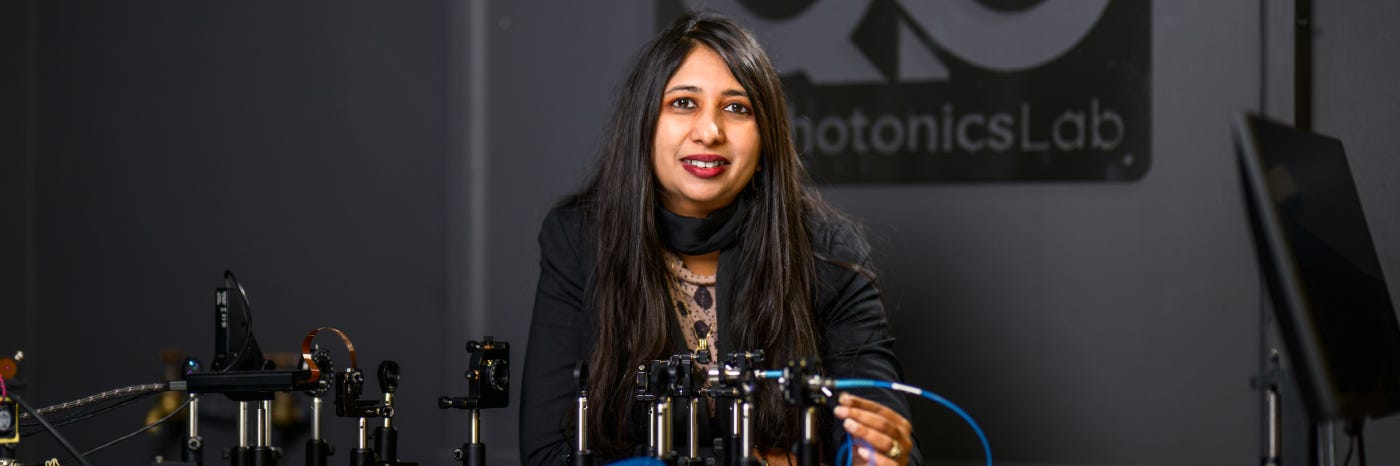
In 2018, Dr Yaseera Ismail walked into a lecture venue at the University of KwaZulu-Natal (UKZN) feeling a little nervous. It was her first class as a newly appointed physics lecturer, and around 400 students were waiting for the class to begin.
A young woman struck up a friendly conversation, assuming Ismail was a fellow student. “When I took to the podium, she was a little taken aback,” Ismail recalls with a laugh. “I think I looked younger than I was.”
Almost a decade later, she is still occasionally mistaken for a student. Only now, the youthful academic standing at the front of the lecture hall has become one of South Africa’s leading quantum physicists.
Over the past two years, this Stellenbosch University (SU) senior lecturer helped establish the first quantum satellite communication link in the Southern Hemisphere and the world’s longest intercontinental ultra-secure quantum link between South Africa and China.
The achievement, published in the prestigious journal Nature, has placed South Africa firmly on the global quantum map and marked a significant step towards developing the quantum internet of the future.
In 2025 she was selected as one of the Quantum 100, a UNESCO International Year of Quantum Science and Technology initiative that recognises people who are advancing research, innovation and community building to mark 100 years of quantum mechanics.
First-generation academic
Growing up in Chatsworth in KwaZulu-Natal, Ismail never imagined she would one day represent South Africa at UNESCO in Paris, chair international scientific conferences or lead pioneering quantum research. She was simply determined to make the most of opportunities, “I was the first person in my immediate family who got a degree,” she says. “On my first day on campus, I didn’t know where to go.”
Her original ambition was to become an optometrist. As a young girl, she had an eye infection which led to numerous operations. The experience left her fascinated by vision, lenses and light. After being advised to consider another field, she enrolled for physics. “It helped that I was already interested in optics and photonics, which deals with light, lasers and lenses,” Ismail explains. “I realised physics was my calling.”
That initial passion eventually led her into the world of optics, photonics and quantum communication – a field that uses the unique properties of quantum mechanics to make information transfer extraordinarily secure. Today she heads SU’s QuPhotonics Lab, where she leads research into quantum communication technologies and the development of future quantum networks.
Aiming for the sky
In late 2024, almost every strand of Ismail’s career converged at once in a daunting week. By day, she chaired the 26th Congress of the International Commission for Optics at SU – the first time it had been held in Africa. At the event, she hosted esteemed scientists such as a Nobel Prize winner Prof Donna Strickland. By night, she ran experiments for the pioneering quantum satellite link, often from 22:00 until 02:00. In the middle of it all, she flew to Pretoria to be inaugurated into the South African Young Academy of Science.
“I literally don’t know how I did it. It was probably just adrenaline!” she says. “I wanted all those activities to work, no matter what it took.”
They did. The conference succeeded, the experiment went live on 13 October 2024, and the research produced a record-breaking quantum-secure link over 12 900 km. In the same year, she was appointed by the leading international society for optics and photonics, Optica, as the vice president of the International Commission for Optics.
Ismail credits her paternal grandmother as her first role model. “She had little formal education, but she taught herself through books and by spending time in libraries. She inspired me to pursue my education as far as I could and motivated me to continue beyond an undergraduate degree all the way to a PhD.”
Later, another role model Prof Francesco Petruccione, Director of the National Institute for Theoretical and Computational Sciences at SU, became an inspiration as he showed her how to become a rigorous researcher, build a research group and support others.
A mentor in her own right
Ismail, who is a keen participant in the Department of Higher Education and Training’s Future Professors Programme, devotes much time to mentoring young scientists, supporting women in STEM (science, technology, engineering, and mathematics) and helping develop quantum capacity across Africa.
She co-founded Optica’s international mentorship programme, serves on global scientific committees and believes no country on the continent should be left behind as quantum technologies reshape the world. She also helps to raise scholarship funding and serves on the selection committee for Women in Optics. Over the past ten years, Ismail has secured over R16 million in grant funding. “For me it’s all about passing on opportunities and knowledge to the next generation,” she says.
Her influence on younger scientists became clear during an unexpected encounter with a postgraduate physics student at the UKZN. The student told her: “You’re the reason I study physics.” Years earlier, Ismail had judged her project at the Eskom Expo for Young Scientists and had written encouraging words on her scorecard. The student had kept it.
“I was genuinely shocked because I had no idea such a small interaction could have such a profound impact on someone’s life,” Ismail says. “It reminded me that we often underestimate the power of a few words of encouragement.”
A legacy of empowerment
Ismail has often found herself the only woman in the room at quantum conferences in South Africa and says women are still not always taken seriously in the discipline. She is currently the only female principal investigator within the South African Quantum Technology Initiative. “I really want to see a community. I want to see growth. I want to see a pipeline, and not only for women, but for everyone,” she says.
When she was first interviewed at SU and asked what she’d hope her legacy would be one day, Ismail said she wanted to establish quantum satellite links at the institution. That ambition was realised sooner than expected. Now the dream has expanded.
“I would like to contribute to building a quantum ecosystem in South Africa and leave it in the hands of people who can really drive it forward after me,” she says. “Leaving opportunities for the next generations would be the best legacy.”
©Higher Education Media Services.