


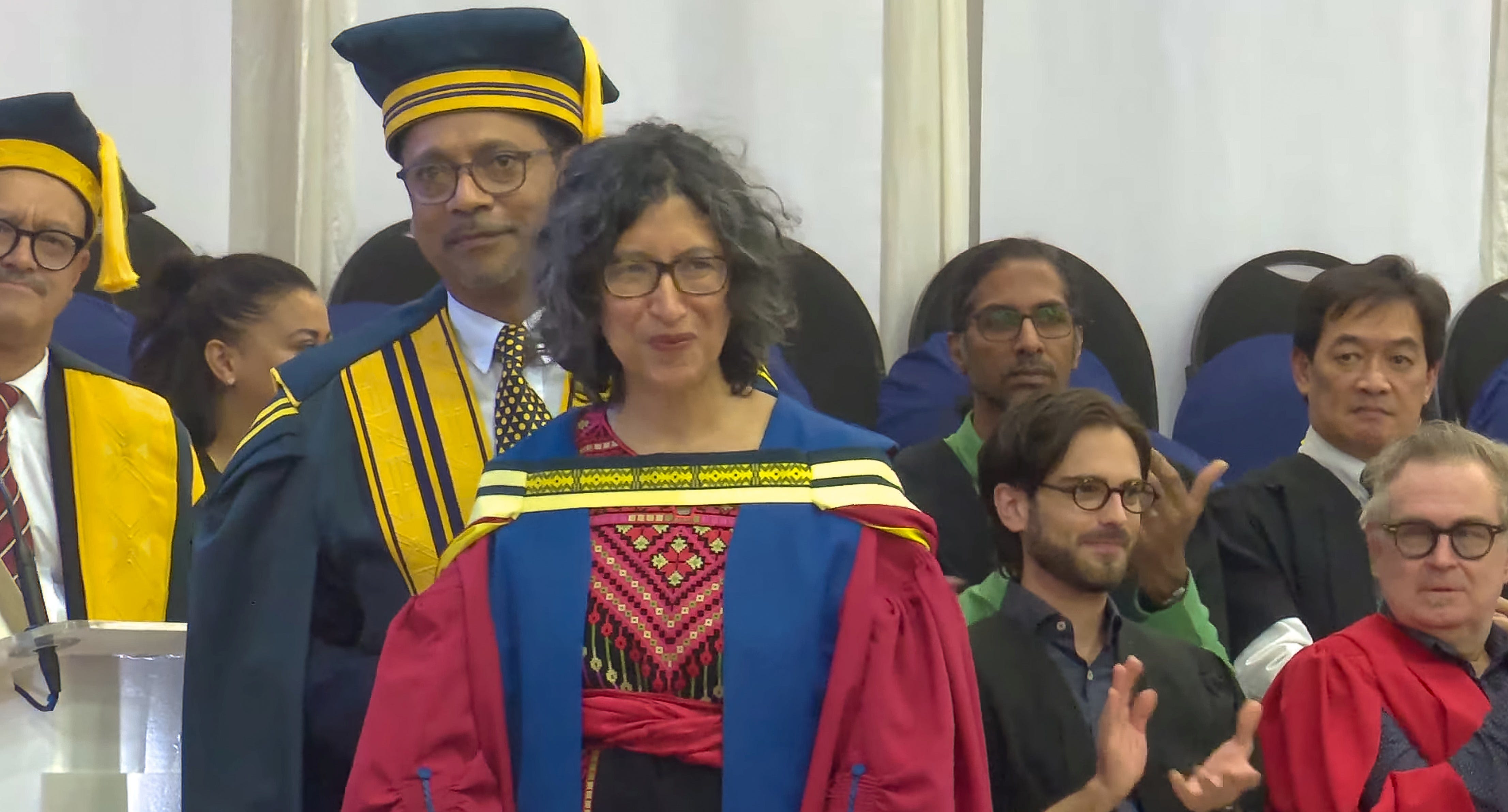
Gqeberha – In a moment that braided together memory, scholarship and homecoming, Professor Gabeba Baderoon – one of South Africa’s most acclaimed literary voices – was recently awarded an honorary Doctor of Literature by Nelson Mandela University.
For Prof Baderoon, the recognition was not only an academic milestone, but a deeply personal return to where her life began.
“I breathed my first breath just 14 kilometres from here,” she said in her acceptance speech. “The air of the Eastern Cape lives within me.”
A poet, scholar and public intellectual of international standing, Prof Baderoon’s work has long explored the intimate intersections of memory, identity, belonging and justice. Currently an Associate Professor at Pennsylvania State University, her scholarship and creative writing span continents, while remaining firmly rooted in the textures and histories of South African life.
Yet, on this occasion, it was her mother’s story, and the enduring legacy of education, that anchored her message.
Born to a doctor who worked until the very hour before her birth at Livingstone Hospital, Prof Baderoon described education as both an inheritance and a responsibility.
Her mother, who studied medicine at the University of Cape Town during apartheid, went on to serve for 35 years in a state hospital, despite systemic inequality and lack of recognition.
“This is a powerful reminder (that) the world may not always reward your goodness – but your goodness will endure,” she said.
The staunch belief in education as something that must extend beyond the self runs through Prof Baderoon’s work and life. Her writing, from poetry collections such as The Dream in the Next Body and The History of Intimacy to her acclaimed non-fiction, has consistently illuminated the ways personal histories are shaped by broader social forces, including colonialism, apartheid, migration and faith.
Her scholarship has also foregrounded often marginalised voices, particularly in her work on Muslim identity in South Africa and her co-leadership of the African Feminist Initiative, which is a transnational platform advancing interdisciplinary research and collaboration across the continent and its diaspora.
In conferring the honorary doctorate, the University recognises not only her literary excellence, but her contribution to expanding global conversations on race, gender, religion and belonging.
Prof Baderoon herself framed the honour as part of a much larger continuum that connects past, present and future.
“In Athlone, where I grew up, lived great intellectuals such as Archibald Campbell Mzolisa Jordan and Phyllis Ntantala – thinkers who created spaces of debate, imagination, and scholarship,” she said. “Their legacy connects places, generations, and ideas… Today, we are all part of that continuum.”
Prof Baderoon called on graduates to resist conformity, embrace uncertainty and to act with courage and imagination.
“You are not here to be an afterthought of someone else’s thinking,” she said. “You are here because there is something only you can contribute.”
In an era she described as “intricate” and uncertain, Prof Baderoon urged graduates to understand their education not as an endpoint, but as an ethical commitment.
“Your education is not merely a qualification – it is a responsibility. It is an inheritance you must share; through your integrity, your compassion, your courage, and your refusal to accept injustice,” she said.
For Nelson Mandela University, the conferral of the honorary doctorate affirms its alignment with a scholar whose work embodies the transformative power of the humanities; to help societies understand themselves more fully, and to imagine more just futures.
For Prof Baderoon, it was a moment held with humility and reverence.
“This honorary doctorate is the greatest honour of my academic life,” she said. “To the place and people who gave me life, breath and inspiration – I carry you within me.”
©Higher Education Media Services.