


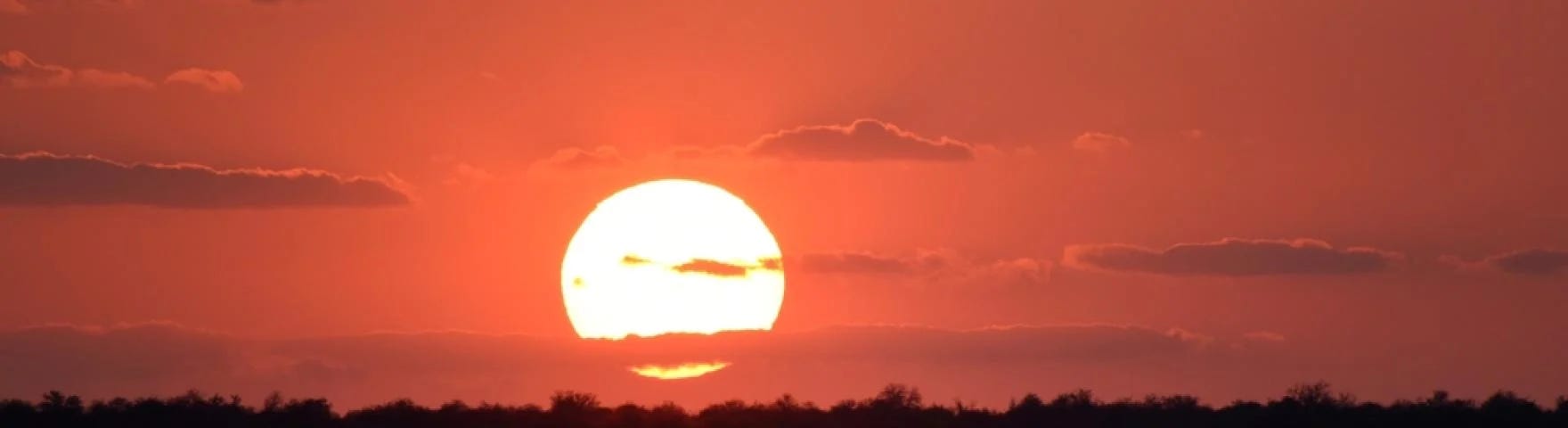
Artificial light from surrounding towns and settlements is spilling into the Kruger National Park, threatening one of nature’s most overlooked resources – darkness. New research led by the University of Pretoria (UP) has found evidence of light pollution in 87% of night-sky images captured across the park, raising concerns about the potential effects on wildlife, from insects to lions and endangered rhinos.
Published in the international journal Biological Conservation, the study reveals that even vast protected areas are not necessarily shielded from the effects of human development beyond their borders.
The culprit is a phenomenon known as skyglow, the artificial brightening of the night sky caused when light from streetlights, buildings, and other infrastructure scatters through the atmosphere. While we might associate light pollution with cities, the researchers discovered that its effects extend surprisingly far into one of Africa’s most important conservation areas.
“People tend to think of national parks as places where nature is protected from human interference,” says lead researcher Dr Bernard Coetzee of UP’s Department of Zoology and Entomology. “But light does not recognise park boundaries. Our findings show that even when we protect the land, we may still be changing the environment that animals experience at night.”
When the night is no longer dark
Covering approximately 19,200 km², the Kruger National Park is larger than 44 countries. Less than 0.1% of its area has direct artificial lighting, making it an ideal location to investigate how light pollution travels beyond its source.
Working with researchers from the UK’s University of Exeter and South African National Parks (SANParks), the UP team analysed 55 images of the night sky captured across the park during winter and summer fieldwork in 2016 and 2017. Using specialised cameras capable of measuring faint light across the entire sky, they discovered evidence of artificial skyglow in 48 of the 55 images, or 87%.
Importantly, the pollution was most noticeable along the horizon rather than directly overhead, particularly near the park’s western and southern boundaries. Only 7% of images showed light pollution directly overhead, suggesting that conventional measurements focused on the sky above an observer may underestimate how extensively artificial light penetrates protected landscapes.
The park’s interior generally remained darker, but the findings demonstrate that artificial light can extend well beyond the towns and settlements producing it.
Why darkness matters to wildlife
For many animals, darkness is as important as daylight. Natural cycles of light and dark regulate feeding, reproduction, movement, and interactions between predators and prey. Previous research has demonstrated that artificial nighttime lighting can disrupt bird migration, change insect behaviour, and interfere with biological rhythms.
The new study raises particularly interesting questions about the Kruger’s large predators. Lions, for example, are predominantly nocturnal hunters whose activity can be influenced by moonlight. African wild dogs also use moonlit conditions when moving and hunting.
The researchers suggest that artificial skyglow could create conditions resembling persistent moonlight in some areas, potentially changing when and how these animals hunt.
“Darkness is not simply the absence of light,” Dr Coetzee says. “It is an essential part of the natural environment. If we change nighttime light conditions, we could also change the behaviour of animals that depend on natural patterns of darkness.”
However, the researchers emphasise that the study measured light pollution, not its direct effects on the Kruger’s wildlife. Whether skyglow is changing predator behaviour remains an important question for future research.
The findings raise another concern: rhino poaching.
Poachers can use moonlight to navigate and operate at night. The researchers suggest that artificial light from settlements outside the park could similarly provide visual landmarks and improve visibility along some boundaries. This potential risk has not yet been directly tested, but it highlights how light pollution could complicate conservation management.
Beyond wildlife protection, the gradual disappearance of dark skies could also affect opportunities for stargazing and astronomy-based tourism.
Protecting the darkness
The study highlights an important challenge for conservation, which is that protecting biodiversity requires looking beyond the boundaries of national parks. Because much of the artificial light originates outside the Kruger, addressing the problem will require cooperation between conservation authorities, surrounding communities, planners, and policymakers.
“Protecting nature means protecting the conditions that allow it to thrive, including the natural darkness of the night,” Dr Coetzee says. “We need to think more carefully about how development and artificial lighting outside protected areas affect what happens inside them.”
The research provides a baseline for future investigations into light pollution in African protected areas and reinforces a growing conservation message that saving wild places also means saving their dark skies.
©Higher Education Media Services.