


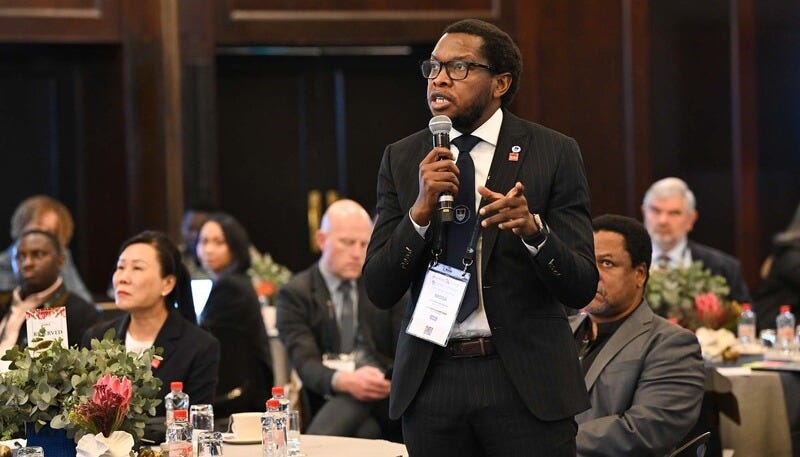
Attendees at the All-Africa Rankings Initiative hosted by the University of Cape Town (UCT) left day two on a proverbial cliffhanger. The question that remained was: How do we define excellence in higher education in Africa? Vice-Chancellor Professor Mosa Moshabela took it a step further by asking: What should excellence in African fourth-generation universities look like in the 21st century?
The two-day event, hosted in partnership with Applied Higher Education (AppliedHE), was aimed at caucusing around university ranking systems and how they do not always fully reflect the diversity of missions, priorities and contributions that characterise higher education in Africa.
At the close of day two on 1 September, Professor Moshabela, in acknowledging the contributions of the co-creation workshops, firstly spoke about South Africa’s Higher Education Act.
“While listening to discussions, I had to go back and remind myself what the act says about the mandate of universities because in some ways, we are reimagining what a university ought to be doing, and it may not be consistent with the original mandate as established. So, it’s important to go back to your institutions and reflect on what it is you are mandated to do because we may need to collectively revisit that.”
He said the thinking behind a fourth-generation university found expression in the formulation of UCT’s fourth mission in Strategy 2030: innovation and entrepreneurship. “A fourth-generation university is one that contributes directly to socio-economic development.” He explained that it’s a simple beeline to follow: universities produce graduates who then become employed and thus contribute to the country’s economy.
“The other argument I use on this point is the number of people employed by a university – from permanent staff to contractors to suppliers. The other way, I’ve argued, is through grants that staffers secure for research.”
“We are building both excellence and credibility.”
Moshabela continued: “When we talk about contributions to the economy, it’s a conversation about how your graduates are no longer just jobseekers – they are also job creators, creating a pathway for youth development and building entrepreneurial mindsets.”
Over two days, delegates sought to capture what excellence means, university by university and region by region; establish what can be measured now, what needs data development, and what cannot yet be measured; as well as producing a written record that goes directly into methodology design.
‘The central tension’
“We are building both excellence and credibility with the conversations we are having, and the two are important, particularly if you want to institutionalise excellence, such that it is embedded in our institutions,” Moshabela added.
In sharing their feedback from the co-creation workshop, attendees spoke about excellence in terms of, among other things, student success, governance, financial sustainability, access, equity and policy agility. The next step will include a report for commentary among delegates to clearly set out the definition of excellence before proceeding to measurement considerations.
At the end of day one, delegates attended a gala dinner at the Southern Sun Cape Hotel, where the two-day event took place. They were entertained by the Jabulani Ensemble, and heard from Professor Lise Korsten, president of the African Academy of Sciences.
There exists, as she called it, ‘the central tension’: “While global ranking systems were designed to create comparability across institutions, in doing so, they created a single axis of value – one that systematically advantages institutions in the Global North, and disadvantages those in Africa and the developing world.”
The several metrics used for rankings include global reputation, research income, English publications and international citations. “What they miss is teaching in local languages, service to communities, knowledge preservation, community-based research, policy influence in Africa, humanities and social sciences, as well as oral knowledge traditions,” Professor Korsten said.
“In rethinking excellence for Africa, excellence should be measured by community impact, student success, African knowledge, continental collaboration, as well as ethical research.”
At the end of day two, a name change was announced where AppliedHE now becomes AppliedEdu.
©Higher Education Media Services.