

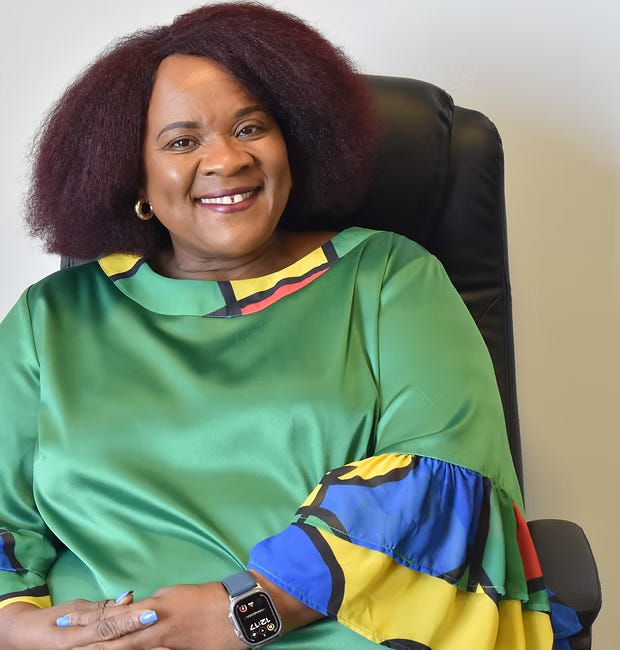
The first female vice-chancellor in 45 years at South Africa’s only township-based university, Professor Nokuthula Sibiya, says her tough upbringing has prepared her for the rough road ahead.
The mother of two boys takes the hot seat at the Mangosuthu University of Technology (MUT) today (1 August 2024), mindful that she is working with limited funding for community initiatives, overcoming infrastructure challenges in the township, and balancing the university needs with development goals.
Addressing deep-rooted poverty and unemployment in Umlazi, south-west of Durban in KwaZulu-Natal, South Africa, is high on the list of socio-economic priorities for the trained nurse, whose love for the profession mirrors that of Florence Nightingale, the ‘Lady with the Lamp’ who revolutionised nursing.
The former deputy vice-chancellor of teaching and learning at the Durban University of Technology (DUT), where she began as a lecturer in 2003, obtained her doctoral qualification in 2009. By returning to her roots, Sibiya says she is determined to tackle the effects of historical disadvantage on education and development and to overcome scepticism and hopelessness in the community she grew up in.
Reflecting on her appointment, Sibiya says she feels honoured to lead MUT as its new vice-chancellor, starting at the beginning of National Women’s Month in South Africa. Sibiya knows her work is cut out for her. The MUT budgeted for a ZAR27 million (about US$1.4 million) deficit in the current fiscal year.
Following her appointment at the weekend, Sibiya spoke to University World News.
UWN: MUT has been under an administrator since 2022. What is your approach to leadership, and how will you maintain stability with an emphasis on excellence and delivery?
NS: When giving my presentation as part of the interview process, I was asked to share my strategies to ensure financial sustainability and contribute towards improving the socio-economic status in South Africa. I looked at the good, the bad and the ugly of MUT. On the good, I shared that it is the strategic location of MUT that you need to capitalise on, a fully-fledged university in the township with more than 90% of our students funded.
So, we need to leverage that, work with the community, and collaborate with the industries around Umlazi to build on what we have. When it comes to the bad, four assessors have been appointed at the MUT by the minister of higher education and training. Looking at the reports, similar issues have been raised. The current administration period ends in September.
The challenges that have been raised include a lack of proper and effective governance, inadequate leadership and management capacity, divisive and unhealthy institutional culture with policies, and a lack of clarity around academic identity.
When I went through the assessors’ reports, I discovered that the minister, in a meeting with the council in May 2018, proposed the establishment of a multidisciplinary task team to provide technical support to the MUT management, but no, you will not believe it, that’s not happened to date. That is going to be my priority, too. I will focus on governance systems and processes and improving the financial muscle. Currently, the university has a deficit of ZAR27 million, so I am responsible for ensuring that the university is sustainable.
UWN: Women vice-chancellors have had an arduous journey since the beginning of democracy. How will you buck the trend, given that the upper echelons of higher education remain biased towards men?
NS: This is a sad story. After 30 years of democracy, we have had only 20 women vice-chancellors in South Africa. Some universities have never made any effort to appoint a woman in their history, including the very same MUT. After 45 years of its existence, it has appointed a woman for the first time.
So, currently, the country has only six women vice-chancellors. Three are doing their second term, and three are in their first term. I had the opportunity to present at the Higher Education Resource Services-South Africa Summit after being invited by Brightness Mangolothi (a director at Higher Education Resource Services-South Africa), where I emphasised that the main reason we are not going up the ladder is that higher education is structured in such a way that it favours males. When looking at the (MUT) council, most council members are men; the senate, where decisions are made, is dominated by men; to the executive management committee, males are the majority. Inevitably, males tend to support one another. So, it is a sad part of the story in South Africa. However, one is hoping that more women will take up these positions.
This appointment is a collective victory for all women who aspire to break barriers and lead purposefully. I am committed to building on the MUT’s proud legacy and working collaboratively with our faculty, staff and students to drive excellence and innovation. Together, we will create a vibrant and inclusive university that empowers our students and contributes meaningfully to the development of our society.
UWN: The new Minister of Higher Education and Training, Dr Nobuhle Nkabane, said she wants to see more women vice-chancellors in South Africa. What is your view on this?
NS: Now that we have a female minister of higher education, we have hope. We hope that she will pressure universities to open their doors to support women to take up leadership positions. Some women are not allowed to be vice-chancellors when we go to the forums. This bottleneck must be addressed.
UWN: What is your vision for MUT, and what role should it play in South Africa’s higher education sector?
NS: Before I shared my vision with MUT, I mean with the council and the panel members, I shared with them a commitment if ever appointed. I quoted [the Bahamian evangelist] Myles Munroe, who once said that people fall into one of three groups: the few who make things happen, the many who watch things happen, and the overwhelming majority who have no notion of what happens.
I said that, if I am appointed as vice-chancellor, I commit to ensuring that the MUT community stops waiting for things to happen and steps out of its comfort zone to make things happen.
Then, I shared my vision of a sustainable community for MUT to be a university of academic excellence underpinned by transformative and innovative education, guided by national and global imperatives with a strong commitment to socially responsive education.
UWN: How vital will international collaboration be for MUT?
NS: Yes, that is my focus. I did indicate in my presentation and interview that I want us to strengthen and bridge the gap in our knowledge production so that we are competitive at the global level; even the kind of students that we produce. Our graduates must be the graduates that can compete at a worldwide level. Hence, my priority will be establishing an international office we currently do not have. Fortunately, we have earmarked grant funding from the [South African] Department of Higher Education and Training to set up an office, which will be my priority.
UWN: Describe growing up in a township and explain how you rose in life and the many challenges you faced to become a voice in nursing, and a vice-chancellor.
NS: I always say, once a nurse, always a nurse. Whenever I share my bio, I do not forget to mention that I am a nurse. My PhD was in nursing. Nursing is close to my heart.
Having been born and raised in the township (the third-largest in South Africa), gave me first-hand experience of the socio-economic challenges of township life.
I attended schools in the township where we, as learners, doubled up as window cleaners. We took turns cleaning the toilets, sweeping the floors, mopping up and cutting the grass. That is the kind of life that I went through. But I always looked on the positive side because it taught me to ensure that my environment was always clean.
I did not have the tools one takes for granted. I touched a computer for the first time when I enrolled at the University of Zululand, because the schools I attended did not have computers. When people talked about a mouse, we would run around looking for a live mouse.
But we did not go hungry, as learners at my school received meals.
Due to my upbringing in a township where life was a daily struggle, my values embody the ubuntu philosophy. I live the ‘I am because we are’ principle and am eager to demonstrate how individual success can lift an entire community. I always strive to foster a spirit of collective progress and mutual support.