


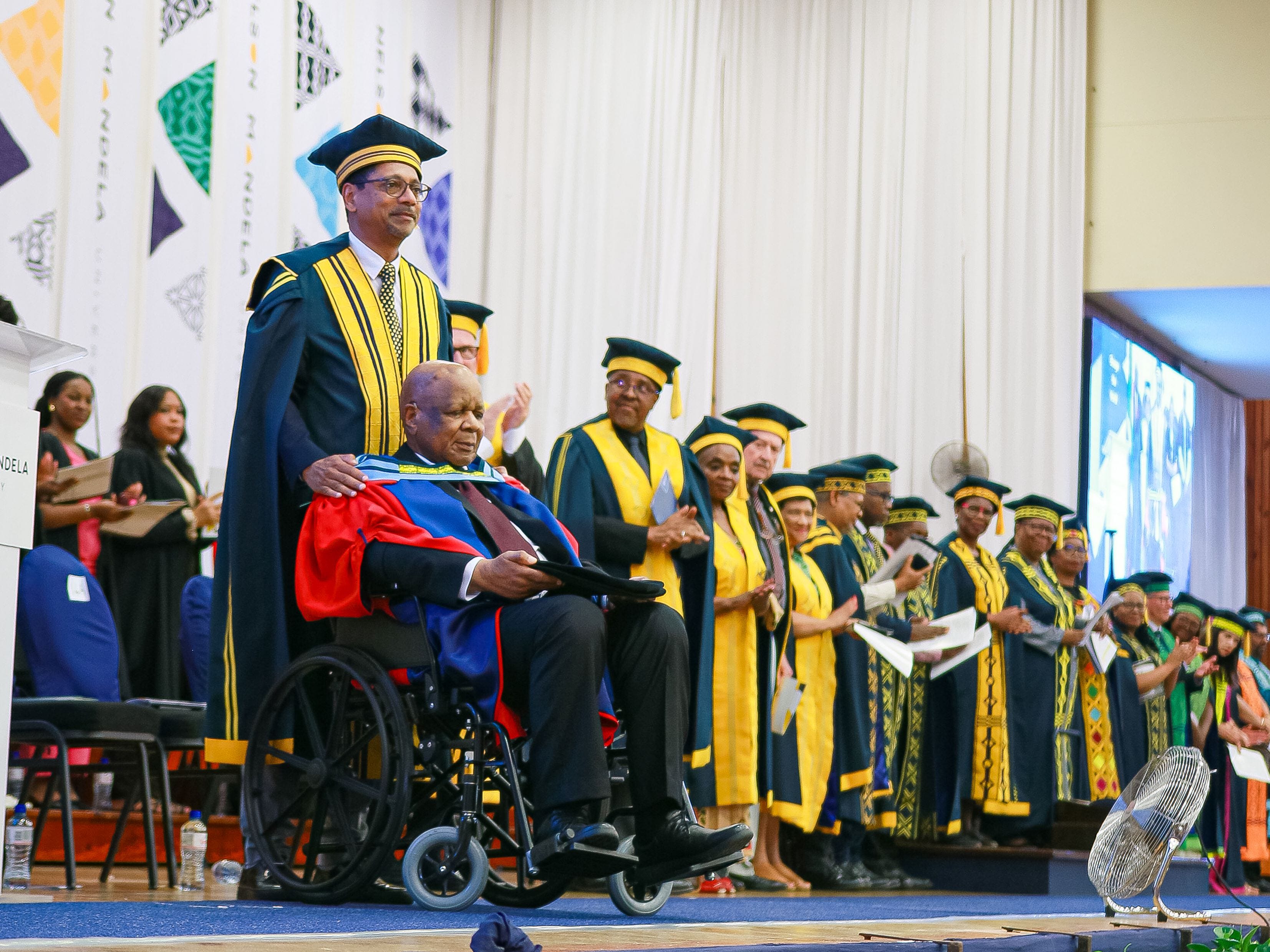
Gqeberha – From interpreting legal conversations in a rural village for no pay, to reshaping the contours of South Africa’s judiciary, the life of Justice Cecil Mpho Somyalo is a story of quiet determination, moral clarity, and historic firsts.
On Friday, 10 April 2026, Nelson Mandela University conferred on him an honorary Doctor of Laws, recognising a career that has not only spanned more than four decades, but helped redefine the very architecture of justice in a democratic South Africa.
Born in Qumbu in the Eastern Cape, Justice Somyalo’s introduction to the law was not in lecture halls or courtrooms. As a schoolboy in the 1950s, he spent his holidays interpreting for a local attorney with no pay. Despite that, he did not quit.
“My interest in law began not in a lecture hall, but in a village in the 1950s,” he said.
“As a student, during the school holidays, I would act as an interpreter for a local attorney in my village of Qumbu. I was not paid a cent for this, and yet I thoroughly enjoyed every moment of it. There is something about the law, even when encountered informally, that captures the imagination. It speaks to justice, to the dignity of ordinary people navigating extraordinary circumstances.”
That early exposure would ignite a lifelong calling. After completing a Bachelor of Arts degree at the University of Fort Hare and beginning his career as a teacher, Justice Somyalo returned to pursue legal studies through the University of South Africa (UNISA). He subsequently entered a profession that, under apartheid, remained largely inaccessible to black South Africans.
Admitted as an attorney in 1971, he went on to practise law in Gqeberha for over two decades, serving communities during one of the country’s most volatile periods.
Justice Somyalo’s appointment to the bench in 1995 marked a turning point not only in his own career, but in South African legal history. As a judge of the Transkei Division of the High Court, he became the first attorney in the country to be permanently appointed to the bench, effectively challenging longstanding traditions that favoured senior advocates.
His climb up the legal ranks was swift and significant. In 1997, he became the first black jurist to be appointed Judge President of the Transkei Division and Judge President of the Eastern Cape Division of the High Court just two years later.
At a time when the judiciary was grappling with the fragmentation inherited from apartheid – in terms of former homelands and provinces – Justice Somyalo played a pivotal role in unifying the courts across Makhanda, Bhisho and Mthatha. His leadership helped lay the groundwork for a more coherent and integrated judicial system in the province.
In 2001, he served two terms as an acting justice of the Constitutional Court of South Africa, contributing to the development of constitutional jurisprudence during a formative period in the country’s democracy.
While his institutional contributions are substantial, it is his moral philosophy that continues to resonate in the most powerful way.
He recalled a defining moment from his early legal career that demonstrates his moral compass, where, after successfully defending a client in a criminal matter, the overjoyed client committed payment “in full”.
“He looked me in the eye and told me he would pay me in full. He disappeared briefly and then returned, holding a fax machine as his form of payment. A fax machine that he had clearly not purchased legally,” he recounted.
“I want you to hold that moment in your minds, for what it taught me. The law brings you into contact with people at their most vulnerable, their most desperate, and their most human. You will be tested – not just intellectually, but morally. And how you respond in those moments, when no one is watching, when the temptation may be simply to look away – that is the measure of a lawyer. For the record, I declined the fax machine.”
For Justice Somyalo, integrity is non-negotiable.
“Integrity is not something you apply selectively. It is not a policy you follow when it is convenient and set aside when it is costly. It is a compass. And if you allow it to guide you consistently – even when it is uncomfortable – you will never truly lose your way. The most valuable attributes of a lawyer are not found in the sophistication of their arguments, but in the unshakeable quality of their character.”
Addressing graduates directly, Justice Somyalo urged them to think beyond borders – both geographic and psychological.
“Now, let me speak directly to you, the graduates. Things are different for you. Profoundly, beautifully different. When I was starting out, the boundaries of one’s career were largely the boundaries of one’s geography,” he said.
“You practised where you lived. Your clients were your neighbours. Your world was, in many ways, your immediate surroundings. That is no longer true.”
He emphasised the global standing of South African legal education and the responsibility that comes with it.
“The legal education you have received at Nelson Mandela University – in this country, with its rich and hard-won constitutional heritage, its sophisticated jurisprudence, its grounding in both African values and international standards – is world-class. South African legal education is respected globally, and rightly so,” he said.
He called on the newly qualified legal practitioners to think boldly and broadly.
“Do not confine your ambitions to what is familiar or comfortable. The greatest contribution you can make – to your families, to your communities, to this country – may require you to go somewhere you have never been, to do something that has never been done before, to stand in rooms where people do not expect to see someone who looks like you. Go anyway. Stand there anyway. And do it with the full confidence that you belong.”
In conferring the honorary doctorate, Nelson Mandela University recognised more than a distinguished career. It honoured a legacy of transformation, mentorship and unwavering commitment to fairness and dignity.
Justice Somyalo’s work with judicial governance structures, including contributions to the Code of Conduct for Judges and his role in the Rules Board for Courts of Law, further cemented his influence on the ethical foundations of the judiciary.
“I wish to express my deepest and most sincere gratitude to the University for this extraordinary honour. I will carry it humbly, and I will do my best to remain worthy of it,” he said.
©Higher Education Media Services.