


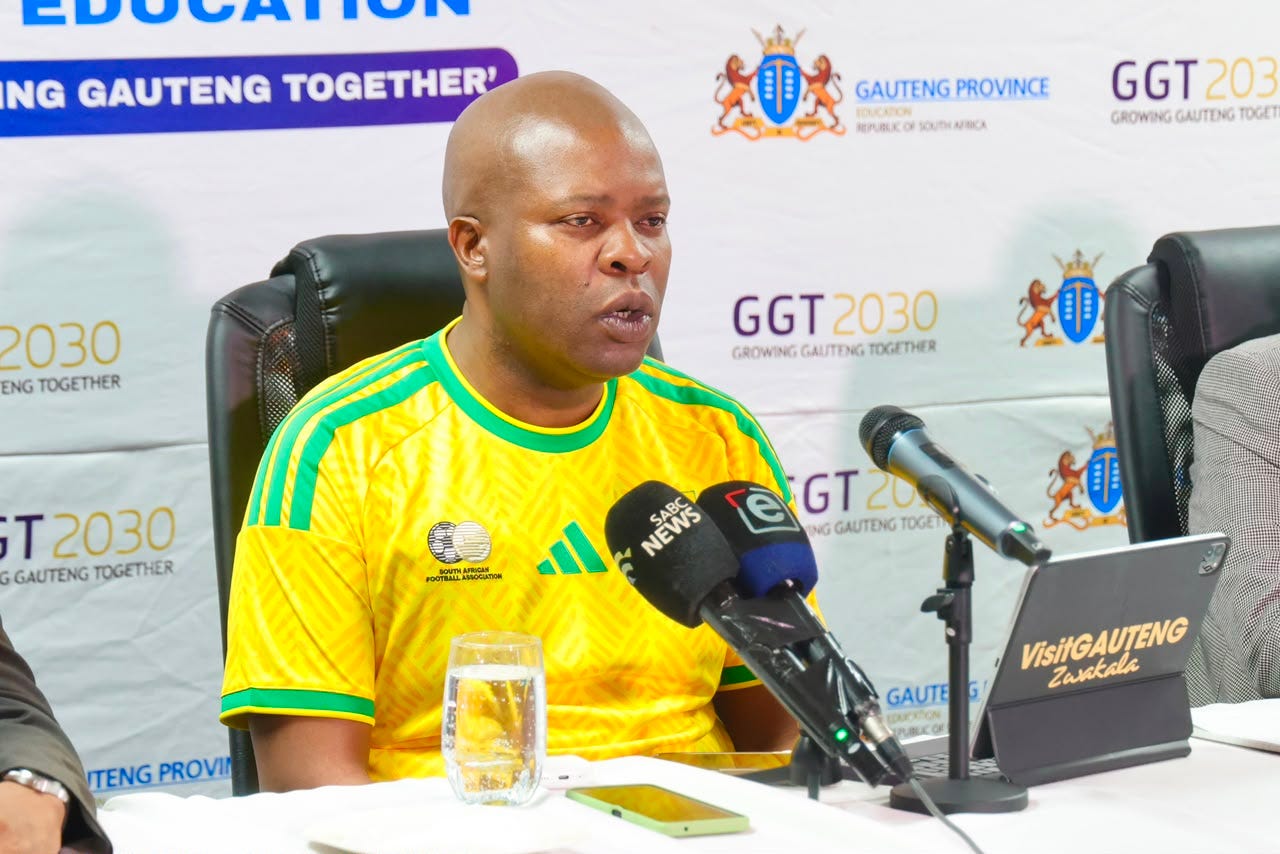
The Gauteng Department of Education (GDE) has concluded a comprehensive internal assessment into allegations of corruption, fraud, financial mismanagement, maladministration and procurement irregularities affecting public schools across the province between 2023 and June 2026. What has emerged is a clear picture of a challenge that is both serious and systemic — but also one that the Department is determined to confront decisively, said Lebogang Maile, the Gauteng MEC for Education, Sport, Arts, Culture and Recreation.
The assessment forms part of a broader effort to strengthen governance, safeguard public resources and restore confidence in the education system. Conducted through an extensive review of departmental data and records, the assessment identified 41 serious matters involving principals, School Governing Body (SGB) members, finance officials, educators, administrative staff, support personnel and service providers entrusted with the management of public resources.
Importantly, the Department’s review marks the beginning of a more intensive phase of accountability and enforcement, added Maile, and was in line with the Prevention and Combating of Corrupt Activities Act (PRECCA), through which government departments are legally obliged to report suspected corruption involving R100 000 or more to the Directorate for Priority Crime Investigation (the Hawks).
While internal investigations focus on gathering evidence for disciplinary action and institutional reform, criminal investigations remain the responsibility of specialised law enforcement agencies. The Department will therefore pursue all appropriate legal processes and referrals to ensure that wrongdoing is fully investigated and prosecuted where necessary, the MEC said.
A Persistent Challenge Requiring Structural Solutions
The assessment found that 22 cases were recorded in 2023, accounting for 54% of all reported matters. A further 13 cases were recorded in 2025, while six cases had already emerged by June 2026.
Although the annual numbers fluctuate, Maile said the findings indicate that corruption and financial misconduct remain active within parts of the schooling system. The pattern suggests a structural challenge that requires sustained intervention rather than isolated corrective actions.
The cases are spread across multiple districts, with Johannesburg East accounting for 24% of recorded matters, followed by Ekurhuleni South (15%), Johannesburg Central (10%) and Tshwane South (7%). Together, these districts account for more than half of all recorded cases.
He added that the findings reveal recurring patterns including inflated invoices, duplicate quotations, procurement conducted outside prescribed processes, unauthorised withdrawals, undocumented cash transactions and payments for goods or services that were never delivered.
Behind every irregular transaction lies a direct impact on learners. Resources diverted through corruption are resources taken away from textbooks, classrooms, school meals, infrastructure improvements and learner support programmes.
In one district alone, the assessment uncovered allegations involving more than R1 million in misappropriated funds at a primary school, irregular procurement worth approximately R230 000 at another institution, significantly inflated supplier payments at a school for learners with special educational needs, and overspending exceeding R2.2 million at a high school over two financial years.
Learners Bear the Greatest Cost
Maile said the Department is particularly concerned about misconduct that affects some of the province’s most vulnerable communities.
Many of the schools where irregularities have been identified are located in historically disadvantaged communities facing overcrowding, infrastructure pressures, unemployment and poverty. In these communities, schools serve not only as centres of learning but also as providers of nutrition, stability, psychosocial support and social protection.
When corruption occurs in such environments, its effects extend far beyond financial losses.
The assessment identified concerns around the alleged theft of food intended for the National School Nutrition Programme, which serves approximately 1.6 million learners. There are also reports involving the theft or misappropriation of furniture, stationery, building materials and technical equipment.
The MEC said that the Department was equally concerned about scholar transport irregularities. Preliminary evidence suggests that some service providers may have misrepresented the size and condition of their vehicle fleets while receiving payment for services not fully delivered. Such practices not only undermine value for money but may place learners’ safety at risk through overcrowding, extended travel times and increased exposure to road accidents.
Similarly, concerns regarding undeclared donations have highlighted weaknesses in financial accountability. While many schools benefit from support provided by businesses, churches, NGOs and community organisations, every donation—whether financial or in-kind—must be properly declared, recorded and audited to ensure transparency.
Strong Action Already Underway
The Department has not waited for the completion of the assessment to act.
Using powers provided under national and provincial education legislation, Maile said the Department has intervened decisively in schools where governance failures have been identified.
Between 2024 and June 2026:
Functions were withdrawn from 26 public schools.
SGB members were removed from office in 37 schools.
Interventions were implemented across all 15 education districts in Gauteng.
These actions were undertaken in accordance with applicable legislation and due process requirements.
The grounds for intervention included procurement irregularities, self-awarded contracts, bribery allegations, financial mismanagement, nepotism, unlawful appointments, payment of suppliers without supporting documentation, irregular transport claims, failure to comply with governance requirements and breaches of the SGB Code of Conduct.
While each case differs in its specific circumstances, the message is clear: governance failures that compromise teaching, learning and learner welfare will not be tolerated.
A New Phase of Accountability
Building on the findings of the assessment, Maile said that the Gauteng Department of Education is now implementing a strengthened anti-corruption programme aimed at addressing both immediate risks and systemic vulnerabilities.
A key focus area will be investigations into allegations that individuals within the education sector may be doing business with the state through proxies, family members or undeclared interests. Such conduct is prohibited under the Public Administration Management Act and the Public Service Regulations.
The Department will also strengthen financial oversight through enhanced vetting and accountability measures for individuals responsible for managing school finances. These measures will include criminal record screening, financial background checks, conflict-of-interest declarations, qualification verification and competency assessments.
Scholar transport oversight will likewise be intensified through route verification, vehicle audits, compliance inspections and stricter contract monitoring.
Most significantly, the Department will deepen collaboration with the South African Police Service, the Hawks, Gauteng Provincial Treasury and internal risk, compliance and labour relations structures to ensure that cases move beyond internal investigations and into the criminal justice system where warranted.
Protecting Education Through Collective Action
The Department’s response is guided by a simple principle: every rand lost to corruption is a rand taken away from a learner’s future.
The findings underscore the need for stronger accountability, tighter controls and a collective societal response. Schools cannot be expected to defeat corruption alone. Parents, educators, learners, communities, faith-based organisations, labour unions, business and government all have a role to play in protecting public education.
Through initiatives such as It Takes a Village to Raise a Child, Maile said the Department will continue to promote community participation, transparency and social accountability in schools.
The ultimate goal is not merely to expose wrongdoing, but to build an education system where integrity is non-negotiable, public resources are protected, and every learner has the opportunity to succeed in a safe, accountable and well-governed school environment.
Maile concluded with a strong message: corruption has no place in education, and those who seek to profit at the expense of learners will increasingly face both disciplinary and criminal consequences.
Action, though, say critics, is the key!
©Higher Education Media Service.
Looking at this guy talking about corruption and how they are trying to fight it sends me straight into panic mode. We do not need fake commitments that are not matched by actions. We need a complete overhaul of the system and its guardians and overseers because they have failed dismally.