


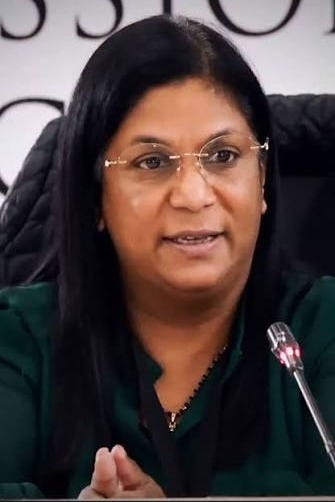
Minister of Justice and Constitutional Development, Mmamoloko Kubayi, together with National Director of Public Prosecutions (NDPP) Adv Andy Mothibi, have announced a series of remedial steps to restore stability, strengthen accountability, and rebuild public confidence in the Investigating Directorate Against Corruption (IDAC).
The briefing follows President Cyril Ramaphosa’s acceptance earlier this week of Adv Andrea Johnson’s immediate resignation as head of IDAC.
Minister Kubayi said the departure “gives an opportunity to reposition and focus IDAC,” stressing that South Africans are right to demand accountability and protection of their institutions.
Kubayi rejected calls from some political parties and civil society groups for IDAC to be disbanded, describing such demands as “without foundation.”
She emphasised that institutions must not be reduced to individuals: “Individuals come and go but institutions remain, and we must defend and protect them because they fulfil a societal need.”
She acknowledged that some IDAC officials had deviated from operational norms and standards, but insisted that accountability mechanisms would be strengthened to ensure rogue elements are dealt with decisively.
Three weeks ago, government launched the Office of IDAC Oversight, led by retired Judge Takalani Raulinga, to investigate complaints and alleged misconduct within the directorate. Kubayi said this office will safeguard integrity and public trust.
Additional measures include:
HR analysis of all 146 staff members, to be completed by 14 August 2026.
Lifestyle audits for all employees.
Appointment of a skilled investigator from the SIU to conduct a full case audit.
Review of all cases currently on the court roll to ensure proper charges.
Strengthening digital forensic capacity within IDAC.
Kubayi confirmed that disciplinary processes have begun, with Dylan Perumal suspended as chief investigator, and Brian Padayachee and Suneel Bellochun also suspended pending proceedings.
Addressing Demographic Perceptions
The Minister dismissed claims that IDAC was dominated by prosecutors and investigators of Indian origin, presenting demographic statistics to show diversity:
Investigators: 81.2% African, 7.3% Coloured, 10.1% Indian, 1.5% White.
Prosecutors: 50% African, 17.5% Indian, 32.5% White.
“Wrongdoing is wrongdoing - it should not be allowed regardless of who is involved,” Kubayi said.
Legislative Review
Recent developments have accelerated the review of the National Prosecuting Authority Act. Key proposals include:
Introducing defined terms of office for Directors of Public Prosecutions and the head of IDAC.
Strengthening checks and balances to minimize abuse of power.
Eliminating conflicts of interest, particularly where prosecutors must decide on arrest warrants against colleagues.
Kubayi underscored that while the NPA is not a Chapter 9 institution, it remains a vital public body supporting democracy and the rule of law.
Minister Kubayi reminded the public that IDAC is only 18 months old, with significant potential for growth and stability. She praised the integrity of many investigators and prosecutors who continue to uphold their oath of office.
She also urged all employees to cooperate fully with the Madlanga Commission by submitting affidavits and testimony “openly, honestly and truthfully.”
“The fight against crime and corruption requires each element of the criminal justice system to be fully functional and effective,” Kubayi concluded. “We all have the responsibility to protect and defend the NPA, including IDAC, so that we can strengthen our democracy and ensure its stability.”
©Higher Education Media Services.