


As the global community celebrates World Quantum Day on 14 April, the National Science and Technology Forum (NSTF) highlights the growing importance of quantum science and technology in driving innovation, economic competitiveness and scientific advancement.
Quantum research is rapidly transforming fields such as secure communication, advanced computing and precision measurement, positioning it as a cornerstone of future technological development.
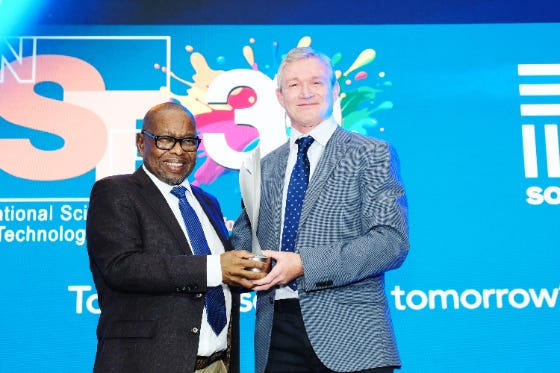
In recognition of this international day, the NSTF proudly honours Prof Andrew Forbes, Distinguished Professor at the University of the Witwatersrand (Wits) and winner of the 2025 Special Annual Theme Award: Quantum Science and Technology of the ‘Science Oscars’ of South Africa (SA), the highly acclaimed NSTF-South32 Awards.
The award acknowledges his pioneering contributions to quantum photonics and his leadership in developing South Africa’s (SA) quantum technology research capacity.
“We are making quantum systems resilient for the real world. And we are doing it right here in Africa.”
His research has demonstrated how structured light can encode large amounts of information, enabling more efficient communication systems. He has also contributed to quantum imaging advancements, enabling imaging under extremely low-light conditions.
Forbes’ achievements include multiple national and international recognitions, including the South African Institute of Physics (SAIP) Gold Medal and the World Academy of Science (TWAS) Physics Prize, and his appointment as Editor-in-Chief of APL Photonics. In 2015 he was also the inaugural winner of the first NSTF Special Annual Theme Award, which recognised his outstanding contributions to photonics in celebration of the International Year of Light and Light-based Technologies that year.
“All awards are of course retrospective; they look to the past, but the past is the stepping-stone into the future. Our future is quantum. We want to see a quantum economy for SA. We want to see a trained, quantum-literate workforce. So I look forward to that future and hopefully you’ll join us in it,” says Forbes.
Beyond research, Prof Forbes has made a major impact in developing young scientists, mentoring numerous postgraduate students and early-career researchers who now contribute to academia and industry.
World Quantum Day: The Day is an international initiative dedicated to promoting awareness and understanding of quantum science and its impact on modern society. The date, 14 April (4.14), symbolically represents Planck’s constant, a fundamental value in quantum physics.
Quantum science is at the forefront of technological transformation. It underpins innovations such as quantum computers capable of solving complex problems far beyond classical limits, ultra-secure communication networks based on quantum encryption, and advanced sensing technologies with applications in healthcare, environmental monitoring and navigation.
Globally, countries are investing heavily in quantum research as part of their innovation strategies, recognising its potential to drive economic growth and technological leadership. Initiatives such as the International Year of Quantum Science and Technology further highlight the global importance of this field.
By profiling leaders such as Prof Forbes, the NSTF underscores the importance of supporting cutting-edge research and ensuring that SA remains competitive in the global knowledge economy.
The NSTF encourages learners, students, researchers and industry stakeholders to support and engage with quantum science and technology in SA. Strengthening education, fostering collaboration and investing in innovation are essential to building a quantum-ready workforce.
Young people are especially encouraged to pursue studies in science, technology, engineering and mathematics (STEM), where quantum science offers opportunities to contribute to global innovation and national development.
©Higher Education Media Services.