


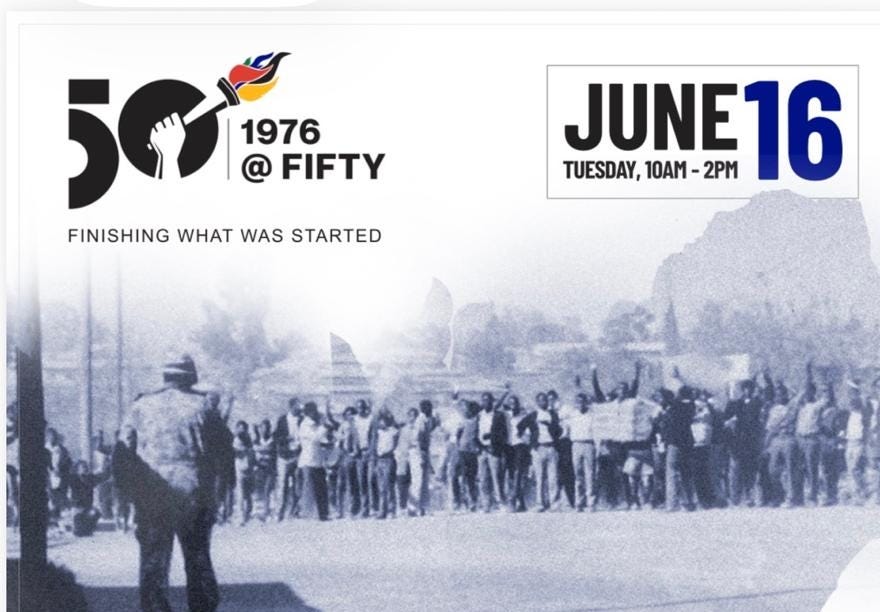

An African Proverb: “ the hunt will always glorify the hunter.”
The June 16, 1976 Uprising remains one of the most defining moments in South African history. Hundreds of unarmed schoolchildren were confronted and killed by armed forces in one of the most brutal state sanctioned violence incident, one of the worst crimes of the twentieth century . A day that transformed the political landscape of South Africa, altered the trajectory of liberation movements. It exposed apartheid's cruelty to the world.
Yet fifty years later, uncomfortable questions confronts us.
Have we begun to remember June 16 through mythology rather than historical fact?
History should never only be about what happened, it is about what future generations believe happened. When facts become blurred, when assumptions are repeated often enough to become accepted truths, and when political convenience overtakes historical accuracy, we risk building fictitious monuments rather than memory.
One of the most persistent narratives surrounding June 16 is the assertion that students marched from various schools with the intention of converging at Orlando Stadium to hand over a Memorandum. This narrative has become so widespread that many South Africans and the world accept this as an unquestionable fact. Yet serious historical scrutiny demands difficult QUESTIONS. Where is the documentary evidence? Where are the meeting minutes where this action was resolved? Who were the students going to hand over the Memorandum to? Who booked Orlando Stadium? Who paid for its use? Which organisation received permission for this March to happen? Which committee coordinated logistics? Where are the records confirming this destination?
If none exist, why has this version become dominant? These are not questions of political convenience. They are questions of historical integrity. We understand a profound truth that.
“When the roots of a tree begin to decay, it spreads death to the branches.”
If the foundation of our national memory is weakened by untested assumptions, future generations will inherit confusion rather than truth.
THE CONTEXT OF JUNE 16
To understand what happened on June 16, we must first understand what the students were responding to. The apartheid government had imposed Afrikaans as a compulsory medium of instruction in key subjects.
For Black students, Afrikaans was not just another language. It was widely viewed as the language of oppression, police brutality, forced removals, pass laws and state sanctioned violence.
Student organisations such as the South African Students Movement (SASM) had been mobilising opposition to the policy. The Soweto Students Representative Council (SSRC) emerged as a critical coordinating structure.
The intention was to organise a peaceful protest and to show solidarity with students who were supposed to be at school writing Afrikaans exams on the 16th of June 1976. What is not disputed is that thousands of students from numerous schools mobilised on the morning of June 16.
What remains contested is what exactly the final destination was supposed to be.
THE ORLANDO STADIUM NARRATIVE
Over time a dominant narrative emerged. Students were supposedly marching to Orlando Stadium where a mass rally would be held. This version has been repeated in speeches, documentaries, commemorative programmes and public discourse. Repetition does not transform a claim into historical fact. Historical claims require evidence.
A stadium rally involving thousands of students would require prior arrangements. Access approval, security planning. coordination structures, communication channels and financial arrangements.
Even under normal circumstances such an event would demand organisation.
Under apartheid conditions it would have required even more planning. The critical question remains,
WHERE IS THE EVIDENCE?
If Orlando Stadium was indeed the intended destination, records should exist somewhere.
Yet researchers, veterans and historians continue to debate the issue. The absence of evidence raises legitimate concerns. Students did not lack organisation, therefore historical accuracy is important .
WHAT WAS THE ACTUAL INTERPRETATION OF THE STUDENTS ?
Many veterans have consistently argued that the primary objective was not a stadium event. Speaking to Titi Mthenjane who was in the frontline of the student formations, has always categorically states that the objective was a coordinated solidarity demonstration against Afrikaans as a medium of instruction. “We did not even tell our parents that we were going to march, that day I left my home as a child and after witnessing what I did, I returned home as an adult” recalls Titi Mthenjane, Chairman of the June 16, 1976 Foundation.
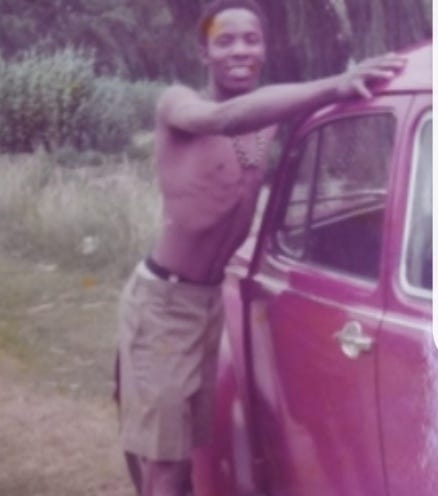
A 18 year old Titi Mthenjane washing the vehicle was used during 1976
The emphasis was on collective visibility. The power of student solidarity.The symbolism of mass resistance. The rejection of apartheid education.
Accounts vary regarding routes, assembly points and intended gathering locations. Such variation is entirely normal in mass political actions involving thousands of participants. What is less normal is the later emergence of a single, definitive destination that appears inadequately supported by contemporaneous evidence by people who were not even part of the student leadership, and didn't even attend the meeting on June 13, 1976. There are living survivors and student leaders of that time who were there in the vortex of the Youth Uprising yet our media selectively give platforms to a sole voice who continue distorting the facts of the such a ground breaking event that influenced the collapse of the Broederbond.
We need to be cautious that the history of the June 16, 1976 Youth uprising does not become vulnerable and disputed when later interpretations become treated as original intentions.
We must pursue the truth while the living archives of June 1976 are still with us, those whose memories remain clear, whose testimonies remain unfiltered, and whose experiences remain invaluable. The history of the uprising cannot be reduced to a single voice or a singular narrative. What began in Soweto, the epicentre of youth resistance, reverberated across township schools, colleges, universities throughout the then four provinces including the former homelands, becoming a national revolt.
The historical record demands correction and expansion. Thousands of schoolchildren whose lives was irrevocably altered, they were maimed, detained, tortured, imprisoned, banned, exiled, and killed. Families were torn apart. Parents spent years searching for answers, some died without knowing whether their children were alive or dead.
This is the unfinished truth of 1976, a collective sacrifice that extends far beyond Soweto, the iconic images and familiar names.
To honour that generation fully, we must preserve the plurality of its voices and confront the depth of its human cost.
THE DANGER OF HISTORICAL CONVENIENCE
Africa has always understood the importance of truthful storytelling. Our elders have taught us that, “A lie may travel with the wind, but truth walks with the ancestors.”
Individuals, including organizations will create simplified narratives so they get funded by those who are comfortable with the distortions and untruths. Complex events become compressed into digestible stories, nuance disappears, contradictions are removed and questions become inconvenient. Yet the June 16 Youth Uprising deserves better.
It deserves honesty and most importantly, it deserves evidence.
When we simplify history, we risk reducing the agency of those who lived it. The young students of 1976 cannot be treated as symbols. They are human beings, these students debated, they probably disagreed while strategising They made decisions under extraordinary circumstances. .
THE COMMERCIALISATION OF MEMORY
An even more troubling question emerges. Why are events funded around the notion of "finishing the march? The phrase might sound inspiring, it even creates emotional resonance or perhaps even symbolic continuity.
Now, if the original march was never intended to end at Orlando Stadium, what exactly is being finished? I understand that a commemorative event can be reimagined. Perhaps also create educational opportunities, however historical symbolism must rest upon historical truth. Otherwise we risk creating the possibility of not being able to distinguish between commemoration and reconstruction. By commemorating we remember history, and by reconstructing events in history aren't we rewriting it?
Let's remember the youth who died in the uprising, many never saw democracy and many never witnessed the freedom their sacrifices helped create.
The moral responsibility placed upon us is therefore immense. Know that every historical distortion affects memory. Every unverified claim alters how future generations understand the sacrifice of the Class of 76. Every convenient myth risks replacing lived experiences.
The dead cannot correct us, the responsibility falls upon us, the living, as another African proverb reminds us that, “The dead are not gone; they speak through the truth we preserve.”
WHY HISTORICAL ACCURACY MATTERS
Some may ask, Does it really matter?
The answer is unequivocally Yes!
Historical accuracy is not an academic LUXURY. It is a democratic NECESSITY. When societies become comfortable with historical ambiguity, the consequences extend beyond history. The same habits begin influencing POLITICS, Public POLICY, National IDENTITY, . Collective MEMORY . and EVENTUALLY facts become NEGOTIABLE. TRUTH becomes PARTISAN . EVIDENCE becomes OPTIONAL . Now, isn't that dangerous for our constitutional democracy?
THE NEED FOR ORAL TESTIMONY
The generation of 1976 is aging.
Every year invaluable memories are lost. Every funeral represents the disappearance of an irreplaceable archive. This is why oral testimony remains critical.
Those who organised. Those who mobilised. Those who marched.
Those who survived. Their voices matter. Memory does form part of the historical record.
The task is not to replace documents with oral history.
The task is to place them in conversation. Only then can a fuller picture emerge.
A NATIONAL INTERGENERATIONAL CONVERSATION IS LONG OVERDUE
The fiftieth anniversary of the youth uprising can't be about celebration only. It should be about investigation. It should be about documenting and archiving evidence. It should be about restoring historical precision.
This is not an attack on anyone nor is it an attempt to diminish the significance of June 16. On the contrary. It is because June 16 matters so profoundly that every detail deserves scrutiny. The students of 1976 challenged an entire state because they believed that their voices mattered. They refused to accept official narratives imposed from a racist regime.
The greatest tribute we can offer them is to uphold that same principle, not a convenient history. Neither a commercially attractive history, but truthful history.
IN DEFENSE OF THE TRUTH
June 16, 1976 was the day schoolchildren shook the very foundation of an apartheid state. It was the day young people altered the course of South African history. A day the world witnessed the moral bankruptcy of racial oppressive state. Nothing can diminish that achievement. History demands vigilance. If the claim that students intended to march to Orlando Stadium is true, let evidence be presented. If it is not true, let the record be corrected.
For nations are not weakened by the refusal to seek TRUTH. The generation of 1976 deserves a country brave enough to correct history . For as the elders say,
“When the drumbeat changes, the dancer must ask who changed the rhythm.”
Half a century after the Youth Uprising that shook the world, South Africa faces a CHOICE. Do we inherit HISTORY or do we pursue the Truth, because the future memory of June 16 will not be determined by what happened in 1976. It will be determined by whether we have the courage, in 2026 and beyond, to tell the story as it truly was.