


By Sinoyolo Mahlasela
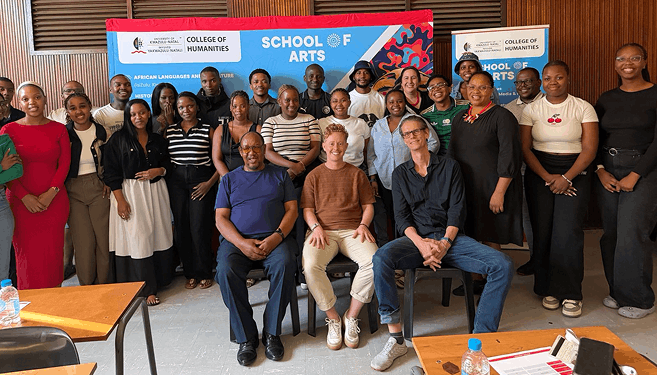
Caden Browne, a PhD candidate in the Department of Political Science at Boston University in the United States of America (USA), presented his doctoral research work during a seminar hosted by the School of Arts in the College of Humanities at the University of KwaZulu-Natal (UKZN).
The research was titled: ‘The Politics of Language and Identity: A Provincial Study of Multilingualism in South Africa’.
The seminar was commissioned by the Dean and Head of School, Professor Nobuhle Hlongwa and organised by Dr Muhle Sibisi, lecturer in the Linguistics sub-discipline. The seminar was well attended by postgraduate students and academic staff in the School of Arts, including the Cluster Leader for Languages and Literature, Professor Jochen Zeller.
Browne’s talk focused on the role linguistic identity plays in shaping national identity and societal cohesion – or division – with the focus on post-colonial societies due to their ‘unique linguistic legacies in which European languages often sit at the top of a hierarchy as languages of power’.
The major question he ponders in his research is “how historically-marginalised language speakers decide which languages to adopt and use and what are the implications of those decisions for national unity.”
To address that question, he examines the Government’s language planning initiatives as well as the choice of individuals around language adoption in the South African provinces of the Western Cape and KwaZulu-Natal.
His research took him to public spaces such as farmers’ markets, churches, town halls, courts, universities, and museums where he interviewed a variety of community leaders, including lecturers in the eThekwini municipality.
Browne says his study revealed distinctive similarities between the two provinces, especially how both are comfortable or uncomfortable with the English language used in their daily lives. He said that for some in the Western Cape, it was easier to just speak in English even though it was obvious that they were outsiders. “While not built around identity, it does have markings. KwaZulu-Natal is different because of the pride of amaZulu which was distinctive in the various places I travelled,” he said. However, he also saw a strong use of translanguaging in both provinces which highlights the invasiveness of the English language and an interference with identity.
Illuminating the gap in research, Browne said: “It is fascinating how few Political Science studies examine politics through the lens of language. In highly diverse societies, language can be a vehicle to promote national identity and nationalism and a means through which leaders mobilise political support and distribute power”.
Responding to the presentation, UKZN Cluster Leader for African Languages and Literature, Professor Nogwaja Zulu, offered an insightful glimpse into the history of language planning in South Africa. Referring to pre-democracy Convention for a Democratic South Africa (CODESA) negotiations, Zulu said the importance of understanding how discussions on language inclusion affected politics was demonstrated by Caden’s interdisciplinary studies. Discussions went into language planning and multilingualism in South Africa, then into language identity and multilingualism issues.
Zulu shared how apartheid negatively affected the strength of indigenous languages, which led to a strong Constitutional directive where no language from one tribe could be inferior to another in a democratic South Africa.
Speaking about the importance of multilingualism from pre-colonial times up to the post-colonial era in South Africa and the subsequent designated governments’ roles in language planning across the different eras, Zulu said: “In the pre-colonial era, Lesotho’s King Moshoeshoe’s grandfather Peete, spoke Sesotho that indigenous Basotho called peteketsa as it varied from the mainstream.” He, thus, identified three strands of linguistic identity in South Africa: pre-colonial language identity, colonial language identity, and post-colonial language identity.
In closing, Zulu emphasised how much post-colonial language identity is inclusive, democratic, multicultural and sensitive. “Multilingual policies must embrace these ideals, and institutions need to craft policies, especially at universities such as UKZN, to show commitment to them. This promotes the sentiments of: ‘I am first a South African who is bound to co-exist with other South Africans’.”
©Higher Education Media Service.