


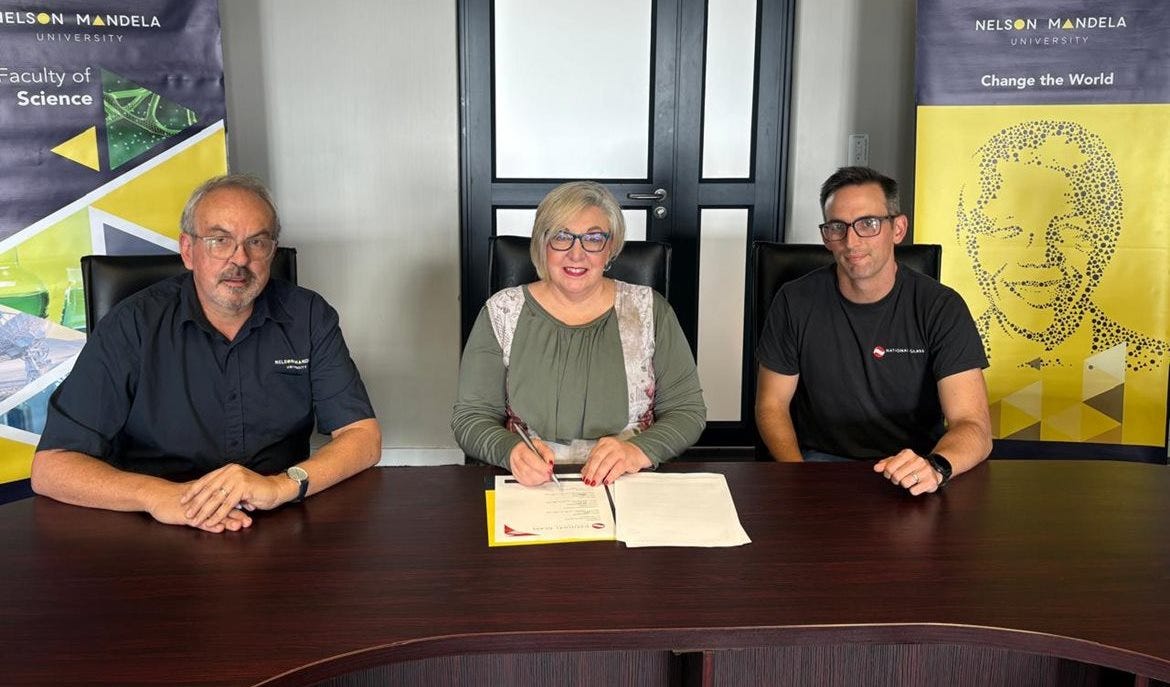
The Department of Computing Science at Nelson Mandela University has signed a sponsorship agreement with National Glass to support PhD student Stephan Mulder, who will assist staff in training and guiding third-year students in the use of AI tools. This intervention forms part of the department’s Capstone Project initiative aimed at empowering students to use Generative AI constructively and responsibly.
The partnership with National Glass, a leading South African glass processing and manufacturing company, reflects the growing role industry plays in supporting innovation and future-focused education within higher education institutions. Through its investment in student development and emerging technologies, National Glass is contributing towards equipping future graduates with practical skills and exposure to the rapidly evolving AI landscape. The collaboration also highlights the value of academia-industry partnerships in preparing students for the demands of a digitally transformed economy.
Executive Dean of the Faculty of Science, Prof Christa Grobler, highlighted the importance of collaboration between academia and industry in shaping the future of AI innovation.
“For the faculty ongoing partnerships with industry is pivotal, to position ourselves at the forefront of AI innovation, bridging the gap between academic excellence and industry disruption to ensure our graduates lead the next generation of the global digital economy,” said Prof Grobler.
The Department of Computing Sciences has received ongoing input from industry partners regarding the growing importance of AI integration in higher education. In August 2025, the Industry Advisory Board delivered a clear message: departments must continue strengthening the fundamentals of computer science while simultaneously equipping students with the skills to productively use Generative AI tools in coding and problem-solving.
Head of Department, Prof Jean Greyling, said it is critical for the Department of Computing Sciences to ensure that graduates remain highly sought after in industry.
“Over many years we have received very positive feedback from the employers of our students, and we simply cannot afford to ignore this current revolution.”
Earlier this year, alumnus and Alumni Achiever David Brown visited the department from Seattle, where he serves as Senior Vice President at Amazon. During his visit, he encouraged both students and staff to embrace and take ownership of Generative AI technologies.
While maintaining a strong focus on core computing fundamentals in first and second year, the department has introduced several interventions, including a dedicated Honours module focused on the effective use of Generative AI tools. The department is among the few computing departments in South Africa offering a specialised module of this nature. The module complements existing Honours offerings in Artificial Intelligence and Evolutionary Computing. Through sponsorship support from Amazon, students will also gain exposure to cutting-edge AI tools (used by Amazon developers globally) for their projects.
“We are very excited to partner with Nelson Mandela University’s Computer Science Department to support the development of AI-focused modules that give students practical, future-ready skills for the rapidly evolving technology landscape. We believe this collaboration is an important first step in helping prepare future computer science graduates,” said National Glass Executive Director Chris MacKeown.
Prof Dieter Vogts, who coordinates the Honours module, explained that to ensure students maintain a competitive edge in the workforce, it is vital they master the Generative AI technologies now. He said that the Applied Generative AI module is designed to navigate this fast-paced landscape through a student-driven teaching model.
“These classes are high-energy hubs of enthusiastic, rigorous discussion and peer-to-peer interaction,” said Prof Vogts.
“The module challenges us students in a good way, and we feel far more prepared and at ease as we are about to enter the working world,” added Honours student Zahid Uddin.
© Higher Education Media Services.