


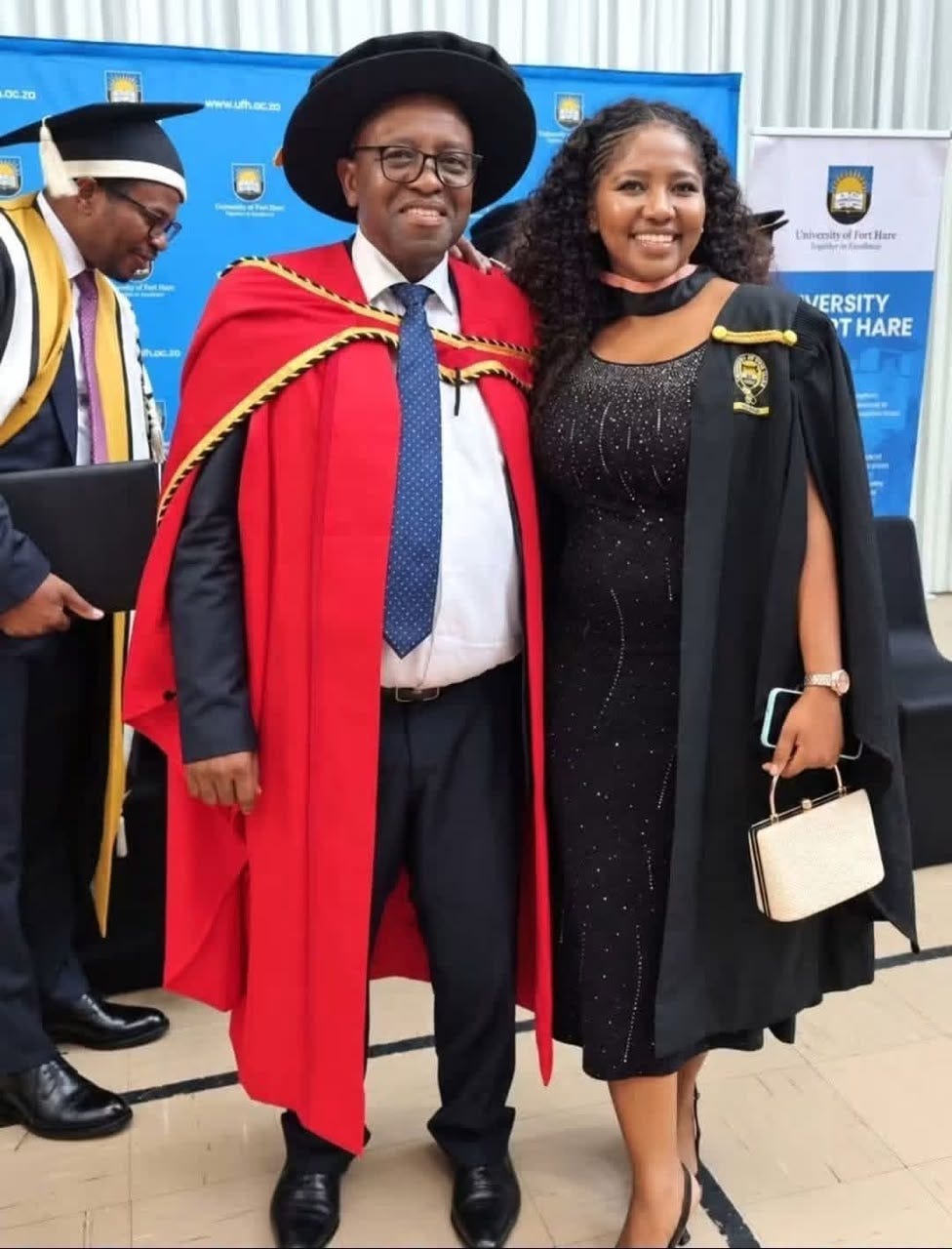
Justice Mbuyiseli Madlanga has urged University of Fort Hare graduates to see their education as more than a qualification, challenging them to use what they have learned in the service of society.
Receiving an honorary Doctor of Laws, Honoris Causa, at UFH’s Spring Graduation in Alice on Saturday, Justice Madlanga told the 395 graduates that the true measure of a university education lies not only in what happens within its walls, but in what its graduates go on to do with their knowledge.
“A university’s influence is thus measured not only by what happens within its walls, but also by what its graduates go on to imagine, create, and contribute beyond the university itself,” he said.
He said universities have a responsibility to produce graduates who can think critically, question prevailing assumptions and contribute to solving society’s problems.
“They cannot merely be repositories of knowledge, but institutions of foresight, imagination, and societal problem-solving.”
A university’s influence, he said, is ultimately measured by what its graduates go on to do.
Justice Madlanga’s reflections were also personal.
During his long leave from the Constitutional Court, he spent time at UFH as a visiting professor teaching constitutional law.
He arrived expecting to share what his years in legal practice and on the bench had taught him.
“What I did not anticipate was how much I would learn in return,” he said.
He recalled students who wanted to understand where legal principles came from, what they meant, and why they mattered.
Their questioning, he said, reminded him that studying law was not simply about acquiring technical skills but about cultivating sound judgment.
“When my teaching stint came to an end, I left Fort Hare deeply inspired and profoundly hopeful, hopeful for our future,” he said.
That experience later found expression in the achievements of UFH law students like Babalwa Mofokeng and Christian Buthelezi, who distinguished themselves at the Constitutional Court during the Public Interest Law Moot Court Competition in 2025 before representing Africa at the Price Media Law Moot Court Competition at Oxford University.
Justice Madlanga said their achievement illustrated the importance of opportunity. “Talent has never been confined to particular institutions, provinces, or communities. What has too often been unevenly distributed is opportunity,” he said.
“When opportunity is matched with talent, excellence has an extraordinary way of revealing itself. That is why institutions such as Fort Hare matter.”
This question of opportunity brought Justice Madlanga to one of the central topic of his address: what it really means to have access to higher education.
He acknowledged the expansion of access as one of the enduring achievements of South Africa’s constitutional democracy but cautioned against confusing admission with fulfilment.
A student may gain entry to university, he said, while still struggling to access the knowledge, resources and opportunities necessary to succeed.
Drawing on the concept of “epistemic access”, he said meaningful access requires an environment in which students can participate, understand, learn and succeed.
He pointed to libraries, laboratories, lecture halls, residences and digital resources, as well as financial insecurity and institutional support, as factors that can determine whether formal access becomes meaningful.
“The question, therefore, cannot simply be: How many young people have been allowed into our universities?” he said.
“We must also ask: What have we enabled them to do once they are there? How have we empowered them to give meaning to their presence at the universities?”
Justice Madlanga expressed his gratitude to UFH for the honorary doctorate, acknowledging his late parents, family, teachers, law lecturers, colleagues in academia, legal practice and on the bench, friends and others who had shaped his journey.
He said an honorary doctorate was more than a personal accolade.
“In this latter sense, the honor is not only historical; it is an exhortation for sustained service for the public good,”
Council Chairperson Dr Siyanda Makaula said the honour recognised more than Justice Madlanga’s individual achievements.
“It recognises not merely what an individual has learned, but what humanity has gained through that individual’s contribution,” said Dr Makaula.
He said Madlanga’s journey from the rural Eastern Cape to the Constitutional Court represented extraordinary intellectual achievement, but that it was what he had done with the authority entrusted to him that distinguished his contribution.
“Through your jurisprudence, you have defended human dignity, constitutional rights and institutional independence. Through your leadership and your continuing public service, you have demonstrated that the pursuit of justice does not end with judicial office.”
Acting Vice-Chancellor and Principal Professor Mzukisi Njotini said the honour also spoke to what UFH wanted its students and scholars to value.
“When a university chooses whom it honours, it also says something about itself,” Prof Njotini said.
“It identifies the qualities it wishes its students to admire, the principles it wishes its scholars to defend, and the kind of society it hopes its graduates will help to build.”
Deputy Vice-Chancellor: Teaching and Learning, Associate Professor Matshepo Matoane, said Justice Madlanga’s life demonstrated the relationship between knowledge, conscience and service.
“History remembers those who exercise power. But humanity remembers those who exercise conscience,” Prof Matoane said.
“For Justice Madlanga, the law has never been merely an intellectual exercise. It is an instrument through which the dignity of the individual confronts the authority of institutions,” she said.
She said his continuing public service offered an important example at a time when public confidence in institutions is repeatedly tested.
“At a time when public confidence in institutions is repeatedly tested, his continuing willingness to answer the call of public service offers something our society desperately needs: the possibility of hope grounded in principle,” she said.
©Higher Education Media Services.