


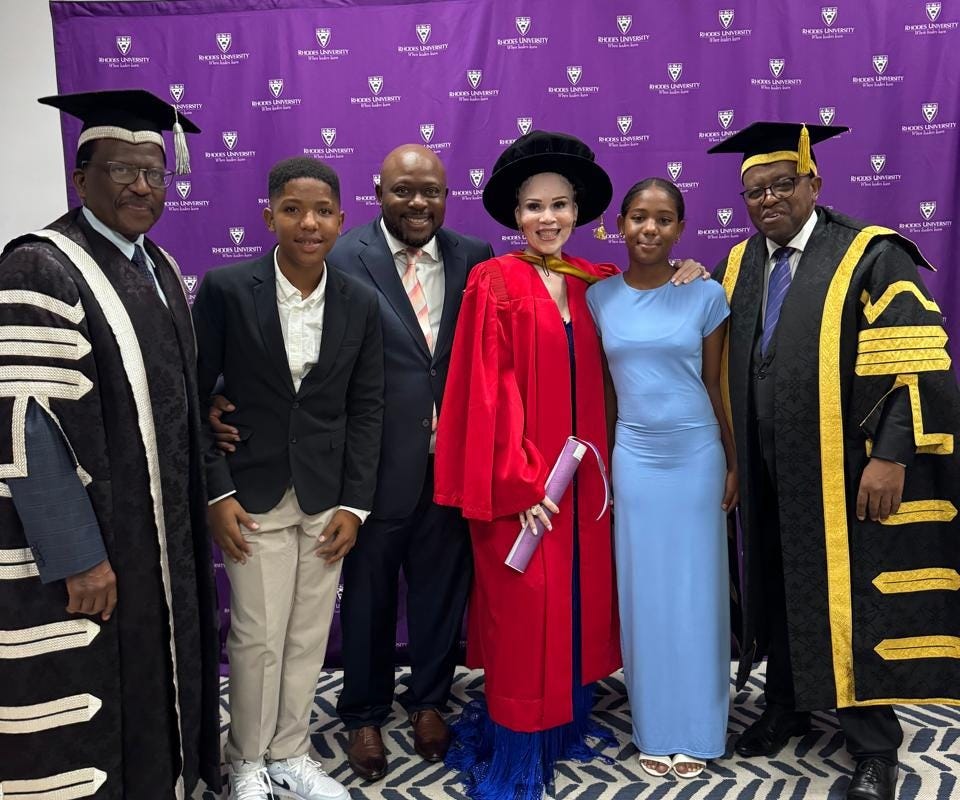
South Africa was a country where the law was once codified injustice, and silence was enforced as policy. That’s why today was no small thing for an artist to be conferred an Honorary Doctorate of Laws. It is, in many ways, a rewriting of history.
When Leleti Khumalo stood before Rhodes University to receive this rare honour, it should never be seen as a moment of personal recognition; for us, this moment should be a profound statement about what justice looks like in a society still reckoning with its past.
Perhaps today was an acknowledgement that the lecture rooms are not the only spaces where justice, truth and the law are taught or defended. Sometimes, justice is staged. Sometimes, it is sung or danced. Sometimes, it is embodied in you, and sometimes, it looks like a young girl stepping into the fire of Sarafina!, carrying the defiance of a generation that refused to watch the brutality of an apartheid regime go unchallenged.
Art is testimony, and for too long, the arts have been relegated to the margins of “serious” discourse, as entertainment, as distraction, as something ornamental rather than essential. In South Africa, art has never had the luxury of neutrality. Under apartheid, the law was weaponised. It did not protect us, the black folk; it persecuted us, exiled many, including artists. In that reality, artists became archivists of truth. They documented what the law refused to see. They gave language to pain and brutality that had no legal standing. They made visible what the system sought to conceal.
This is where Leleti Khumalo’s body of work must be understood. It was not only about applause and performances; I understood the story she carried with the entire cast of young artists. In Sarafina!, the stage became their site of protest, a living archive of youth resistance, where songs and movement carried the urgency of a people demanding liberation. It was theatre, it was political education, it was mobilisation, it was memory in motion.
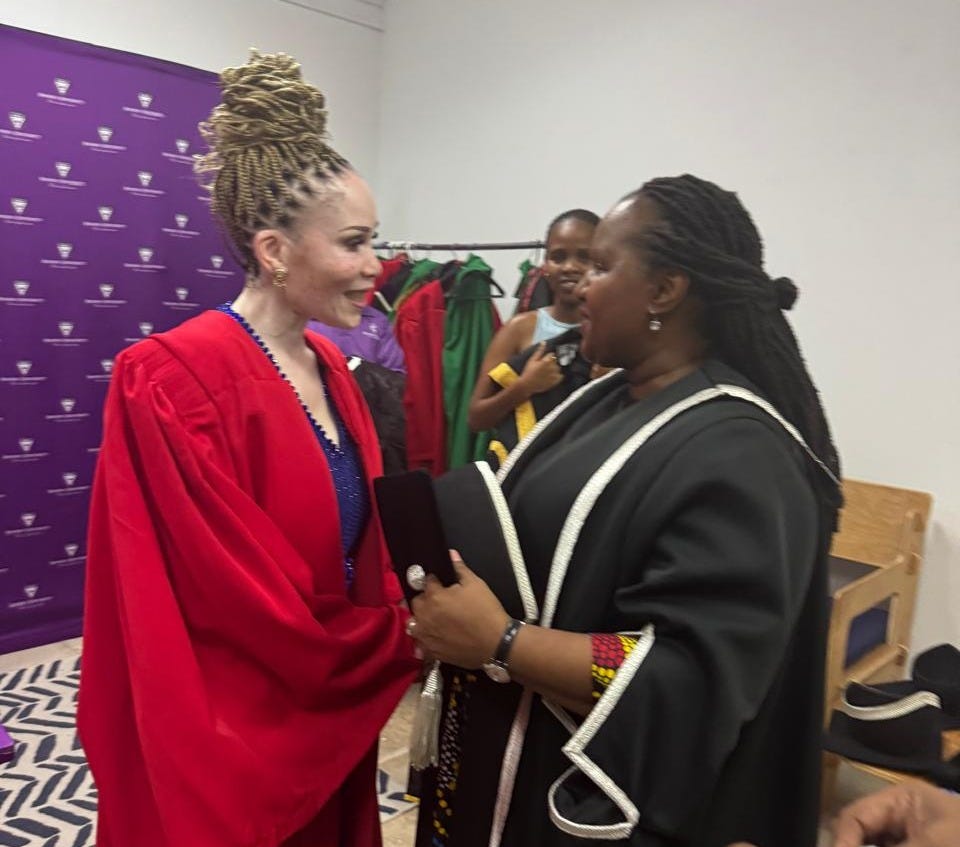
Years later, in Yesterday, Leleti Khumalo would again step into a role that blurred the line between art and advocacy. At a time when HIV/AIDS stigma was pervasive, and silence was literally deadly, Yesterday did something radical: it humanised. It slowed down the conversation. It insisted that behind every statistic was a life, a mother, a woman, a story worthy of dignity.
In both instances, art did what law alone could not; it reached the heart before the mind, shifting perception, unsettling prejudice and creating the emotional conditions necessary for justice to take root.
Law, at its best, is a framework for justice, but law has its limitations, as it operates within language, precedent, and structure. Art, on the other hand, operates within imagination. It stretches beyond what is written into what is felt, what is possible, what is yet to be conceived. This is why, in my view, the intersection between art and law is not incidental; it is essential.
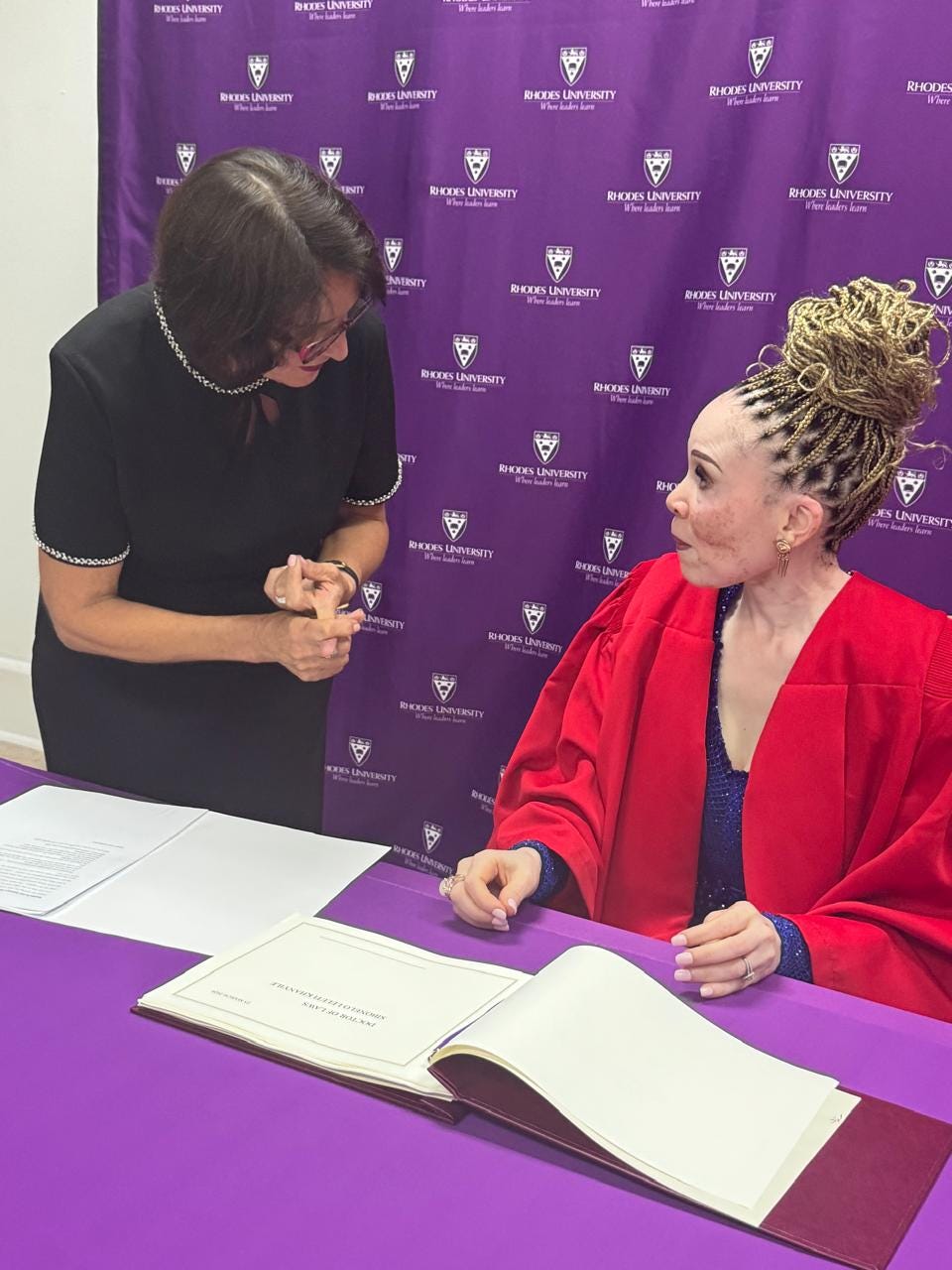
Why? Because before a society can legislate equality, it must first imagine it. Before rights are codified, they must be believed in. Before justice is delivered, it must be desired.
Artists expand their imagination. They challenge the boundaries of who is seen, who is heard, and who is considered worthy of protection. They do not draft legal arguments, but they influence the moral climate in which those arguments are received.
In this way, art becomes a precursor to justice. It prepares the ground; it softens resistance. It creates empathy. And empathy, though often dismissed as soft, is one of the most powerful humane tools we have. Without it, laws remain hollow. With it, they begin to live.
There is something deeply political about the body of an artist, especially a Black South African woman who has lived through the shifting terrains of visibility, expectation, and representation. Leleti Khumalo’s journey, including her openness about living with vitiligo, disrupts dominant narratives of beauty and belonging. In an industry that often demands conformity, her presence has been a quiet, persistent act of elegant resistance. To exist visibly, unapologetically, in a body that defies narrow standards, challenges systems that have long dictated whose stories are valuable and whose are disposable. This, too, is justice work. Because justice is not only about policy, but also about presence, it is about who gets to occupy space without apology.
It is about whose humanity is affirmed, not conditionally, but fully. To speak of Leleti Khumalo solely as an actress would be to diminish the breadth of her contribution. Her work as a mentor, a businesswoman within the artistic ecosystem, and a nurturer of young talent speaks to a broader understanding of what activism looks like.
Activism is sometimes about building platforms where none existed. It is in the quiet investment in young voices, ensuring that the next generation does not have to fight the same battles for visibility and access. It is in creating sustainability in an industry often marked by precarity. This is where the honorary doctorate takes on even deeper meaning. It recognises Leleti Khumalo’s invisible labour, her work in shaping an ecosystem where art can continue to function as a vehicle for justice.
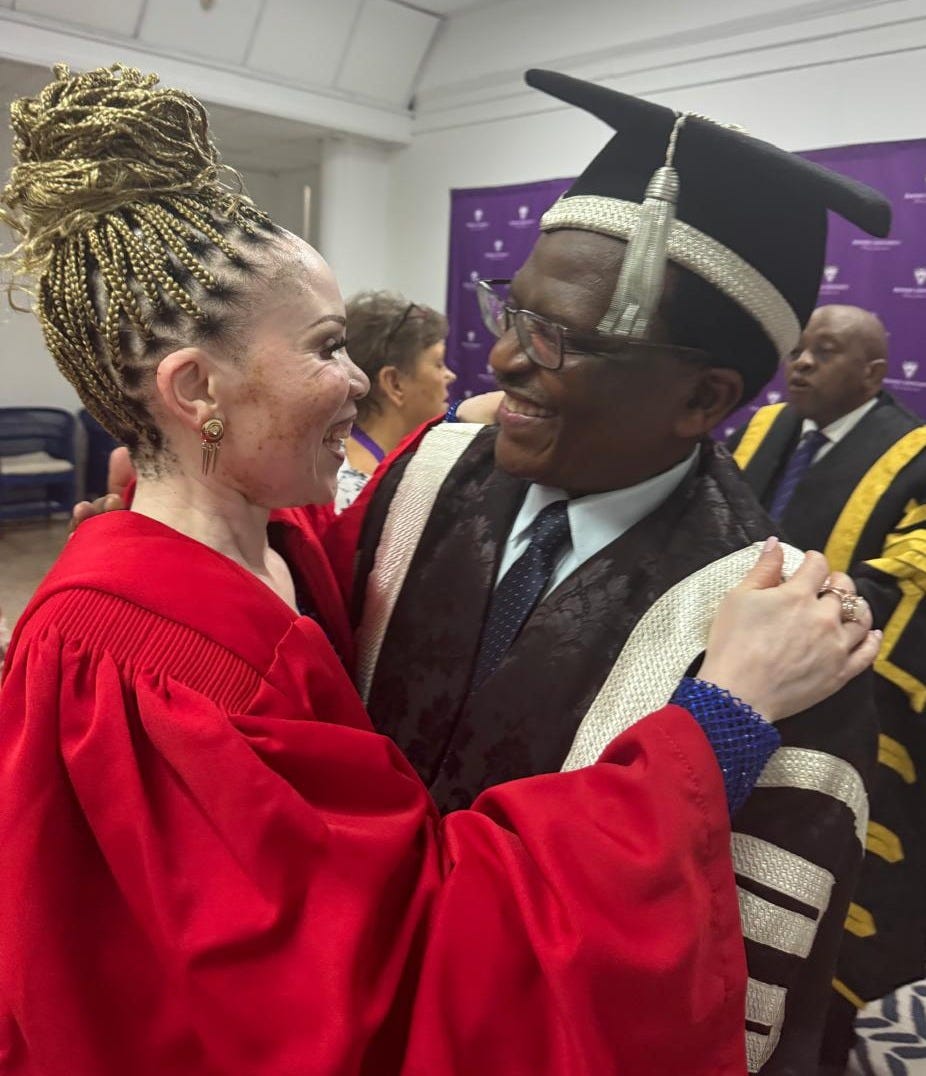
If justice is one pillar of this conversation, peace is the other, and it is often misunderstood. Peace is not merely the absence of violence. It is the presence of dignity. It is the ability to live, to love, to exist without fear of erasure. Art plays a critical role in this. Because before peace can be sustained politically, it must be cultivated culturally. Through the Arts, societies can confront their wounds, process their histories, and imagine reconciliation. Art creates spaces where difficult conversations can happen, not in the adversarial tone of a courtroom, but in the shared vulnerability of human experience.
In post-apartheid South Africa, this work remains unfinished. The fractures are still there, economic inequality, social division, and lingering trauma. And so, the role of the artist remains urgent. Not to provide easy answers, but to continue asking difficult questions.
For an artist to receive an Honorary Doctorate of Laws is to challenge the hierarchy of knowledge itself. It asks: what counts as expertise? Who gets to shape the discourse on justice? Whose contributions are deemed worthy of academic recognition?
In honouring Leleti Khumalo, Rhodes University is making a bold statement: lived experience, cultural production, and storytelling are not peripheral to justice; they are central to it. It is an invitation to reimagine the relationship among institutions, communities, academia, artistry, law and life. It is, in essence, a call to decolonise our understanding of knowledge.
The significance of this moment extends beyond the ceremony. It is a challenge for institutions, for artists, for society at large.
To the institutions, I say expand your definitions of scholarship. Recognise the intellectual labour embedded in creative work. Honour those who shape society not only through theory, but through practice.
To the Artists, do not underestimate the power of your work. You are not just entertainers. You are historians, provocateurs, healers, and architects of imagination.
And to society, please listen! Listen to the stories being told. Engage with them. Allow them to unsettle you, to move you, to change you. Justice can never be a destination; it is an ongoing process. And in that process, art should not be optional. Essentially, in the end, what Leleti Khumalo’s recognition represents is a simple but radical truth. It requires an artist, standing at the intersection of truth and imagination, reminding us of who we are, and who we still have the power to become.
©Higher Education Media Services.