


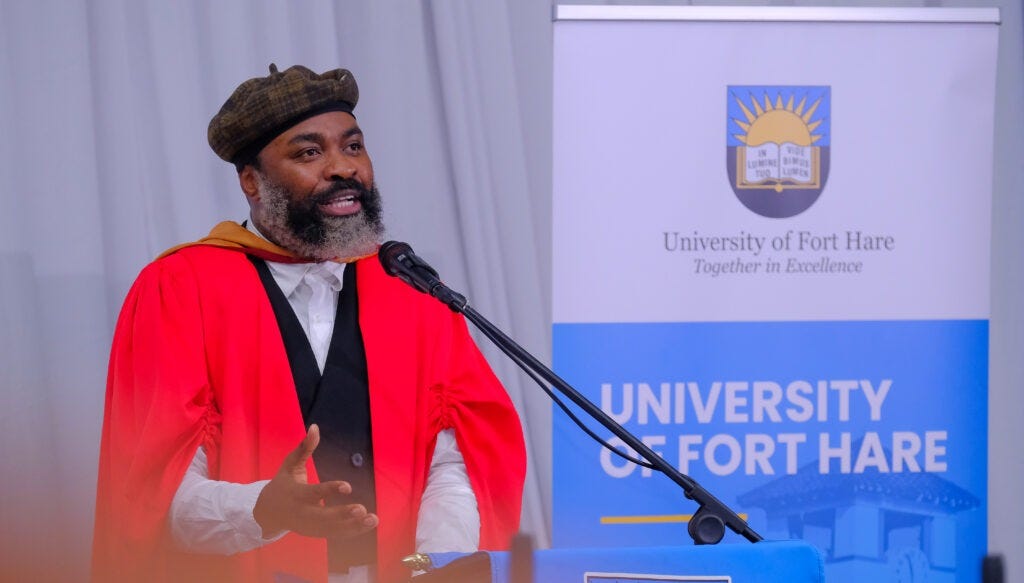
The University of Fort Hare (UFH) celebrated the life and legacy of legendary Isicathamiya musician Joseph Shabalala of Ladysmith Black Mambazo (LBM) at its 3rd Annual Joseph Shabalala Memorial Lecture on 1 October at the institution’s heritage campus in Alice.
The lecture was delivered by world-renowned award-winning pianist, composer, lecturer and researcher Dr Nduduzo Makhathini.
In his welcome note, the Dean of the Faculty of Social Sciences and Humanities, Prof Neil Roos, described the event as fast-evolving and developing into a major home for Black humanities in South Africa.
The Deputy Vice-Chancellor: Research, Partnerships & Innovation, Dr Nthabiseng Taole-Mjimba reflected on the origins of the partnership between UFH and Ladysmith Black Mambazo.
“It is not a coincidence that we are gathered here today to honour this legend, Dr Joseph Shabalala. We have a special and unique history in South Africa, I dare to say in the world. From its earliest years, UFH possessed an imagination that extended beyond the South African borders. Over the years, we have continually drawn from the past while imagining new possibilities for our future.
“Ladysmith Black Mambazo occupies a very remarkable place in our cultural heritage. Their music may have emerged from the soil of South Africa, but their story that has been carried through does not only belong to South Africa, but to the world in general,” she said.
The five-time Grammy Award-winning Ladysmith Black Mambazo was established in 1960. In his address, Dr Makhathini reflected on how the group’s legacy continues to echo across generations and communities, with its music and story inspiring people in South Africa and beyond.
He drew on themes he had previously explored with the group in different seminars, including the LBM pilgrimage and their diverse approach to the practice of Isicathamiya. These discussions have considered the genre in relation to migrant labour during apartheid South Africa, the temporal organisation of Isicathamiya, hierarchical societal relationships, gender inequalities in performance roles, the internal organisation of performance groups, the symbolic representation of home in choir names, the ritualisation of regional opposition in competitions and the aesthetic expression of conflict in song texts.
What stood out for Dr Makhathini were two themes that he said had been less discussed in the literature: Ladysmith Black Mambazo’s distinctive approaches to musical harmony and composition.
He said that while the group’s conception of harmony transcended normative sonic limits and addressed questions of being and community, its approach to composition dealt with what he termed “expanded anthologies” that challenged conventional understandings of time and space.
Dr Makhathini said these expansive concepts question the limits of musicology and require us to consider music as a way of being in the world and as a way of knowing.
Mr Sbongiseni Shabalala of Ladysmith Black Mambazo welcomed the collaborative work with UFH, saying it had brought dignity to and brought together the collection of the group and that of Joseph Shabalala.
He said his wish was to build the LBM Music Academy in Mnambithi, which would accommodate and preserve traditional music.
“With this great institution, we know his dreams will be realised,” he said.
©Higher Education Media Services.