


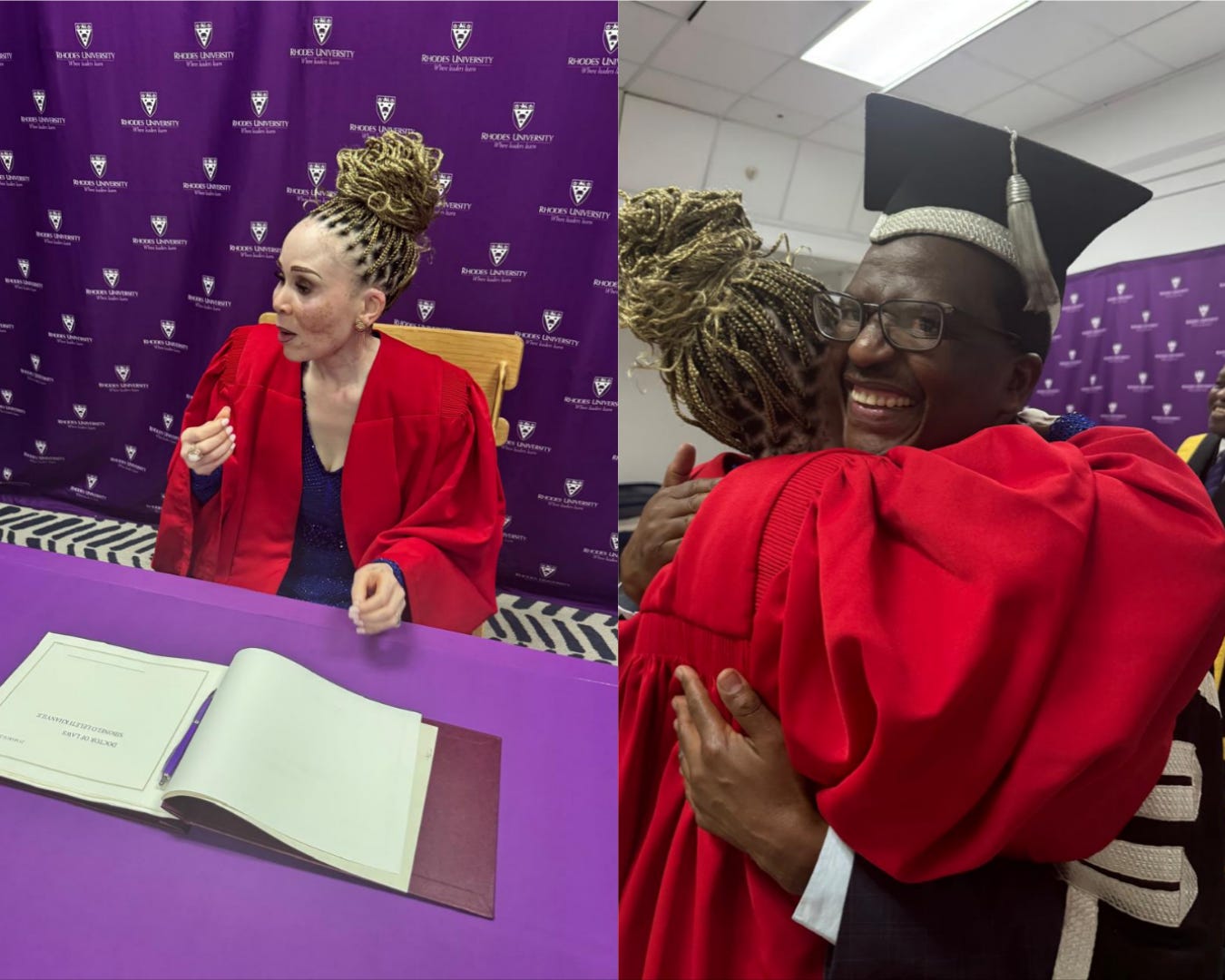
When Rhodes University announced it would confer an honorary Doctor of Laws (LLD) on Leleti Khumalo, the news landed with a quiet power — much like the woman herself. For decades, South Africans have watched her embody the country’s pain, defiance and hope. But for Khumalo, this recognition is not just about a career. It is about what storytelling has meant to her life.
“It still humbles me,” she has often said in interviews. “I never set out to be famous. I just wanted to tell the truth of where I come from.”
That truth began in KwaMashu, where community theatre offered her a stage long before the world knew her name. It was there that she learned what performance could do — not just entertain, but awaken. That instinct would later define her role as Sarafina, the character that carried her from Durban to Broadway and into global consciousness. Her portrayal introduced the world to the courage of South African youth during apartheid, earning her a Tony Award nomination and cementing her place in cultural history .
But Khumalo’s reaction to the global acclaim has always been grounded: “Sarafina wasn’t about me. It was about us — our struggle, our voices, our dignity.”
That humility has shaped every role since. In Yesterday, she carried the weight of the HIV/AIDS epidemic with a quiet, devastating honesty. The film became the first South African production to receive an Academy Award nomination for Best Foreign Language Film, but Khumalo’s focus remained on the women whose stories inspired it. “I wanted people to see their strength,” she has said.
Her work across Hotel Rwanda, Invictus, Generations, Uzalo and Imbewu has continued that thread — performances rooted in dignity, resilience and the lived realities of ordinary South Africans .
For Khumalo, storytelling has always been a form of service.
“I act so people can feel seen,” she once explained. “If someone watches a story and says, ‘That is my life,’ then I’ve done my job.”
It is this ethos — not just her talent — that Rhodes University is recognising. Her honorary doctorate acknowledges not only her artistic achievements, but her role in shaping South Africa’s social conscience through narrative, emotion and truth-telling .
As she prepares to address the graduating class on 25 March 2026, Khumalo’s message is likely to echo the values she has lived: courage, compassion and the belief that stories can heal.
Because for Leleti Khumalo, storytelling has never been performance. It has been a way of holding a mirror to a nation — and helping it see itself with honesty and hope.
©Higher Education Media Services.