


The Durban University of Technology City Campus recently became a vibrant site of creative and intellectual engagement through an exhibition titled: Macbeth Slashed and Rendered- An Exploration of the Adaptive Process. Bringing together visual art, literary interpretation and film theory, the exhibition examined how classic texts continue to evolve through adaptation, reinterpretation and contemporary cultural dialogue.
Hosted by the Satellite Gallery, the exhibition invited audiences to reconsider William Shakespeare’s Macbeth not as a fixed canonical work, but as a living text constantly reshaped by new artistic perspectives. Through experimental and conceptual displays exploring the adaptation of the play into graphic novel format, the artist, Dr Ursula Vooght, investigated the many ways in which adaptation “slashes” into an original text while simultaneously “rendering” it anew for different audiences and contexts.
Prof Maleshoane Rapeane-Mathonsi opened the exhibition, saying: “This event, as outlined in the programme, brings together a range of engaging activities, each carefully curated to reflect our shared commitment to knowledge production, creativity, and meaningful dialogue. T
he theme of this exhibition reminds us that the work we do in the arts and humanities is not isolated but deeply embedded in the social, cultural and linguistic realities of our communities today. The pieces on display respond to this theme in diverse and imaginative ways, challenging us, inspiring us, and inviting us to reflect more deeply on our roles as scholars, as practitioners, and as citizens,” she added.
The exhibition’s title reflected this dual process of deconstruction and recreation. The artist interrogated themes of ambition, violence, power and moral corruption all central to Macbeth while reimagining them through a visual and contemporary lens.
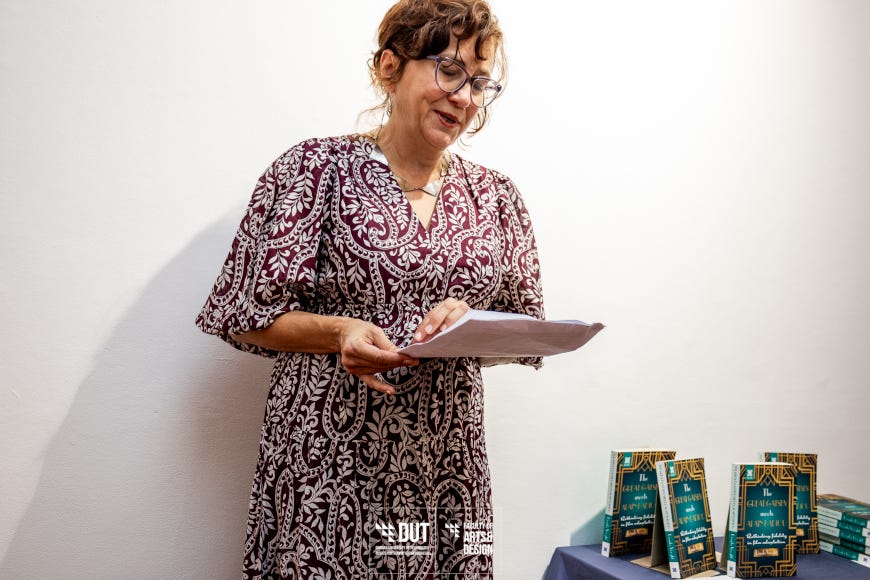
A highlight of the event was the launch of Dr Vooght’s scholarly publication, The Great Gatsby Meets Alain Badiou: Rethinking Fidelity in Film Adaptation. Dr Vooght, a lecturer in the Department of Media, Language and Communication at DUT, is recognised for her research into adaptation studies, film theory and the relationship between literature and cinema.
Her book examines the enduring debate around “fidelity” in film adaptation through the philosophical framework of French thinker Alain Badiou. Using the multiple film adaptations of F. Scott Fitzgerald’s The Great Gatsby as case studies, Dr Vooght argues that adaptation should not be judged solely by how faithfully it reproduces a source text, but rather by how truthfully it engages with the spirit, ideas and possibilities of the original work.
In her own words, “In Badiou’s version, faithfulness is about an approach towards the original artwork or text that is without prior judgements, and authentic, that opens it up rather than closes it down into a copy.
“At the end, the book offers guidelines for artists who are interested in making work that doesn’t just repeat, but speaks both with the voices of the past and the present, and cracks open what Badiou refers to as ‘the murmur of the indiscernible’ – what one might call the eternal or universal that is hinted at behind the forms.”
The pairing of the exhibition and book launch created a compelling interdisciplinary dialogue. Both events centred on adaptation as an act of interpretation rather than imitation. While the exhibition visually and materially reworked Macbeth, Dr Vooght’s publication offered a theoretical framework for understanding how texts survive and transform across mediums and historical moments.
The program also included performed extracts from Welcome Msomi’s isiZulu adaptation of Macbeth, u Mabatha, by our own drama students here at DUT, led by DUT’s Dr Rowan Munsamy.
The event highlighted the growing role of DUT’s City Campus as a dynamic creative hub within KwaZulu-Natal’s cultural landscape. The campus has increasingly become a space where visual arts, performance, design and academic scholarship intersect, encouraging students and researchers to engage critically with contemporary artistic practice.
Macbeth Slashed and Rendered: An Exploration of the Adaptive Process ultimately demonstrated the enduring relevance of adaptation in both art and scholarship. By revisiting canonical texts through new creative forms, such as the graphic novel, the exhibition and accompanying book launch challenged audiences to see adaptation not as secondary to the original, but as an essential process of cultural renewal and reinterpretation.
Story by Isiphile Mathenjwa first appeared on the DUT website.
©Higher Education Media Services.