


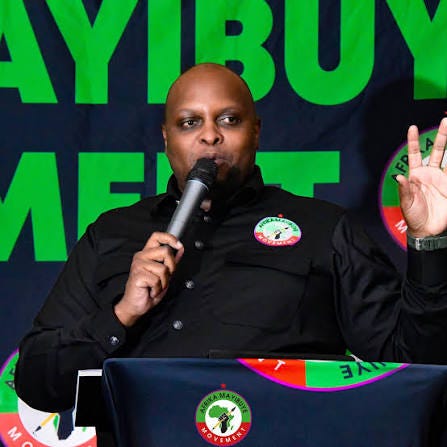
The Afrika Mayibuye Movement (Mayibuye) has issued a strongly worded appeal to the IEC, warning that the exclusion of thousands of prospective candidates due to technical submission errors risks undermining democratic participation and public confidence in the electoral process.
In an open letter addressed to the IEC chairperson, commissioners and chief electoral officer, Mayibuye president Floyd Shivambu outlined the organisation’s achievements in its first year of existence, while raising alarm over the fate of candidates whose details were captured in the Online Candidate Nomination System (OCNS) but not finally submitted before the deadline.
According to the IEC’s own announcement, 2,274 prospective candidates from 45 political parties - including 480 proportional representation (PR) candidates and 1,794 ward candidates - were affected. Shivambu argued that the consequences extend far beyond administrative inconvenience, striking at the heart of South Africa’s democratic rights.
“A democratic right purchased through such sacrifice must never be treated as an administrative inconvenience,” the letter states.
Mayibuye, less than a year old when nominations closed, claims to have built the largest municipal electoral footprint of any new political organisation in South Africa. The movement reports contestation in more than 200 municipalities, candidates in every ward of metropolitan cities, and a presence in all nine provinces.
The organisation highlighted its grassroots mobilisation - from community consultations in Gauteng, Limpopo, Mpumalanga and North West, to engagement with traditional and religious leaders, and volunteer networks across rural and urban areas.
Shivambu emphasised that these achievements belong to ordinary citizens who contributed time and resources to building a democratic alternative.
Yet, despite this progress, the party insists it cannot celebrate while other organisations and candidates face exclusion due to technical submission failures.
The Stakes of Exclusion
The letter warns that excluding entire party lists or ward candidates has profound consequences:
Loss of voter choice: Communities may be denied the opportunity to support their preferred candidates.
Candidate disenfranchisement: Eligible individuals lose the chance to seek public office.
Narrowed competition: Exclusion alters the range of contestants before voting begins.
Resource inequality: Smaller, volunteer‑driven organisations suffer disproportionate consequences.
Erosion of trust: Citizens may withdraw from voting or distrust institutions.
Shivambu stressed that a councillor candidate who completed documents and consented to nomination should not be penalised for an administrator’s failure to click the final submission button.
“An administrator’s genuine mistake should not, wherever lawful correction is possible, become a community’s lost political choice,” he wrote.
Mayibuye urged the IEC to conduct a transparent examination of affected records, disclose how comparable cases were handled in previous elections, and apply consistent criteria across all parties.
The letter references the 2021 local government elections, when the candidate nomination process was reopened and upheld by the Constitutional Court. Shivambu argued that if materially similar cases received corrective treatment then, refusing equivalent remedies now would be “grossly unfair.”
The movement also acknowledged the Electoral Court’s dismissal of the ANC’s candidate list challenge but insisted that materially different factual circumstances should receive proper consideration.
Citing HSRC/IEC voter participation research, Mayibuye highlighted troubling statistics: national trust in the IEC stands at just 32%, with even lower figures in KwaZulu‑Natal. While these findings do not prove manipulation, Shivambu warned they signal urgent need for institutional responsiveness.
“Confidence grows when institutions listen, explain their decisions and correct errors transparently. It weakens when people believe that their participation has been sacrificed to a process they neither controlled nor understood,” the letter cautions.
The movement insists that admitting eligible candidates whose nomination information was captured before the deadline, through a lawful and transparent corrective process, need not undermine free and fair elections.
Safeguards such as preserving original records, verifying consent and eligibility, and preventing the introduction of new names can protect electoral integrity while ensuring participation.
Shivambu’s appeal concludes with a direct plea to the IEC, “protect the integrity of the election by protecting meaningful participation in it. Hear the affected parties. Examine the records. Correct what can lawfully be corrected. Allow qualifying candidates to face the judgment of the voters.”
The Afrika Mayibuye Movement’s intervention underscores a broader tension in South Africa’s electoral administration: balancing strict deadlines and procedural certainty with the constitutional imperative of inclusive participation.
With more than 2,000 candidates and 45 parties affected, the scale of the issue demands urgent institutional attention. Whether the IEC will revisit its processes and provide remedies remains uncertain, but the stakes - voter choice, candidate opportunity, political competition, and public trust - could shape perceptions of electoral fairness for years to come.
©Higher Education Media Services.