


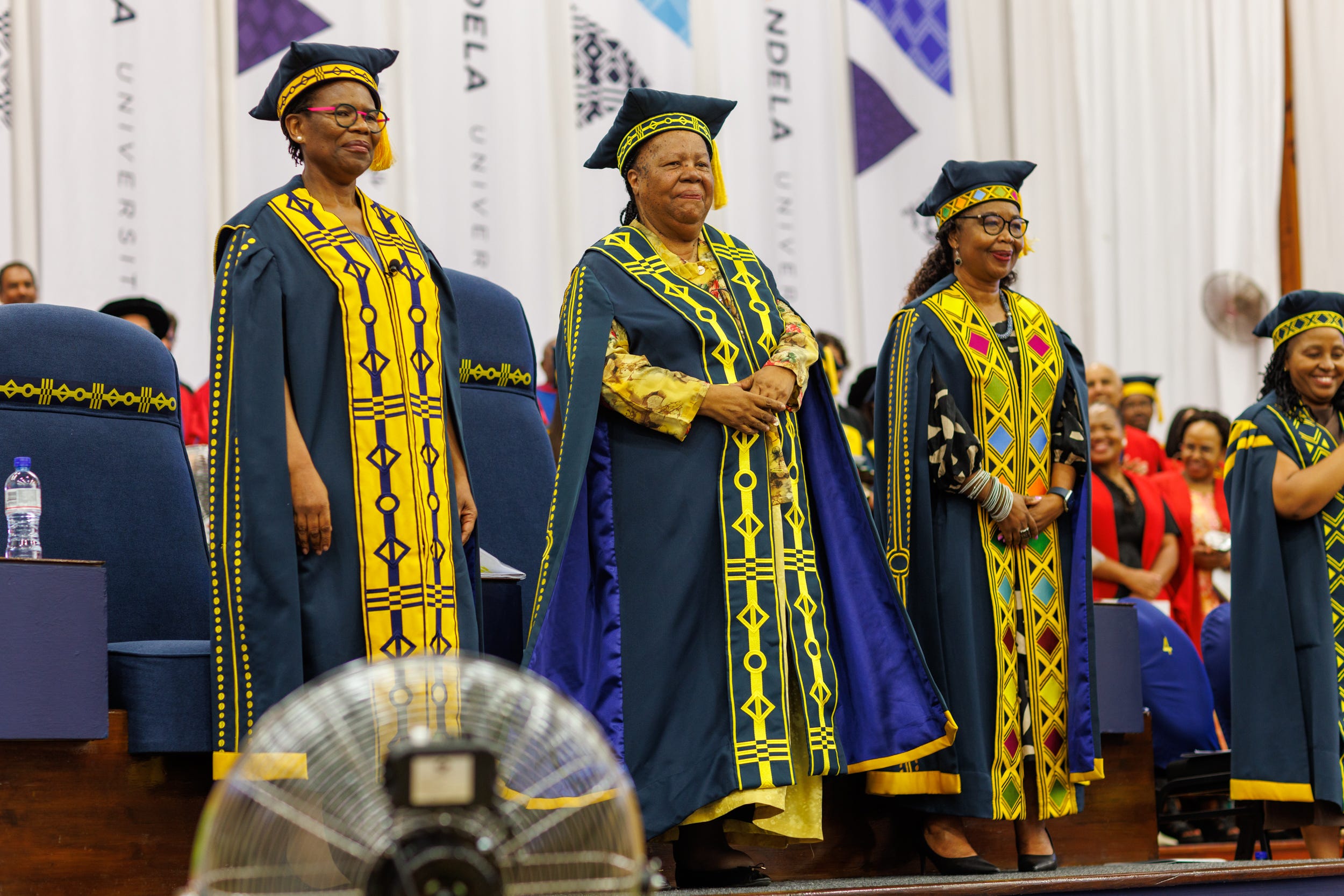
Gqeberha – Nelson Mandela University’s newly installed Chancellor, Dr Naledi Pandor, has set out a bold and values-driven vision for the institution, calling for strengthened academic excellence, stronger African collaboration and an unwavering commitment to justice, dignity and academic freedom.
Speaking at her official installation ceremony at the University’s Madibaz Indoor Sport Centre on Wednesday (8 April 2026), Dr Pandor reflected on the significance of the role and paid tribute to the leadership of her predecessor, Dr Geraldine Fraser-Moleketi.
“I wish to express my sincere gratitude to the entire University community for the esteemed honour you have given my family and I by selecting me to serve as Chancellor of Nelson Mandela University following in the footsteps of the excellent leadership given by our former Chancellor Dr Fraser Moleketi,” she said.
“It is a welcome pleasure to return to the academic sector and to have the opportunity to once more immerse myself in the same cooling embrace of intellectual rigour,” said Dr Pandor, who was herself an academic, and whose political career has centred around education. She headed several ministries in the South African government, serving as Minister of Education from 2004 – 2009, and Minister of Higher Education and Training from 2018- 2019.
She commended the University’s trajectory as one defined by strong academic performance, impactful research and meaningful engagement.
“All the reports on the University performance point to a university committed to academic excellence, high quality research performance… and to genuine and effective collaboration with universities throughout the African Continent,” she said.
Grounding her address in the legacy of Nelson Mandela, Dr Pandor called on the University community to embrace ethical leadership and active citizenship.
“President Mandela is renowned for being a leader who called on all people to make every effort to be people who make good trouble… He believed the condition of harm experienced by many should persuade us to make good trouble for change,” Dr Pandor said.
Positioning the University within a complex global context – including where higher education institutions are destroyed in conflict areas – she warned of growing threats to academic freedom and the autonomy of higher education institutions.
“This increasingly worrying threat to academic freedom and free expression is a development that should cause us as Nelson Mandela University to set out our perspectives… and to assert our abiding commitment to freedom, justice, and the development of new knowledge through untrammelled scientific inquiry,” she said.
She further underscored the importance of strengthening Africa’s voice and contribution to global knowledge systems.
“This seeming absence of the South in articulating a progressive, humane, global agenda, must encourage our university to increase efforts at achieving Africa wide academic excellence,” she said.
“Our university has a stated commitment to Africa and this needs to be pursued beyond rhetoric through real actions in support of Africa’s Agenda 2063.”
At an institutional level, Dr Pandor emphasised the importance of dignity, inclusion and lived values.
“Our commitment must also include sustainably nurturing an institution in which all enjoy respect and dignity… a university in which our Bill of Rights is rehearsed in practice.”
She called on the University community to honour the legacy of democracy through excellence and service.
“We owe a legacy to all the founders of our democracy to express our gratitude by being hard working quality students, quality academics, quality administrators, quality university leaders and quality leaders of society.”
The installation was marked by strong messages of support from government, higher education sector and institutional leadership, and various stakeholders, affirming confidence in Dr Pandor’s leadership.
Vice-Chancellor, Professor Sibongile Muthwa, welcomed the appointment and reaffirmed the University’s commitment to ethical, service-oriented leadership.
“I take this opportunity to congratulate our Chancellor on her ascension to this top office at our university. We are going to continue to do what we have always done – to put our university on a strong footing as a university in service of society,” she said.
“We understand leadership as stewardship… leadership as answering the calling that is larger than all of us.”
Minister of Higher Education and Training, Buti Manamela, described the appointment as both symbolic and significant for the sector.
“Today is not merely ceremonial. It is symbolic. It marks the convergence of leadership, legacy, and the enduring pursuit of knowledge that defines this institution,” he said.
“Nelson Mandela University could not have chosen a more fitting steward of its values, its aspirations, and its future.”
Representing Eastern Cape Premier Oscar Mabuyane, Member of the Provincial Legislature Tony Duba emphasised the strategic importance of the University to provincial development.
“This milestone is not only significant for Nelson Mandela University alone, but also for the Eastern Cape Province as a whole. We are confident that under your stewardship, this University will continue to flourish as a beacon of hope, intellectual rigour, and social justice,” he said.
Nelson Mandela Bay Executive Mayor, Babalwa Lobishe, highlighted the broader significance of the appointment for the city and region.
“This is a moment of great pride and significance, not only for the institution, but for the broader Nelson Mandela Bay community. They have gained a committed, capable and visionary leader whose thought leadership will help guide the institution to even greater heights,” she said.
Student Representative Council President Somila Komani welcomed the Chancellor on behalf of the student body.
“We are honoured to have you at the helm of this institution. May your tenure be filled with vision, inspiration and success,” she said.
Alumni Association president, Lebo Nare, said: “Madam Chancellor, your installation comes at a defining moment for higher education in South Africa… In such a time, your appointment is both timely and deeply meaningful.”
Additional messages of congratulations were received from the University’s Senate, Universities South Africa, and organised labour unions Nehawu and NTEU, reflecting broad support for the new Chancellor’s tenure.
Dr Pandor officially assumed office on 1 April 2026 and is presiding over the University’s Gqeberha graduation ceremonies that commenced on 9 April, which will see more than 6 000 students graduate.
©Higher Education Media Services.