


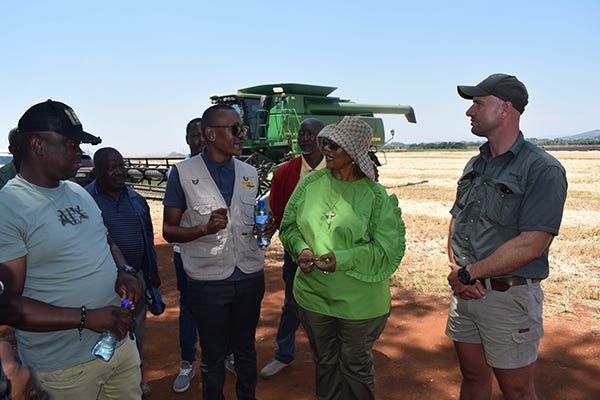
The chancellor of the North-West University (NWU) and professor of practice at the NWU Business School, Dr Anna Mokgokong, called for science, enterprise and partnership to convert rural potential into shared prosperity.
At an agriculture gathering outside Brits on 26 October 2026, Dr Anna presented a compelling vision of how rural economies can be transformed through agriculture, innovation and strategic partnerships.
Traditional leaders, government representatives, researchers, farmers and industry partners listened attentively as she told them that rural communities should no longer be seen simply as beneficiaries of development.
Their land, knowledge, resources and enterprise needed to be the basis of modern, commercially sustainable value chains.
The event brought together a broad coalition – traditional leaders, the North West provincial government and its agriculture department, the NWU, commercial farmers, researchers and industrial partners.
That mattered. Mokgokong central message was that no single institution can do rural transformation on its own. Progress is about connecting community assets to science, capital, infrastructure markets and accountable institutions, then ensuring that local people participate meaningfully in the value created.
Agriculture as engine of prosperity
Mokgokong described agriculture in much broader terms than just food production. In her view it was an industrialisation platform, employment generator, entrepreneurship incubator and wealth creator.
Smallholders and emerging commercial producers need to be able to move beyond supplying raw commodities and become competitive producers, suppliers and shareholders across the value chain, with access to improved seed, irrigation, machinery, finance, storage, technical support and reliable markets being required.
She also commented on structured mentorship by commercial producers. Season-long partnerships can transfer practical skills (production planning, soil management, machinery, record keeping, buyer requirements).
However, dependency was not what was required, but independent farming businesses that can meet commercial standards. In parallel, credible off-take arrangements with maltsters, brewers, millers, food processors and other buyers reduced uncertainty, with specifications, volumes, pricing mechanisms, delivery schedules and contractual responsibilities being agreed on before planting.
Strategic role of the NWU
For the NWU, the event was strategic because it positioned them as a bridge between knowledge and implementation, a university that translates research into increased yields, climate resilience, water efficiency, pest management, crop nutrition, storage and reduced post-harvest losses.
Mokgokong elaborated by mentioning that research should move from the laboratory to demonstration farms, from field trials to commercial production, and from production into viable markets.
This agenda tied the academic mission of the university to the development priorities of North West. By bringing researchers, students and producers together, the NWU can assess locally relevant solutions for maize, wheat, barley, etc., strengthen skills in agricultural science, farm management technology and entrepreneurship, and give students and young people a modern view of agriculture as a technology-driven industry (science, mechanisation, logistics, processing and business leadership).
The university can also function as a trusted convenor. Its research capacity and institutional reach can link traditional councils and rural communities with the government, financiers, established farmers and industry, partnerships that respect land rights, customary processes, and community interests, but that define participation, accountability and benefit-sharing clearly too. Scientific credibility needs social legitimacy if agricultural projects are to survive.
From production to industrial growth
Another theme was the retention of more value in rural areas. Dr Anna called on partners to go beyond the farm gate: to become involved in milling, malting, producing animal feed, food processing, packaging, warehousing and logistics, thus moving closer to production zones.
Processing facilities could create jobs, stimulate local suppliers and connect rural enterprises to national, regional and international markets where commercially possible. She cautioned that export ambition must be balanced with domestic food security and industrial demand.
The event was not just a ceremonial occasion – it laid out a practical platform for cooperation on suitable land, farmer participation, storage sharing, irrigation, production finance, mentoring, research and market access. Its strategic value was that it focused different institutions on measurable outcomes (hectares cultivated, farmers supported, jobs created, volumes produced locally, processing capacity, etc.) rather than abstract concepts (targets): hectares planted, farmers supported, jobs created, volumes produced, local procurement, processing capacity and enterprise sustainability.
A stage for long-term impact
For the NWU the opportunity would be to make engaged scholarship visible and consequential. If we succeed, it will show how a university can combine teaching, research innovation and community partnership to address one of the most important development challenges for South Africa. It would strengthen the NWU as a regional institution whose knowledge directly contributes to food security, inclusive growth and rural industrialisation.
Dr Anna’s message was one of disciplined optimism. Rural transformation will take patient investment, transparent governance and commercially sound projects, but the assets are their land, people, knowledge, institutions and market demand. If those assets can be connected, the NWU and its partners can help turn agricultural potential into productive capacity, productive capacity into industrial growth and industrial growth into shared prosperity.
©Higher Education Media Services.