


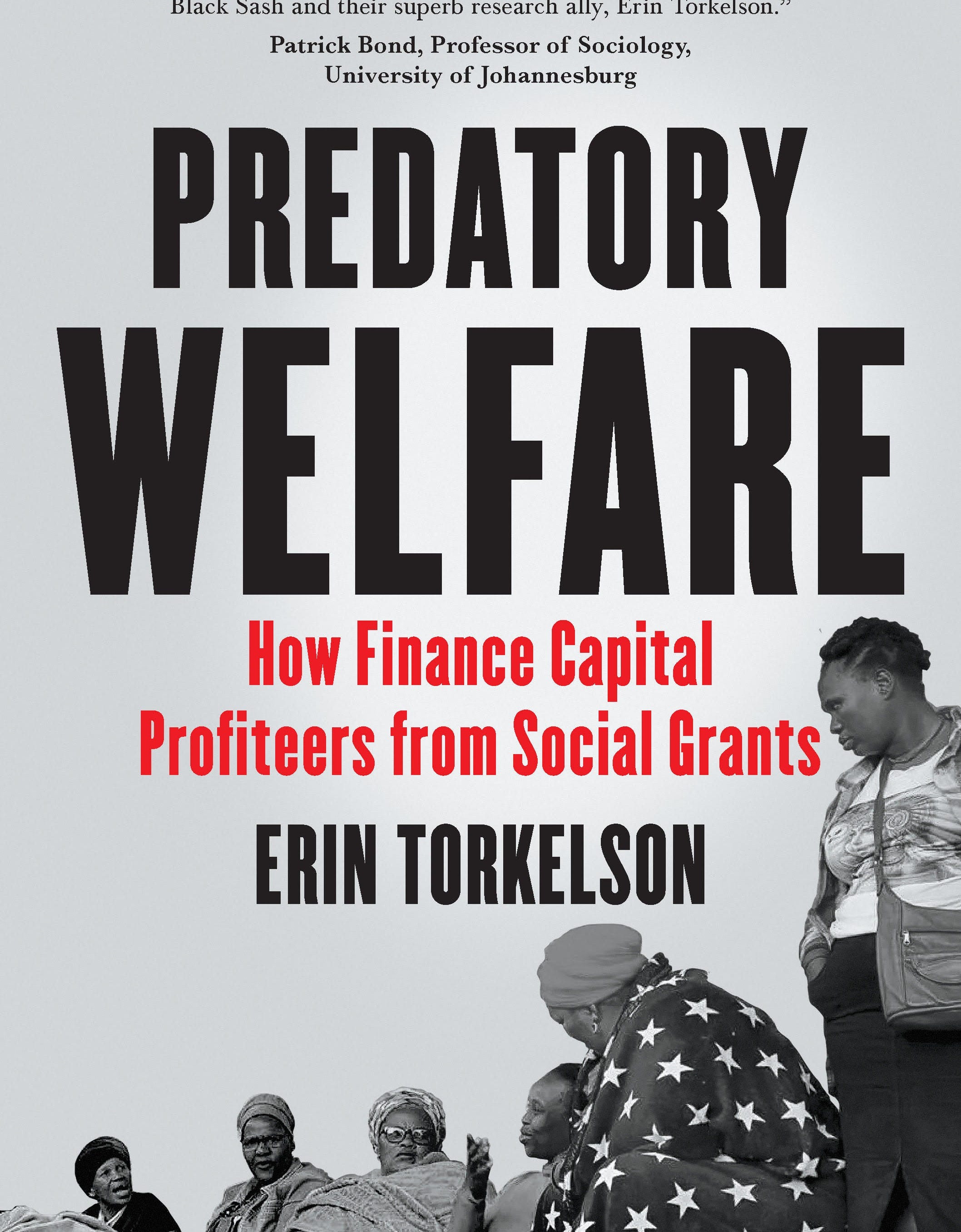
Extract from Predatory Welfare: How Finance Capital Profiteers from Social Grants, by Erin Torkelson in partnership with right-wing, economic justice NGO Black Sash.
Publisher: Jacana Media: The book is the culmination of seven years of fieldwork, activism, grant payment queue volunteering and petitioning the courts, writes, Torkelson, saying he unravels the insidious ways grant beneficiaries, who are most often black women, are manipulated by lenders into leveraging their grants for loans, funeral policies, airtime deductions and similar products pushing them into cycles of debt.
Torkelson asks: “How does a government-sponsored, flagship anti-poverty programme became entangled with predatory finance?”.
Extract: Lerato
In Predatory Welfare: How Finance Capital Profiteers from Social Grants (Jacana 2026), Erin Torkelson probes the political technologies, financial infrastructures and lived experiences of social welfare that have been packaged under the banner of “cash transfer” or “social grants” in South Africa.
She focuses on the gendered, racialized and generational dimensions of debt to explore the reworkings of racial capitalism and the private profit-making that is constitutive of a public state programme.
While cash transfers have been championed by an array of influential policy makers and academics, in recent years, they have changed material form. Despite the name, most cash transfers are no longer distributed as cash, but are digital payments linked to the sale of financial products and services. In this excerpt, Torkelson describes what happened to Lerato, when her daughter’s social grant was transformed into debts for loans, airtime, electricity, and funeral insurance.
Twenty-six cents. That was all that was left in Lerato’s bank account when she went to collect her daughter’s child support grant (cgs) at the Site B Community Hall in Khayelitsha on October 3, 2016. Instead of cash, Lerato clutched a receipt as if her life depended on it. This slip of paper was the only thing that offered some explanation as to why she hadn’t received a cash transfer payment for her daughter that month.
I accompanied Bongiwe Rhadebe, a Black Sash paralegal, to find out how many people had not received their payments that morning.
Bongiwe and I scanned the quiet bustle of people making their way to the front of the queue. Everyone in the auditorium was Black (besides me) and most were women (like me). Some people were elderly or disabled. Some had babies bound to their backs or toddlers playing at their knees.
Their collective goal was to reach one of three Cash Paymaster Services (CPS) technicians that were contracted by the South African Social Security Agency (SASSA) to distribute cash transfers. Each technician stood behind a folding table, on which sat an aluminum briefcase containing a computer, microphone, biometric scanner, card reader, and cash box.
The three CPS technicians slotted grantees’ cards into their card readers and guided grantees’ thumbs onto their biometric scanners. Their machines sprang to life and printed out receipts stating the amount of money each person should receive. The technicians hurriedly counted out cash for the grantees, who tucked it away in their bras or purses before leaving the hall.
While many people got their cash transfers without difficulty, Lerato did not. When she complained to the CPS manager, he directed her to a shorter queue of people waiting to speak to a (SASSA) official. The official was on a two-hour lunch break, and the queue had ground to a halt.
When I sat down next to Lerato, she pushed her receipt into my hand, asking me to attend to its contents. The technician should have handed Lerato R350 —the amount of one child support grant. But, since his machine reported that her account was nearly empty, she was turned away with nothing. Her receipt stated that at 8:54 a.m. R350 was deposited in her account. At the same time, a nearly identical sum of money was removed from her account as “deductions” for airtime, electricity, a funeral policy, a loan repayment, and bank fees.
Lerato had been staring at similar receipts for months. This particular receipt showed that she had purchased electricity and airtime on credit through Umoya Manje (one of CPS’s sister companies), but none of those products had been delivered to her electricity meter or mobile phone.
It showed that she had an automatic debit order for a funeral policy through Smartlife (another one of CPS’s sister companies), but she did not remember signing up for that. It also said that she was repaying a loan from Moneyline (another one of CPS’s sister companies). Lerato acknowledged this debt, explaining that with all the other deductions she needed to borrow money to cover her household shortages.
While I had met plenty of people with deductions before, Lerato’s R0.26 was the smallest account balance I had seen at the time. I asked Bongiwe to help me piece together the timeline of these deductions.
Lerato told us that the deductions started near the beginning of the year in the Eastern Cape. She and her daughter, Angel, had gone to visit her mother in Cala at Christmas time. After their holiday, Lerato returned to Cape Town to start a temporary job, while Angel stayed behind in her grandmother’s care.
Lerato left her cash transfer card with her mother to assist with household expenses. After a few months, Lerato’s mother called to report that the grant money was “short,” but it was only after Angel returned to Cape Town that Lerato experienced these deductions herself.
Lerato’s receipt showed that she had received and spent her daughter’s grant at the very same moment. Yet, the money was rerouted as digital payments for immaterial financial products long before she could make any of the material monthly purchases needed to care for her child. While this slip seemed to present a sort of calculative rationality, Lerato strongly disagreed with what it alleged.
Lerato’s experience jarred with typical narratives about cash transfers. For several decades, cash transfers have been touted as “a quiet revolution” in development. Silicon Valley techies, World Bank bureaucrats, and anthropologists of Southern Africa have hoped that cash transfers could have a stronger impact on poverty than more traditional development interventions—such as public works projects like dams or highways—which have often been characterized as top-down and inappropriate.
Around the world, there has been widespread agreement that regular tranches of cash can enable recipients to decide what their needs are and how best to meet them, pulling themselves out of poverty by their own initiative.
While few advocates would say that they constitute a sufficient response to poverty on their own, many believe they are one of the best poverty relief tools we have. Because cash transfers have achieved a sort of common sense, development professionals and policymakers have steadily pushed to expand such programs worldwide.
In line with this trend, South Africa’s cash transfer program—locally referred to as the social grant program—has been hailed as an unquestionable success. South Africa spends a higher percentage of its GDP on cash transfers than nearly any other country in the developing world, at times outstripping even Brazil and India.
Currently, cash transfers comprise the third largest percentage of the national budget (R286 billion), behind debt servicing (R340.5 billion) and education (R309.5 billion) and ahead of health care (R259.2 billion).
The government provides unconditional, means-tested grants for children under eighteen, adults over sixty, people with disabilities, and since COVID-19, unemployed people between eighteen and fifty-nine. At present, these grants directly support around twenty-six million citizens (46 percent of the population), and they are a vitally important source of income for nearly half of all households.
Many studies have shown that cash transfers have positive effects on reducing poverty, decreasing childhood malnutrition, improving educational outcomes, and stimulating the economy.
When I started this project, I thought I knew what cash transfers were and what they did. However, the longer I worked with recipients, the more my experiences stood awkwardly in relation to such optimistic analyses.
I found that there were no guarantees that social grants would ease the financial burdens of poor households, and as Lerato’s receipt showed, when combined with debts, it seemed just as likely that they would not.
Although most of what I had read touted cash transfers as a substantial innovation in poverty relief, I wondered how they could so easily be converted into debts?
Torkelson would be launching the book at various venues including at the University of Johannesburg, University of Cape Town and Jacana Media in Auckland Park among other venues, from 12 May to 4 June 2026.
©Higher Education Media Services.