


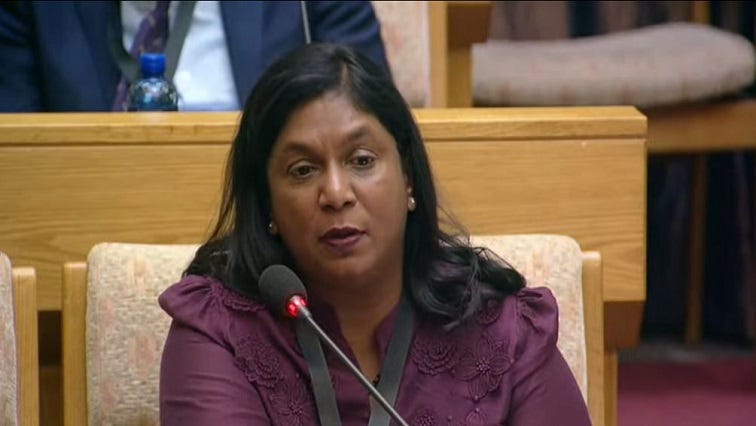
Advocate Andrea Johnson, Investigating Director of the Investigating Directorate Against Corruption (IDAC), has formally requested to vacate office with immediate effect, citing unprecedented personal and professional attacks linked to high‑profile cases against Crime Intelligence officials.
In a letter addressed to the National Director of Public Prosecutions (NDPP) and President Cyril Ramaphosa, Johnson said the past five months had been “challenging” and that the attacks had brought “an extreme amount of negative attention not just to me, but to IDAC and the NPA.” She stressed that she did not want to be the source of reputational risk for the institutions she had served for over three decades.
Much of the criticism, Johnson noted, stems from cases pursued against Crime Intelligence officials. She is currently testifying at the Madlanga Commission of Inquiry, where these matters are under scrutiny.
Her conduct, especially pertaining to the arrest of Brigadier Dineo Mokwele, the Head of Technical Support Services for South Africa’s Crime Intelligence, who became the center of a high-profile legal and investigative controversy regarding her appointment and qualifications - has received a lot of criticism from the public and some in the media.
During her testimony at the Madlanga Commission, Johnson conceded that Mokwele’s prosecution was initiated based on inaccurate, unverified information and admitted she had never actually perused Mokwele’s CV before authorising the warrant of arrest.
Johnson was forced to publicly apologise for describing Mokwele’s appointment as unsuitable or a token placement while Mokwele has lodged a formal misconduct and abuse-of-power complaint against Johnson with IDAC Ombudsman Judge Takalani Raulinga. There has been suggestions that Raulinga head a commission of inquiry into the shenanigans at IDAC based on the revelations at Madlanga Commission
In her statement, Johnson warned that any further inquiry into her fitness to hold office would be costly and time‑consuming, adding that “the country cannot afford another commission.”
She referenced South Africa’s ongoing scrutiny by the Financial Action Task Force (FATF), stressing that IDAC plays a pivotal role in meeting FATF requirements.
Drawing parallels with the recent Chauke enquiry, she said outcomes of such commissions can go either way, but inevitably place the NPA under public scrutiny and financial strain.
Director of Public Prosecutions Advocate Andrew Chauke was last week cleared of all misconduct allegations and found fit to remain in office, following findings by an independent inquiry chaired by retired Constitutional Court Justice Bess Nkabinde.
Retirement Request Becomes Resignation
Johnson had already applied for retirement at age 55, turning 56 next month, with the NDPP’s support. However, she expressed concern that this could be legally challenged if approved by the NDPP and the President.
To avoid dragging either office into court disputes, she requested that her resignation be accepted instead, with immediate effect. While her contract stipulates a three‑month notice period, she asked for a waiver, proposing to vacate office within 24 hours.
She pointed out that similar precedents existed, citing the resignation of the KwaZulu‑Natal Director of Public Prosecutions and Special Director Molele, both of whom were released without serving notice.
President Cyril Ramaphosa has acceded to Johnson’s request in terms of section 12(8)(a) of the National Prosecuting Authority Act of 1998. His decision follows a recommendation by Minister of Justice and Constitutional Development Mmamoloko Kubayi, supported by NDPP Adv Andy Mothibi.
In a statement, the Presidency confirmed Johnson’s immediate release from office and thanked her for her years of service in the NPA and as head of IDAC. President Ramaphosa assured the leadership and staff of the NPA of the government’s “unwavering support for its work in the fight against crime and corruption.”
Johnson said her resignation was motivated by a desire to protect the integrity of IDAC and the NPA.
“The NPA and IDAC must and will always come first,” she wrote. “I believe that this resignation in the manner proposed would serve the institutions and the country best.”
Her departure marks another high‑profile leadership change within the prosecuting authority, underscoring the pressures confronting senior officials tasked with prosecuting corruption cases in South Africa’s security and intelligence sectors.
©Higher Education Media Services.