


Imagine a world of darkness, or a world without a sound, or a world not built to accommodate your abilities.
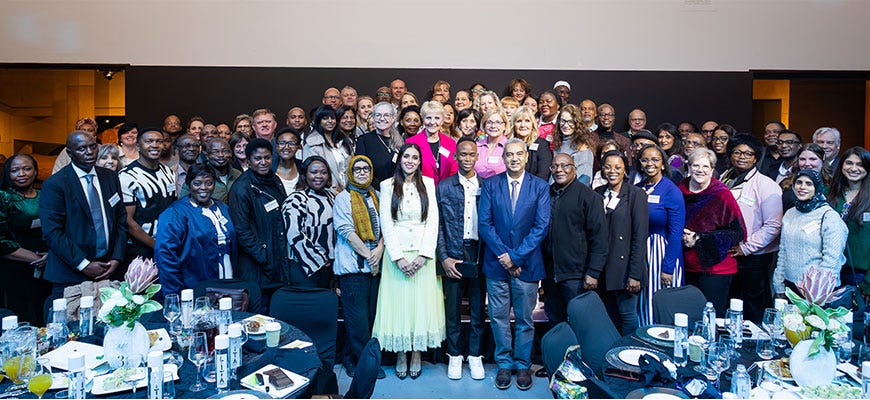
Rethinking inclusion was the theme of the 2026 Wits Principals’ Function which was held on Thursday, 16 April, in the Tapestry Room of the Wits Origins Centre.
The Registrar, Carol Crosley, welcomed about 70 principals from Wits’ top feeder schools to the University. “This is an important annual gathering as it helps us to build a strong partnership between Wits and leading schools in the country,” said Crosley.
The principals were blindfolded and invited to have breakfast in the dark. The Dean of Student Affairs, Jerome September, talked principals through what to expect. A breakfast plate was placed in front of each guest, who had to navigate eating with cutlery, whilst being blindfolded.
Guests hovered with their cutlery in mid-air trying to find the food on their plates. Others groped for their water glasses which they located by memory rather than sight. Conversations softened and then there were bursts of laughter as someone missed a plate by a few centimetres or attempted to use their hands to eat an egg. For half an hour, a room full of experienced school leaders became learners again.
“This event taught me to feel, to reflect and to reimagine what inclusion really means in practice,” said a principal. “It taught me to appreciate my faculties and not to take the human body for granted, and more importantly to put myself into the shoes of a person living with a disability.”
And that was the point.
From Experience to Insight
The experience powerfully set the tone for the address by the Head of the Wits Disability Rights Unit, Dr Leila Abdool Gafoor, who introduced her framework, “Mental Health and Neurodiversity: The Principal’s Playbook.” Drawing on both insight and urgency, Abdool Gafoor challenged educators and institutional leaders to fundamentally reframe how they perceive and support learners who engage with the world in diverse ways.
“We need to think differently about learners who experience and interpret the world through varied cognitive and emotional lenses,” she said. “Within this diversity lies immense, often untapped talent - potential that becomes visible and that can truly flourish when systemic barriers are intentionally removed.”
Her message called for a decisive shift in leadership mindset and practice. Rather than treating inclusion as a matter of compliance, she urged schools and universities to embed it into the very architecture of their systems, thereby moving from compliance to inclusion by design. Instead of reacting to crises as they arise, leaders must cultivate environments that proactively support well-being and shift from crisis management to preventative culture-building.
“In place of reducing individuals to diagnostic categories, institutions should prioritise meaningful, practical support thereby transitioning from medical labels to functional support,” she added.
Preparing Learners for a Complex World
Professor Garth Stevens, the Deputy Vice-Chancellor: People Development and Culture addressed the principals and spoke of the need for academic excellence and the changing demands placed on young people.
“Academic excellence is essential, but it is no longer sufficient on its own. On the one hand, we are seeing highly capable learners arriving exceptionally well prepared academically. On the other hand, today’s learners must also navigate complexity, uncertainty and rapid technological change,” said Stevens.
“We are living in a world shaped by artificial intelligence, shifting social realities and increasing psychological pressures. In this context, the role of schools, and their leaders, become even more critical. It is not only about preparing learners for exams, but preparing them for adaptability, resilience and ethical engagement with a fast-moving world.”
He emphasised that the relationship between universities and schools is important and reciprocal. “The learners who arrive at Wits are shaped long before they step onto campus,” he said.
“The learners from your schools are capable, disciplined, academically skilled, and beginning a journey of maturation as adults, as they engage the world in this new phase of their lives.”
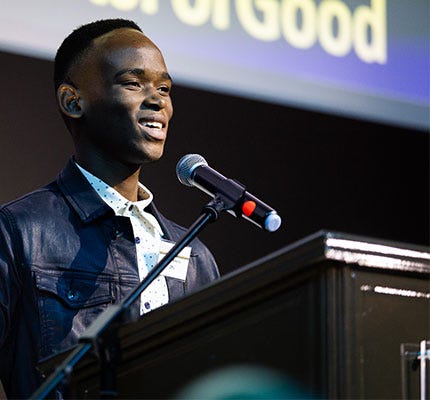
A third-year, high-achieving law student, Kabelo Kekana gave the event a human face.
Kabelo Kekana is a high-achieving student who is blind, and now in his third year of law at Wits. He addressed the principals and spoke to what is possible when barriers are removed and potential is nurtured.
“I think that I am the expert at this event today,” he joked. “I use memory to help me recognise people through their voices, sound to help navigate my immediate environment, and touch to help me navigate through space. I may do things differently but at the end of the day, I still achieve the same outcome.”
He recalled some of the practical challenges that he faced when he first arrived on campus and the role of the DRU in helping him adjust to campus life. He explained the use of technology in overcoming some of these issues. “It takes courage, but with the right support you can achieve all that you want,” he concluded.
The Wits Experience
The morning raised difficult questions about our education systems, and especially those living with disabilities. Are we designing for the average learner or are we creating spaces where all learners can thrive? Are we equipping young people with the tools that they need, or are we expecting them to adapt to systems that were never built with them in mind? How do teacher, learners and principals navigate a new high-tech world where AI is dominant?
“This is exactly what we set out to achieve,” said Sershin Naicker, the Head of the Schools Liaison Office. “This event seeks to recognise and honour our top feeder schools, their leaders, teachers and learners, and also to give principals a taste of the Wits experience, to think differently and critically, and to sometimes leave with more questions than answers.”
The feature first appeared in the Wits University News Website.
©Higher Education Media Services.