


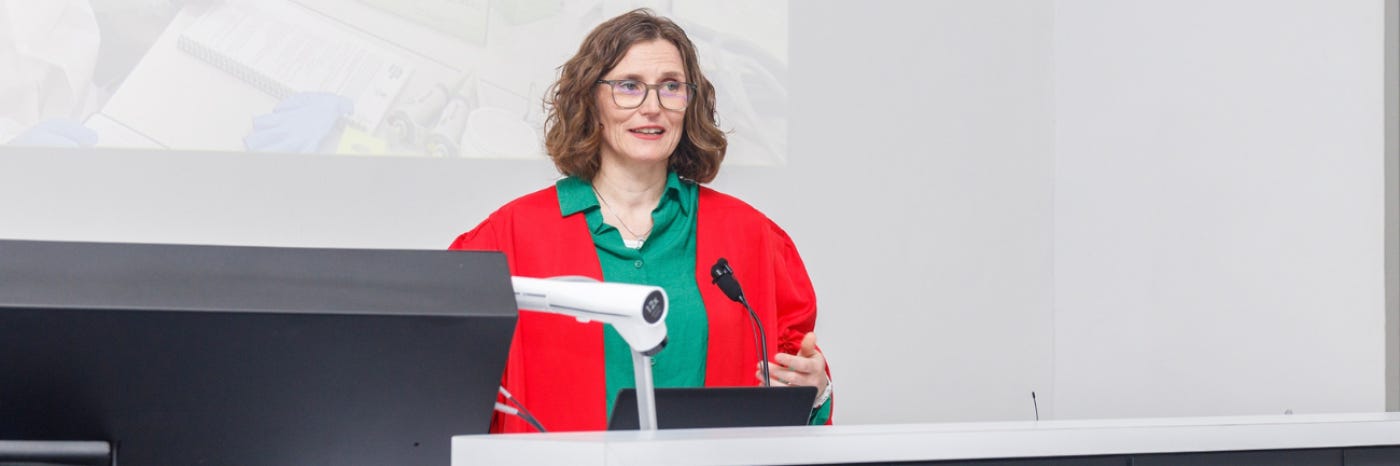
Prof Elizabeth Streicher of the Division of Molecular Biology and Human Genetics delivered her inaugural lecture on Tuesday 1 September 2026.
Her research focuses on the transmission and spread of Tuberculosis (TB).
Knowing where TB transmission is happening can help to stop it from spreading.
Prof Elizabeth Streicher of the Division of Molecular Biology and Human Genetics in the Faculty of Medicine and Health Sciences delivered her inaugural lecture on Tuesday 1 September 2026. The title of her lecture was Decoding tuberculosis: the evolution of technology, epidemiology and the Mycobacterium tuberculosis genome.
Streicher explained to Corporate Communication and Marketing how molecular epidemiology (using genetic information to track how and why diseases spread through populations) has improved our understanding of where drug-resistant TB comes from, how it spreads and how drug resistance evolves within and between populations.
Tell us more about your research and why you became interested in this specific field.
Overall, our research group studies the genome (complete set of DNA instructions found in a cell) of Mycobacterium tuberculosis, the bacteria that cause tuberculosis (TB) disease. Various regions of the genome are interrogated to study different aspects of the disease. My main focus has been on the epidemiology of tuberculosis – how the bacteria’s genome changes over time and what this tells us about the transmission and spread of the disease.
How would you describe the relevance of your work?
If we understand how the bacteria that cause TB change and spread, it can assist in combating TB globally.
How has molecular epidemiology helped improve our understanding of drug-resistant TB?
Molecular epidemiology was very important in drug-resistant TB as it was originally believed that bacteria that become resistant to antibiotics would be less fit and not be able to transmit. But it was shown that they can transmit, and therefore have to be monitored to identify hotspots of transmission and outbreaks, etc.
Can you tell us briefly about the spoligotyping technique and its advantages for studying drug-resistant TB?
Spoligotyping (a molecular technique used to identify and track specific strains of TB bacteria) does not detect drug resistance, but since the technique is relatively quick to do, it can be very useful in real-time situations, e.g. to monitor outbreaks of drug resistance.
Why are interrupting transmission chains and identifying genomic hotspots important for controlling the spread of TB?
Knowing where TB transmission is happening can assist in allocating resources to those areas to stop future transmission and spread of TB.
Higher education can be challenging. What keeps you motivated when things get tough?
Students – how they are so passionate and dedicated to learning and contributing to research and society as a whole.
What aspects of your work do you enjoy the most?
Again, the students and colleagues! But also the fact that it is continuously changing and thereby we are learning and expanding our knowledge. In the end, I know that we contribute to a better society in our small way.
Tell us something exciting about yourself that people would not expect.
Even though I love hiking (day and multi-day hikes) and being outside, I really do not like camping!
How do you spend your free time?
I love hiking (wellbeing in nature) and like to watch most sports.
©Higher Education Media Services.