


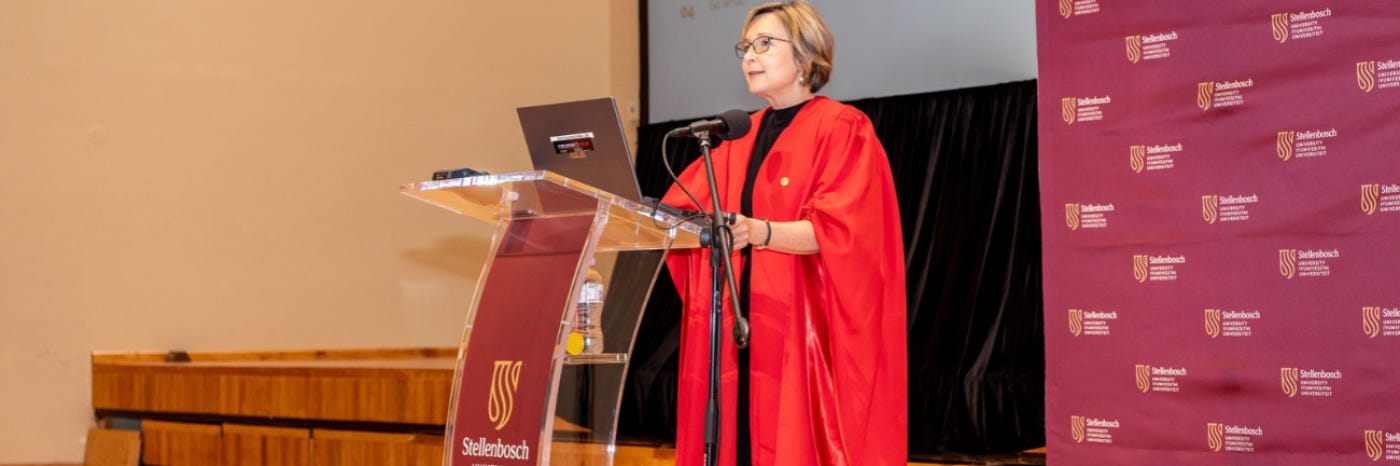
Prof Vasti Roodt, Dean of the Faculty of Arts and Social Sciences, delivered her inaugural lecture on Thursday 5 November. The title of her lecture was Philosophy through the looking glass: thinking with and against metaphor.
Roodt explained to Corporate Communication and Marketing how philosophy can help us recognise and interrogate assumptions built into the concepts we use to make sense of reality and understand other people.
Tell us more about your research and why you became interested in this specific field.
My research falls broadly within moral and political philosophy, with a particular interest in how we reason about moral and political questions, and how that reasoning can go wrong. An enduring concern has been the tension between our need for general concepts, rules and principles, and the importance of paying attention to what is particular and distinct, whether in how we experience and understand the world or in how we regard and treat other human beings.
My interest in thinking about our own thinking initially came about through the work of philosopher Friedrich Nietzsche. His attempts to expose and dismantle concepts that have hardened into unquestioned beliefs, and to uncover the unconscious and often irrational processes that shape seemingly rational thought, have profoundly influenced my own approach to philosophy.
I think of my encounter with Nietzsche’s ideas as an apprenticeship rather than a discipleship, but it certainly set the direction for much of my subsequent work. Why Nietzsche, though, rather than any other philosopher? I don’t really have an answer. How does one explain why a particular thinker, question or way of thinking emerges from the background of everything else and takes hold of you? There is something mysterious about the intellectual interests that end up shaping our lives, and I’m simply very glad that this is what took hold of me.
How would you describe the relevance of your work?
We all rely on concepts to make sense of reality, and we generally assume that our concepts accurately describe what is out there. But the way we organise and interpret our experience is shaped by habits of thought that we are often unaware of. These habits influence what we notice, what we overlook, and what seems obvious or reasonable to us.
My research asks what happens when we mistake these habits of thought for truths about the world. This matters particularly in moral and political life, where the concepts we use to understand other people can have very real consequences for how we treat them. It also matters for scholarship. We can construct elaborate theories that appear to explain something about the world, when much of the reasoning simply follows from assumptions built into the concepts we started with.
I see philosophy as a discipline that helps us recognise and interrogate these assumptions. That is essential to intellectual honesty and to the pursuit of knowledge more generally.
Based on your research, how can moral and political philosophy help us to build a better world for everyone?
I would be wary of claiming that philosophy can tell us how to build a better world for everyone. Philosophers disagree profoundly about what a better world would look like, and for good reason. We live among people whose experiences, interests, values and convictions differ from our own. That plurality is a fundamental condition of political life.
What philosophy can do is help us think more carefully about how we live together. It teaches us to examine our own beliefs, consider their implications, and take seriously the perspectives of people who see the world differently. Hannah Arendt’s work has been especially important to me in this respect. She shows how dangerous it becomes when we stop thinking for ourselves, fall back on conventional categories and clichés, or treat other people simply as members of a group rather than as distinct individuals.
A better political world depends, at least in part, on our willingness to question our own certainties and to make room for disagreement. Philosophy can help cultivate that willingness. Of course, thinking critically is no guarantee of acting morally, but the failure to think critically can have devastating political consequences.
What are some of the ways in which conceptual metaphors and analogies influence our reasoning about political issues?
We often understand abstract political ideas by comparing them to familiar things from everyday experience. For example, we speak about the nation as a family, society as a body, or political power as a physical force that can be exerted, accumulated or resisted. These are more than figures of speech. They provide mental models through which we understand political problems and think about possible solutions.
Take the metaphor of the nation as a family. It invites us to think of the state as a parent and citizens as children. Once we accept that picture, political questions can easily become questions about what kind of parent the state should be. Similarly, when society is imagined as a body, those regarded as outsiders can be portrayed as infections or threats to its health. We have seen how dangerous that way of thinking can become in xenophobic politics.
These metaphors influence political reasoning because they bring familiar associations with them. They make some conclusions seem natural, while directing our attention away from other possibilities. The crucial question is whether the similarities on which a metaphor relies are relevant to the political issue we are trying to understand.
Why are conceptual metaphors also a common source of error, deception and nonsense?
Analogies allow us to understand something unfamiliar in terms of something we already know. This is an extraordinarily useful capacity, and much of human knowledge depends on it. The difficulty is that analogies work by drawing attention to similarities while overlooking differences. We can therefore draw conclusions that seem perfectly reasonable within the analogy, but tell us very little about the thing we are actually trying to understand.
Conceptual metaphors are particularly troublesome because they often operate below the level of conscious awareness. We may not realise that a familiar metaphor is guiding our reasoning. We simply follow the associations it suggests, and because each step seems to follow naturally from the previous one, the argument feels convincing. We can develop elaborate arguments and theories that appear to advance our understanding, when we are really just following the associations suggested by a metaphor.
This has been your second year as the first female Dean of the Faculty of Arts and Social Sciences. What has this experience been like?
This is how I am often introduced, but my immediate impulse is to point out that I am far from being the first female Dean at Stellenbosch University. The faculties of Law, Science, Economic and Management Sciences, Education, and Medicine and Health Sciences either have or have had female deans. So I’m not sure that being a woman is the most noteworthy feature of my tenure.
As for the experience itself, I have enjoyed the opportunity to help shape the Faculty’s strategic direction. That involves both big-picture thinking and tackling very practical problems: improving how things work, making processes more efficient, and ensuring that decisions are made in ways that are clear, consistent and transparent.
Above all, my concern is with ensuring that the Faculty of Arts and Social Sciences is well prepared for the future. This means thinking carefully about who we are, what kind of Faculty we want to be, and what our place should be in a world that is increasingly volatile and unpredictable. Developing a clear answer to those questions, and a realistic strategy for getting there, is probably the overarching focus of my tenure as Dean.
The role of Dean comes with its share of challenges. What keeps you going when things get tough?
For one thing, engaging with colleagues as fellow human beings, rather than simply through the lens of our institutional roles. Having meaningful relationships with people in the Faculty, even when we disagree, which we certainly do, makes it much easier to navigate the challenges of the job. I don’t think I could do it if I felt my role was simply to manage processes and apply rules.
Secondly, having a life outside the University. I love my Faculty and enjoy my work tremendously, but I am not an institutional creature. I have an interesting family and wonderful friends, and I enjoy spending time with them. I’m also a great reader, so I always have a novel on the go and read a lot in my downtime.
How do you juggle your responsibilities as Dean with doing research?
The short answer is that I haven’t managed to juggle them very well at all! My responsibilities as Dean have been pretty much all-consuming over the past two years. However, we now have better systems and processes in place, and have made changes in the Dean’s office to distribute responsibilities more effectively and allow operational matters to run more smoothly without everything landing on my desk. My hope is that this will free up more time for research from next year.
I’m also trying, with varying degrees of success, to set aside time early in the morning for academic work, without emails or meetings. Since accountability helps, I’ve introduced 90-minute “shut up and write” sessions in the Faculty Boardroom from Monday to Thursday, open to all staff. I try to join as often as I can. There is something about sitting in a room with other people who are quietly getting on with their work that makes it much easier to concentrate.
I still supervise postgraduate students, which keeps me connected to the academic work I enjoy. And I have about three research projects under way that I hope will lead to publications over the next year or two.
What aspects of your work do you enjoy the most?
On the one hand, solving problems. I find it immensely satisfying to be presented with a knotty problem and to work out how to untangle it. On the other hand, I love grappling with the big-picture questions: what are the arts and humanities for, what kind of Faculty do we want to be, and how do we get there? What I particularly enjoy is figuring out how to translate that thinking into practical action.
As the Dean of Arts and Social Sciences, what do you see as the benefits of arts and humanities in the 21st century?
I think we often go wrong when we try to defend the arts and humanities either by pointing to the useful skills they teach, such as critical thinking and creativity, or by claiming that they are valuable simply for their own sake. Neither argument, to my mind, gets us very far.
I would make a different argument: the arts and humanities are valuable because they make other valuable things possible, without their own value being exhausted by any of these things. The sustained study of literature, history, philosophy and the arts develops our capacity to understand the world from perspectives other than our own. It introduces us to different lives, experiences and ways of thinking, and helps us see our own lives as one among many possible ways of being human. It also cultivates a flexibility of thinking: the ability to make connections between seemingly unrelated things, to understand one thing in the light of another, and to arrive at insights that would otherwise have escaped us.
These capacities enrich other fields of knowledge and human endeavour. They make for better engineers, doctors, economists and lawyers, as well as better artists, historians and philosophers. And they help us ask the larger questions about what all these endeavours are for, and whose lives they are meant to improve. This is why I think the arts and humanities should be woven into the intellectual life of the university as a whole. Their value extends far beyond the disciplines themselves.
Tell us something exciting about yourself that people would not expect.
I have an enduring love of spy novels, and if I could choose another life, I would probably be either a spy or a writer of spy novels.
Anyone who attended my inaugural lecture will also know about my lifelong devotion to the dancer Mikhail Baryshnikov!
How do you spend your free time?
Reading, listening to music, sitting around a table talking with friends and family, walking through unfamiliar cities, and thinking.
©Higher Education Media Services.