


South African universities must restore the intellectual purpose of postgraduate education, defend the academy’s openness, and strengthen the quality of supervision.
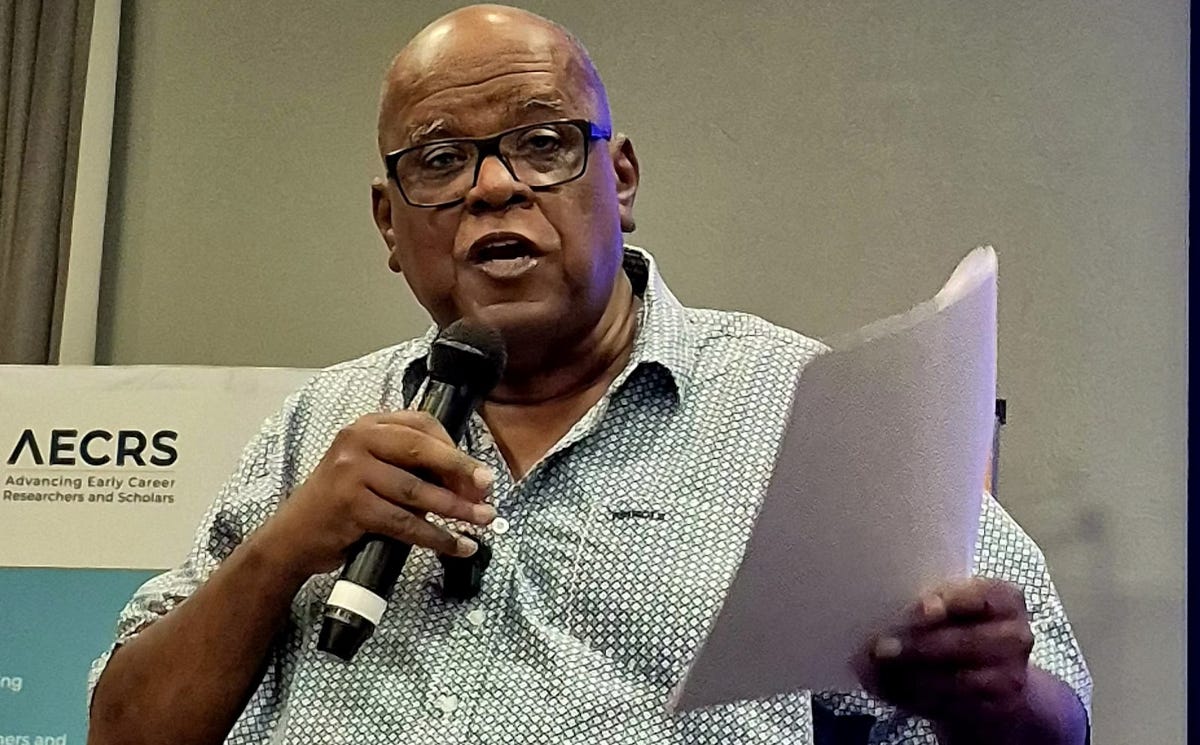
This was the central message delivered by Professor Jonathan Jansen, Distinguished Professor of Education at Stellenbosch University, in his keynote address at the opening of the third Enabling Quality Postgraduate Education (EQPE) colloquium, held in Gauteng, from 16 to 17 March 2026.
The event was part of a continuing programme to interrogate the direction of postgraduate education and to reassert the intellectual mission of universities amid growing institutional and societal pressures.
The two-day colloquium gathered academics, postgraduate supervisors and higher education specialists to reflect on strengthening postgraduate education and building more robust research cultures across South Africa. The event drew participants from across the country to engage critically on the future of postgraduate scholarship and training.
Under the theme Enhancing the Knowledge Project, the 2026 colloquium was the last in a series of three under the EQPE project, led by Professor Sioux McKenna from Rhodes University, with funding from the Department of Higher Education and Training (DHET). The initiative is implemented in partnership with the Community of Practice for Postgraduate Education and Scholarship (CoP PGES), led by Professor Stephanie Burton from the University of Pretoria.
The CoP PGES is a group of Universities South Africa (USAf) operating under the Advancing Early Career Researchers and Scholars (AECRS) Programme. The colloquium included representatives from the DHET, USAf, the Council on Higher Education (CHE), the Department of Science, Technology and Innovation (DSTI) and other national bodies.
Xenophobia has no place in society
Opening his address, Professor Jansen issued a stark warning about the implications of xenophobic rhetoric within higher education. “I never thought the day would come when I would see my government issuing blatantly xenophobic statements about foreign nationals who teach and do research on our campuses,” he said. He argued that such rhetoric poses a direct threat to the intellectual life of universities, which depend on the free movement of ideas and scholars. “Xenophobia has no place, whether on the streets or in the halls of the academy,” he insisted.
He emphasised that knowledge production is inherently collaborative and global. “None of us has developed knowledge in isolation from people in other countries,” he said, rejecting simplistic binaries between local and international scholarship.
For Jansen, the vitality of South African universities depends on their openness to intellectual exchange across borders.
From that political and ethical premise, Jansen turned to the colloquium’s central question: what postgraduate education is for. He challenged what he described as the “easy answers” often given within academia. “We tend to say postgraduate education prepares leaders for professions, meets the demand for high-level skills and inducts students into research methods,” he said. “But the deeper intellectual purposes of postgraduate education are seldom discussed.”
He argued that universities risk reducing postgraduate education to a narrow production system focused on outputs and subsidies. “In real terms, government spending on higher education has steadily declined,” he noted. “Departments, therefore, feel pressure to produce more master’s and doctoral students simply to sustain themselves.” This pressure, he suggested, has distorted academic priorities.
Quality sacrificed for volumes
“At its worst,” Jansen said, “the entire process of postgraduate education has been corrupted in a relentless quest to maximise income and research outputs.” He used the term “corruption” deliberately, not in a legal sense, but to describe the erosion of intellectual and ethical standards within the academy.
This critique was sharpened through his discussion of academic practices that undermine scholarly integrity. “Do not claim authorship on your students’ work,” he said bluntly. “You are paid to supervise that student. It is the student’s work.” He described the practice of supervisors claiming co-authorship on student research as a violation of academic ethics, rooted in career incentives rather than intellectual contribution.
He extended this critique to what is commonly known as “salami slicing”, where a single body of research is divided into multiple publications to inflate output. “You take a small piece of research, and you churn it into several mediocre articles,” he explained. “That is not scholarship. That is gaming the system.”
Similarly, he condemned the use of predatory journals, arguing that universities have a responsibility to safeguard the integrity of their research outputs. “These are public universities funded by taxpayer money,” he said. “We have a responsibility to be honest and to maintain integrity in the work we publish.”
Central to Jansen’s argument was a redefinition of postgraduate supervision. He rejected the idea that supervision is merely a technical process of guiding students through research design and completion. “The purpose of postgraduate education is to cultivate the intellectual mind,” he said. “It should produce students who can think deeply within and beyond the confines of their field.”
The ideal supervisory model
He described the ideal supervisor as someone who models intellectual curiosity, humility and rigour. “The more we know, the more we realise how little we know,” he said, emphasising humility as a defining quality of scholarship. At the same time, he argued that students must be encouraged to surpass their supervisors. “The moment a student surpasses the supervisor is the moment every professor should celebrate,” he said.
Jansen was particularly critical of the traditional single-supervisor model that dominates postgraduate education in many institutions. “No one supervisor, unless you are extremely arrogant, has the depth and the range of knowledge to educate the postgraduate student fully,” he argued. He identified three core problems with this model: limited expertise, isolation of students and restricted intellectual development.
In response, he advocated for cohort-based models of postgraduate education. “These models create intellectual communities rather than isolated supervision relationships,” he said. Through seminars, collaborative discussions, and exposure to multiple scholars, students can develop a broader, more critical understanding of their fields.
The importance of intellectual breadth was further illustrated through Jansen’s reflections on interdisciplinary thinking. Using the COVID-19 pandemic as an example, he argued that narrow disciplinary approaches can lead to flawed policy decisions. “You cannot address social crises using only biomedical expertise,” he said. “The problems of the world do not arrive packaged as disciplines.”
He criticised the exclusion of social scientists from key decision-making processes during the pandemic. “When you ignore the social realities of people’s lives, your policies will fail,” he said, pointing to the impracticality of measures such as social distancing in overcrowded living conditions.
For Jansen, the solution lies in rethinking the curriculum of postgraduate education. “We need scholars who can speak with equal confidence about statistical validity and qualitative credibility,” he said. “That is what intellectual breadth looks like.”
Read full article at www.usaf.ac.za.
©Higher Education Media Services.