


Proponents of distance teaching and learning in the university sector often encourage a shift to distance education as one of numerous solutions to the space challenge confronting public universities. They argue that distance learning relies more on teaching staff and digital infrastructure and less on the size and capacity of lecture halls and other physical infrastructure required at a university.
At its inaugural Thought Leadership event on 2 October 2025, USAf explored whether distance teaching provides a sustainable solution for expanding access to university education, balancing increased capacity with the need to maintain quality and realistic expectations.
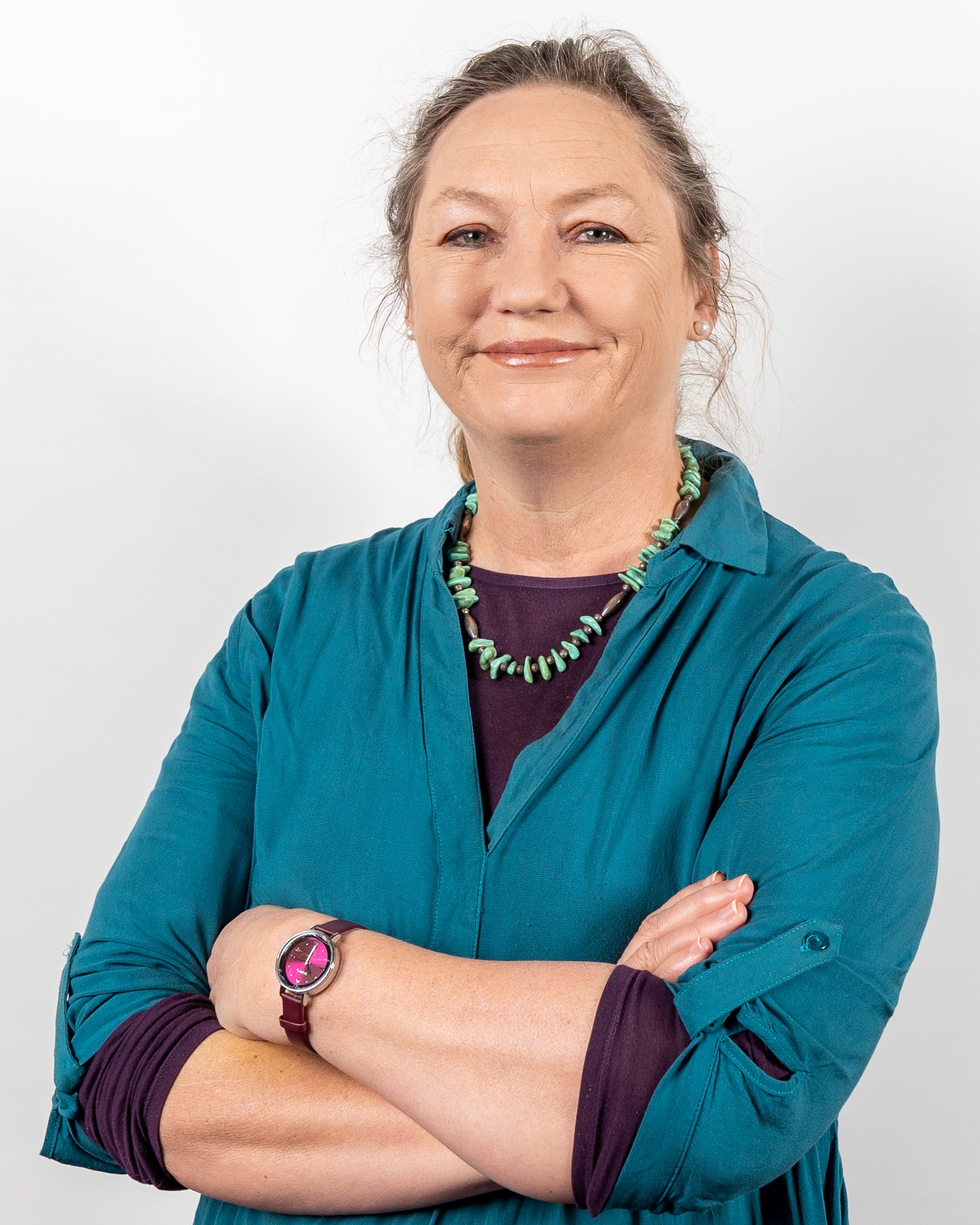
Leading the discussion on this question was Dr Denyse Webbstock (right), Senior Director for Institutional Planning, Evaluation and Monitoring at the University of Johannesburg. She spoke on the topic: Complexities of universities’ institutional and enrolment planning and the policy constraints hindering public universities from leveraging distance learning.
Dr Webbstock was addressing an audience of over 130 delegates comprising senior university executives, senior academics, and senior administrators. Private higher education institutions and TVET colleges were also represented, as were professional bodies, career development organisations, corporate foundations, and education-focused NGOs.
A digitally mature sector
On the one hand, Dr Webbstock painted a sector more digitally mature since 2020, when CoViD-19 imposed emergency remote teaching, improving everyday digital literacy over time. This had led to a larger student base now equipped to engage with well-designed online and blended learning, she said. “There are also student groups, course types and contexts for which remote learning is highly appropriate, especially when content is modular, assessment is authentic, and the pedagogy is built for digital delivery from the outset,” she added.
On the other hand, she conceded that quality distance provision was expensive to establish, considering the investment that went into course design, digital platforms, accessible materials, skilling academic staff in online pedagogy, and equipping support teams to provide timely advice, technical help and tutoring at a distance. “These costs are front-loaded and ongoing. Student completion rates in distance education programmes are generally lower than in contact modes. This can raise the cost per graduate when student support, selection processes, and academic pacing are not effectively managed,” Dr Webbstock explained. “Distance education, therefore, needs to be targeted to programme types and learner profiles where the mode adds value.”
Policy and funding rules governing distance provision
It emerged that the mode of delivery is not just a teaching choice but a regulatory consideration. Dr Webbstock, who has previously served South Africa’s Council on Higher Education (CHE) as Director: Monitoring and Evaluation, said that since 2022, the CHE has formally recognised three modes of higher education delivery: contact, blended and distance learning, adding that each mode of delivery had its own regulatory requirements.
Contact learning refers to learning in a physical setup where the teacher/lecturer and students are present in the same classroom, laboratory or amphitheatre.
Online learning takes place in a situation where the student and the lecturer are in different settings (including different countries). The student may access the lecture from their home or anywhere else on or off-campus, relying on the internet and a learning device for connectivity. Online learning also relies on recorded lectures.
Blended learning fuses in-person and online learning, providing some flexibility while retaining the benefits of classroom-based learning.
Touching on the regulatory requirements, Dr Webbstock said academic programmes are also accredited by mode, which means institutions cannot decide in March to shift a contact programme to distance learning in April, although there is currently a temporary CHE concession in place. That shift would require re-accreditation, accompanied by an indication of substantial measures taken to maintain internal quality, and there would be funding consequences to manage.
She also explained that at the undergraduate level, distance qualifications typically carry a lower funding weight than contact equivalents. This lowers the subsidy base for distance provision and forces institutions to look to fees, donor support or cross-subsidy to cover the full cost of quality delivery. She added that the CHE was currently evaluating the quality and institutional capacity of distance offerings in the wake of emergency remote teaching.
“That process will likely shape future quality expectations, minimum standards for student support, and the kinds of evidence institutions are expected to produce on throughput and learning outcomes. In short, distance can help, but it is subject to accreditation rules, quality assurance and funding models that have evolved to protect standards.” Distance education as a solution to expanding access is also, of course, dependent on the availability of financial aid for students.
The absence of Higher Education policy makers at this dialogue meant there was no official position (from the Government) on the feasibility of policy change to enable contact institutions to expand to distance provision, for the purpose of expanding access.
Distance provision is no universal solution
Dr Webbstock made it clear that distance learning is a valuable part of the access toolkit, but it is not a universal fix. She said it works best when integrated into a diversified system that combines well-resourced contact programmes and blended designs that match pedagogy with purpose.
For full qualifications, she said distance delivery would be effective where laboratory practice is not central to learning, where placement requirements are limited, and where authentic assessment can be delivered online without compromising integrity.
She said even then, success depends on strong student support. Advising, mentoring, peer communities, timely academic feedback, and early alerts for students who fall behind differentiate between a low-throughput distance programme and a route that truly extends opportunity. Distance learning also benefits from access to open educational resources that reduce student costs, from local support centres that give occasional in-person help, and from work-integrated learning that translates theory into practice.
“None of these is totally devoid of costs,” Dr Webbstock said. “The policy environment could also assist by ensuring that funding and quality frameworks do not unintentionally penalise institutions which invest in robust distance ecosystems.”
This was published on the Universities South Africa (USAf) website.