


The sound arrived before the lecture did. Soft chanting filled the Atrium at the Hasso Plattner School of Design Thinking Afrika (d-school Afrika) on the University of Cape Town’s (UCT) middle campus on Tuesday, 26 May. Colourful scarves shimmered under the lights as artist-scholars from the School of Dance moved gracefully through the space, offering oranges to audience members during a Hindu and Jamaican ritual that unfolded with beauty and symbolism – at once intimate, theatrical and deeply spiritual.
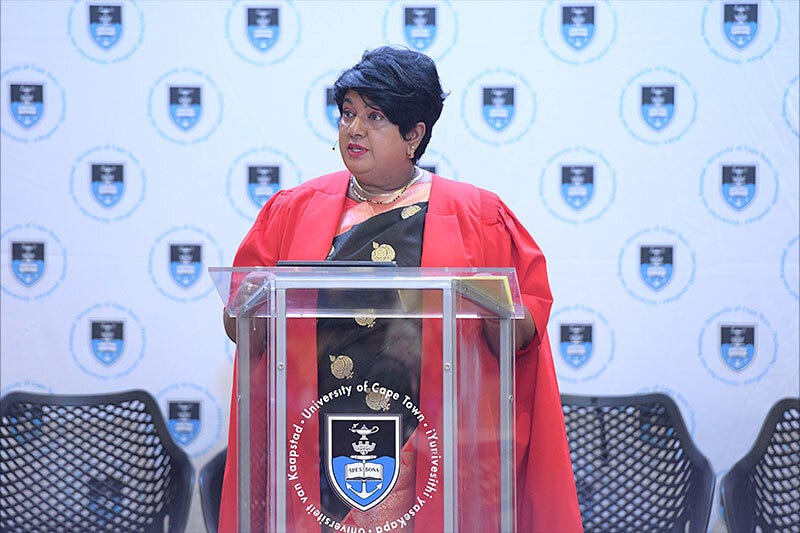
Before delivering her inaugural lecture, Professor Kasturi Behari-Leak asked the audience to pause and “gather us into this space”.
“In my own life, rituals have been a way of marking transitions,” she said gently. “What you hear and see around you draws in a spirit. To earth. To water. As a way of bringing balance.”
The performance transformed the venue from a formal academic setting into something more reflective and human. It became a space of memory, ancestry and reckoning – themes that would shape the evening’s lecture titled “Biographies and Geographies: Who Teaches Matters – Reimagining Knowledge, Belonging and the University”.
“I offer this as an invitation for us to arrive fully in this moment,” Professor Behari-Leak told the audience. “To make present what is here already. Ancestors. Past. Present. And still to come.”
The ritual set the tone for a lecture that was as autobiographical as it was intellectual – a deeply personal reflection on identity, belonging, curriculum transformation and the future of universities in South Africa and beyond.
Currently the dean of the Centre for Higher Education Development (CHED), Behari-Leak is one of South Africa’s leading scholars in higher education transformation, decolonial pedagogy and curriculum renewal. Her work has shaped national and international conversations around socially responsive teaching and learning, and she has held leadership positions across the sector, including as former president of the Higher Education Learning and Teaching Association of Southern Africa and the International Consortium for Educational Development. Showers of praise from scholars at other universities across the country, which were relayed in a video, attested to this.
Rooted in identity and belonging
But on Tuesday night, she did not begin with accolades or achievements. She began with questions.
“Who am I?” she asked. “And who am I not?”
From there, Behari-Leak traced the intellectual and emotional journey that shaped her scholarship. She reflected on growing up in working-class communities in Durban under apartheid, where cultural richness coexisted with structural exclusion.
“My childhood memories are captured in black and white photographs,” she said, “that tell a very colourful story of a life shaped by parents who, having little formal education, navigated the challenges of inequality, marginalisation and racialised exclusion with care and creativity.”
“Without knowing it then, we were learning that our hair, our skin and our histories were not the norm. We were learning about ourselves as ‘Other’.”
Books, she recalled, were treasured objects in her childhood home. Yet they also introduced her to worlds that excluded people like her.
“The stories we encountered through nursery rhymes, fairy tales and imported toys transported us into distant landscapes and imaginaries far removed from our everyday realities,” she said.
Looking back, she realised these cultural experiences were not neutral.
“They taught us who could be heroic, civilised, beautiful and worthy of attention,” she explained. “Without knowing it then, we were learning that our hair, our skin and our histories were not the norm. We were learning about ourselves as ‘Other’.”
This sense of being simultaneously inside and outside institutional spaces became central to her intellectual work. Throughout the lecture, Behari-Leak repeatedly returned to the idea that universities are not abstract institutions detached from society, but deeply human spaces shaped by power, memory and identity.
“The academy does not stand apart from society,” she said. “It mirrors it.”
The unfinished work of decolonising knowledge
Her lecture explored how biographies – the histories and identities people carry – intersect with geographies, the institutional and social spaces people move through. Together, these shape not only how knowledge is produced, but who is recognised as a legitimate knower.
“Who we are is never separate from the worlds we move through,” she said. “Because who teaches matters.”
That question became especially urgent during the #RhodesMustFall and #FeesMustFall student protests that erupted across South African universities in 2015 and 2016. Behari-Leak served on UCT’s Curriculum Change Working Group during one of the institution’s most turbulent periods.
“Students were not simply asking to be included in an existing canon,” she recalled. “They were asking whether the centre itself could shift.”
For Behari-Leak, curriculum transformation is not merely about adding diverse authors or content to reading lists. It is about interrogating power itself – asking whose knowledge is recognised, whose histories are visible and whose humanity is affirmed within universities.
“Curriculum was never neutral,” she said. “It reproduces what scholars call the coloniality of being through what is taught and which bodies are allowed to belong.”
She argued that universities must move beyond the idea of a single “universal” knowledge system and instead embrace what she described as a “pluriversity” – a space where multiple epistemologies and ways of knowing can coexist.
AI, power and the future of learning
The lecture also reflected on how these questions are evolving in an age increasingly shaped by digital technologies and artificial intelligence (AI).
“The books of my childhood have not disappeared,” she said. “They have evolved. They now circulate through digital platforms and increasingly through AI trained on datasets shaped by historical inequalities.”
While acknowledging the transformative potential of AI, Behari-Leak warned that technology can also reproduce exclusionary systems if left unexamined.
“Our task is not to reject these technologies,” she said, “but to engage them critically, attending to what is present, what is absent and whose realities remain invisible.”

At the heart of her lecture was a call to rethink academic staff development and leadership in higher education. Too often, she argued, professional development is reduced to technical training or compliance exercises rather than opportunities for intellectual and human growth.
“Development is not about fixing deficits or enabling advancement alone,” she said. “It begins with recognition.”
She spoke passionately about creating institutional spaces where academics can reflect on how their own biographies and experiences shape their teaching and leadership.
“When we enter the classroom, we should not leave ourselves at the door,” she said. “Different backgrounds make different ways of noticing possible. They expand what teaching can mean and what becomes possible for students.”
In one of the evening’s most memorable moments, Behari-Leak described the transformative power of educators who teach authentically and relationally.
“When students encounter teachers who are able to show up fully, thoughtfully and differently,” she said, “the classroom is magical. And once you see this, you cannot unsee it.”
Reimagining the university
Her reflections on leadership were equally personal. As a black South African Indian woman leading within higher education, Behari-Leak spoke candidly about the tensions of navigating institutional power, while remaining grounded in values of justice and humanity.
“The university cannot simply be administered,” she said. “It must be interpreted, questioned and reimagined.”
She admitted that relational and critical leadership often comes at a cost.
“There were moments when critique was read as resistance,” she said. “Moments when relational leadership was mistaken for softness.”
Still, she refused to abandon the principles that shaped her scholarship and leadership.
“I did not want a form of excellence that required forgetting why this work matters,” she said.
“Teachers are needed to cultivate judgment, interpretation, ethical discernment, relationality and belonging.”
Throughout the lecture, Behari-Leak emphasised that educational development is not remedial or marginal work, but central to the future of universities. In an era increasingly driven by efficiency, automation and productivity metrics, she argued that universities must resist becoming detached from humanity.
“Teaching cannot be reduced to content delivery or information transfer,” she said. “Teachers are needed to cultivate judgment, interpretation, ethical discernment, relationality and belonging.”
As the lecture ended, Behari-Leak returned to the themes of presence, possibility and human connection that had opened the evening.
“At a time when universities are being asked to innovate, adapt and lead the way,” she said, “what is our responsibility in ensuring that possibility never becomes detached from humanity?”
Then came the final reflection – one that lingered long after the applause faded.
“In the end,” she said, “it is not only knowledge that transforms a university. It is its people and its relationships.”
Welcoming guests, UCT Vice-Chancellor Professor Mosa Moshabela described the occasion as both “a personal milestone for the lecturer” and “a collective celebration”.
Reflecting on the lecture’s themes of knowledge, belonging and transformation, Professor Moshabela noted that universities globally are grappling with questions of “inclusion, belonging and transformation”. He stressed that these issues are “not peripheral concerns” but “sit at the very heart of what it means to make our institutions equitable, responsive and rewarding”.
Republished from UCT under a Creative Commons Attribution-NoDerivatives 4.0 International License.
© Higher Education Media Services.