


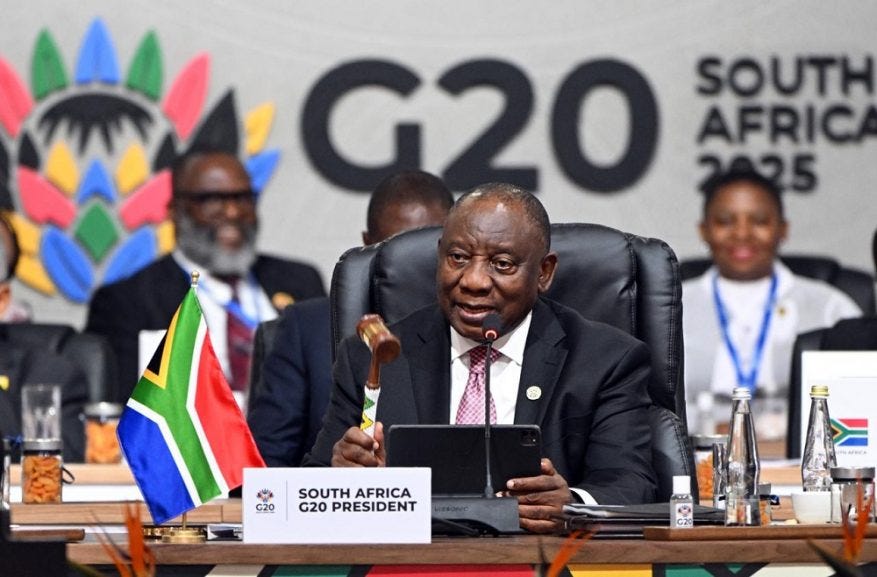
President Cyril Ramaphosa and global experts on inequality met at Wits University on Friday, 24 April to begin establishing an urgent panel on inequity modelled on the intergovernmental on climate change (IPCC), the university said in a statement.
Ramaphosa commissioned the first-ever G20 report on global inequality, authored by an Extraordinary Committee of Experts chaired by Nobel Economics Laureate Professor Joseph Stiglitz, and including Committee Founding Members: UNAIDS Executive Director Winnie Byanyima; Global Fund for a New Economy Director Dr Adriana Abdenur; Professor Jayati Ghosh (University of Massachusetts); Professor Imraan Valodia (Wits University); Professor Wanga Zembe-Mkabile (South African Medical Research Council); Representatives of the Panel’s founding governments — Brazil, Norway, South Africa and Spain — also participated.
The Report recommends establishing an International Panel on Inequality, modelled on the Intergovernmental Panel on Climate Change (IPCC). The event discussed the urgent need for the panel and progress towards its founding.
‘Inequality is about power’
In a video message, the Secretary-General of the United Nations, Antonio Guterres, warned that inequality is “eroding trust, deepening polarisation, and destabilising economies.
“Increasingly, we see a world where the ultra-wealthiest and the companies they control are calling the shots like never before. They are wielding outsized influence over economies, information, and even the rules that govern us all.”
He adds: “But let’s be clear: Inequality is not only about income or wealth. It is about power: who holds it, who is denied it, and how it shapes every chance in life.”
“We face a world in which billions lack the basics, while a few reap extraordinary gains. A world where unfair global rules trap countries into patterns of vulnerability and dependence. A world where unequal outcomes today lock in unequal opportunities tomorrow – in education, in health care, in every aspect of life.
“And emerging technologies are accelerating the divide. It does not have to be this way. We can – and we must – confront the injustice of inequality. It is essential for a future of dignity and sustainability for all.”
What the International Panel on Inequality will do
Led by Stiglitz, the committee’s report warned of an “inequality emergency”, with one in four people worldwide regularly skipping meals, while billionaire wealth has reached the highest level in history.
At last year’s G20 Summit in Johannesburg, the leaders of Spain, Norway, and Brazil joined Ramaphosa in supporting the initiative, alongside President of the European Council Antonio Costa. In February, the African Union unanimously passed a motion supporting the panel.
At the Wits on Friday, the Founding Committee discussed the composition and mandate of the panel.
Imraan Valodia, Professor of Economics and Pro Vice-Chancellor: Climate, Sustainability and Inequality at Wits University, says:
“Every country has scope to address inequality at the national level and it is in every country’s strategic interest to cooperate internationally. While there is a wealth of academic literature about inequality – there is not a single central body that assesses the global state of inequality.
“Indeed, many estimates seem to have severely underestimated the level of inequality in our societies. Without proper scrutiny, inequality has spiralled out of control – and it’s time to get a hold of it.”
Winnie Byanyima, the UN Under-Secretary General, Executive Director of UNAIDS, and member of the Founding Committee of the International Panel on Inequality, says: “I am excited to be back in South Africa to help deliver on a key outcome of last year’s G20 Summit: the establishment of an International Panel on Inequality.
“At a moment when multilateralism is at its weakest in decades, South Africa, Brazil, Spain, and Norway are demonstrating that governments can still come together to confront the defining challenges of our time.
“We are living through an inequality emergency - one that is driving health crises, deepening climate vulnerability, and trapping millions in cycles of poverty. With South Africa’s President Ramaphosa in the lead, we are choosing to act”.
©Higher Education Media Services.