


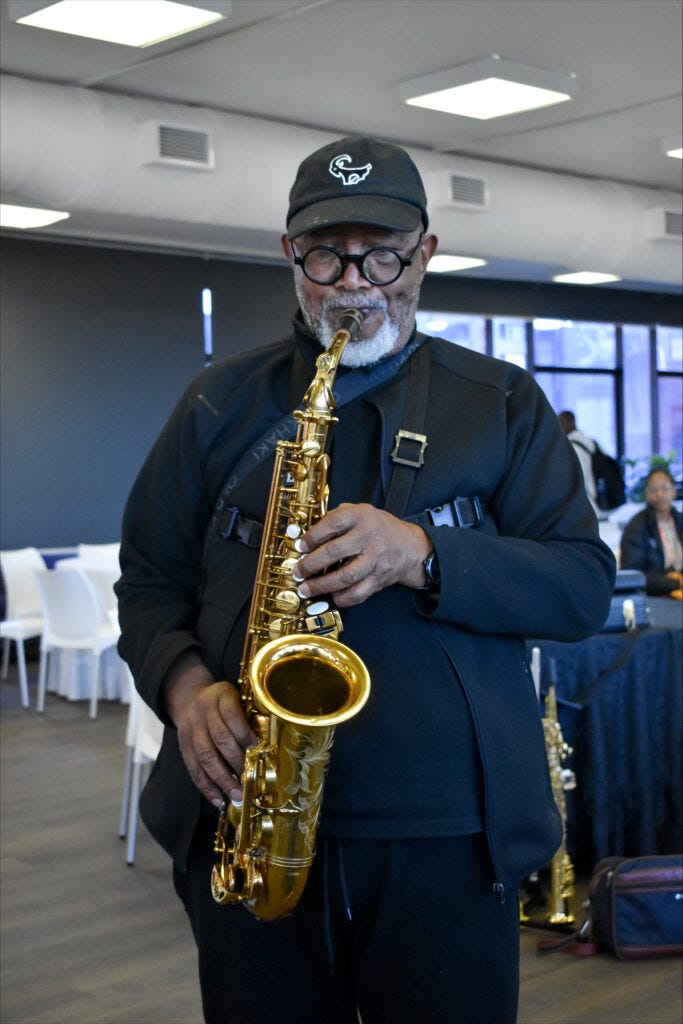
Legendary South African musician Sipho “Hotstix” Mabuse’s extraordinary journey from leaving school to pursue music to returning decades later to complete his matric is among the defining chapters of a new biography being written about his life.
The book, provisionally titled Jive Soweto: The Musical Journey of Sipho “Hotstix” Mabuse, is being written by University of Johannesburg (UJ) academic and award-winning author Professor Siphiwo Mahala as part of the university’s African Biographies Project.
Mahala offered a glimpse into the project during a discussion with Mabuse at UJ’s Chinua Achebe Auditorium on Tuesday, where the veteran musician reflected on a career spanning more than six decades.
Mabuse left school in 1969 to pursue music, but returned to the classroom more than four decades later, completing his matric in 2012.
His decision to resume his education after achieving national and international success has become one of the less conventional chapters of a career that has established him as one of South Africa’s most enduring musicians.
Mahala, Acting Director of the Johannesburg Institute for Advanced Study (JIAS), said writing Mabuse’s long overdue biography was an immense honour and responsibility.

The biography forms part of the African Biographies Project, an initiative of UJ Vice-Chancellor Professor Letlhokwa Mpedi aimed at documenting significant African lives and experiences.
During the event, Mahala presented a paper titled Sounds of Soweto: The Decolonial Rhythms and Multicultural Roots of Sipho ‘Hotstix’ Mabuse’s Music, examining how Mabuse drew on the sounds, languages, dances and performance traditions of historically marginalised communities.
“Mabuse’s music can be understood not merely as a cultural product, but as part of a broader historical process through which Black South African musicians have appropriated, transformed and re-signified musical forms within their own cultural and political worlds,” Mahala said.
Mabuse’s musical journey started with the high school band The Beaters before the group travelled to then-Rhodesia, now Zimbabwe, in 1976 and subsequently renamed itself Harari.
During the UJ discussion, Mabuse challenged a long-standing assumption that the band’s name was derived from Zimbabwe’s capital, Harare.
He explained that “Harari” loosely translated from Shona as “he who does not sleep”, an appropriate description, he joked, because members of the band did not sleep much themselves.
Mabuse launched his solo career in 1983, developing into an accomplished multi-instrumentalist with an ability to move across musical genres and audiences.
His catalogue includes some of South African popular music’s best-known songs, among them Zanzibar, Thaba Bosiu, Shikisha, Jive Soweto and Burn Out.
Over the decades he has worked with leading South African musicians including Kippie Moeketsi, Miriam Makeba and Hugh Masekela, while his international collaborations have included artists such as Al Jarreau, Timmy Thomas, Brook Benton and Paul Simon.
Mahala argued that Mabuse’s longevity could not be separated from the way his music absorbed and transformed South Africa’s diverse musical and cultural traditions.
More than six decades after beginning his career, Mabuse continues to perform at festivals and music events, extending a musical journey that began while he was still at school and eventually brought him back to the classroom.
For Mahala, documenting that journey is also about ensuring the experiences of influential African cultural figures become part of the continent’s written historical record.
And at an age when many performers would have long since stepped away from the stage, “Hotstix” continues to perform, ensuring that the man behind Burn Out has, quite literally, yet to burn out.
©Higher Education Media Services.