


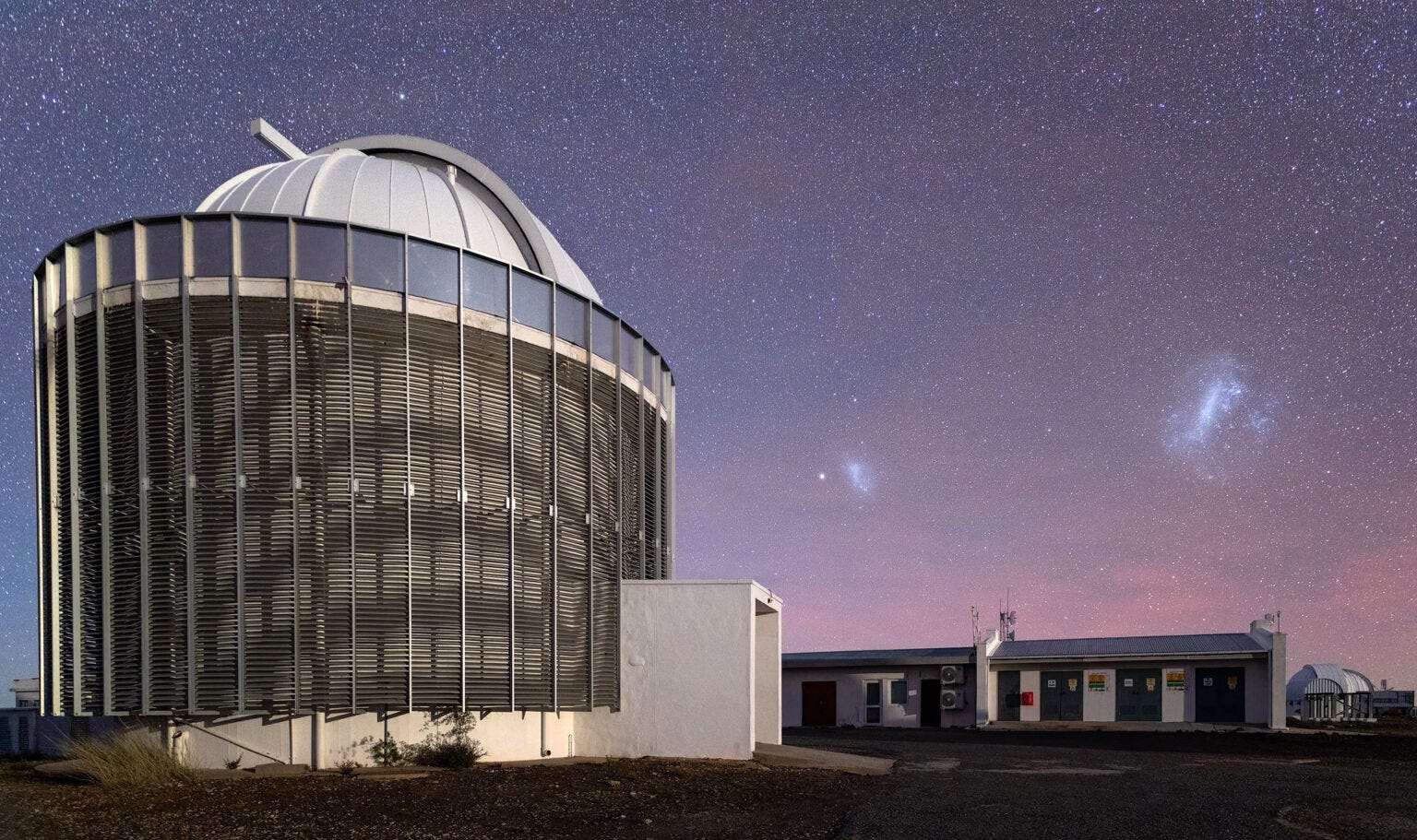
Artificial intelligence is ushering in a new era of precision for South Africa’s leading astronomical observatories. At the heart of this transformation is the Intelligent Observatory programme, a collaboration between the Science and Technology Facilities Council (STFC) Hartree Centre and the South African Astronomical Observatory (NRF‑SAAO).
While automation and efficiency are widely recognised benefits of AI, the deeper scientific impact lies in its ability to produce cleaner observations, minimise human and technical errors, and generate high‑precision datasets that elevate research on a global scale.
Astronomical research has always been shaped by the quality of the data collected. Even the most powerful telescopes battle against subtle distortions caused by the atmosphere, abrupt shifts in weather conditions, and the natural ageing or misalignment of instruments.
Traditionally, addressing these issues required teams of experts manually reviewing logs, checking instruments, and correcting raw data—time‑consuming processes that slowed scientific progress and sometimes introduced inconsistencies.
As the demands on NRF‑SAAO’s facilities grow, and as more astronomers around the world rely on access to South Africa’s skies, ensuring data reliability has become a scientific priority.
This is where the Intelligent Observatory marks a step change. By integrating AI directly into daily operations, the programme enables telescopes to monitor themselves with exceptional accuracy.
Machine‑learning models continuously scan sensor readings, performance metrics, and environmental data, identifying anomalies long before they escalate into issues that could compromise observations.
Instead of responding to faults after they occur, astronomers now benefit from predictive maintenance powered by advanced analytics. This shift dramatically reduces downtime and ensures that every captured image or spectrum is produced under optimal conditions.
The real breakthrough isn’t just automation—it’s the radical improvement in data quality. With atmospheric distortions corrected in real time and faults flagged before they degrade observations, astronomers gain access to more reliable data than ever before. This elevates the scientific value of every observation and strengthens South Africa’s global research footprint.
But the most profound impact is in the real‑time correction of raw observational data. AI‑based tools automatically adjust for atmospheric turbulence, instrument imperfections, and environmental inconsistencies, converting raw telescope output into clean, scientifically robust datasets within minutes rather than hours or days.
This not only eliminates error‑prone manual steps but ensures that datasets from different nights, telescopes, or instruments are far more consistent and comparable. For researchers studying faint galaxies, explosive stellar events, or subtle cosmic signals, this consistency is crucial.
Funded through the UK Research and Innovation International Science Partnership Fund, the Intelligent Observatory unites specialists in AI, software engineering, and telescope operations to meet these challenges. With AI embedded in daily operations, telescopes can monitor themselves, process data instantly, and produce high-quality datasets, freeing scientists to focus on discoveries across the Universe.
Located at STFC’s Daresbury Laboratory, at Sci-Tech Daresbury in the Liverpool City Region, the Hartree Centre is the UK’s leading supercomputing centre dedicated to working with industry and the public sector. It is home to some of the UK’s most advanced supercomputing experts and technologies, from AI and high-performance computing to data analytics.
This international collaboration with NRF-SAAO was initiated by AI specialists, Dr Adriano Agnello and Dr Rob Firth at the Hartree Centre, both former astronomers. Together, the team is building software that monitors telescopes, spots problems early, and turns raw observation data into clear insights, all with minimal human effort. It summarises nightly observations, flags system glitches and weather disruptions, and ensures astronomers capture the best possible data.
The programme’s AI‑enhanced data pipeline dramatically improves what astronomers call “data fidelity”—the degree to which observations reflect the true physical properties of the universe. With higher data fidelity, researchers worldwide can conduct deeper analyses, identify fainter or more complex phenomena, and draw more confident conclusions. Clean, reliable datasets also accelerate collaboration, as international teams can trust the integrity of the observations without extensive reprocessing. For South Africa, this strengthens the role of NRF‑SAAO as a global leader in high‑precision astronomy.
A complementary AI‑powered search and interpretation platform further supports scientific productivity. This system uses Large Language Models to help astronomers rapidly navigate technical manuals, maintenance records, and research papers. By reducing the time spent hunting for critical information, researchers can focus more of their energy on scientific research. This tool also democratises access to knowledge, particularly for students and researchers from historically disadvantaged institutions, who now gain immediate access to insights that once required years of hands‑on operational experience.
Ultimately, the Intelligent Observatory stands as a model for how AI can strengthen—not replace—the work of scientists. By removing noise, correcting distortions, and producing consistently high‑quality data, AI gives astronomers a clearer, more accurate view of the universe. It allows them to spend less time troubleshooting and more time exploring, interpreting, and discovering. In doing so, it elevates not only South Africa’s research infrastructure, but the global scientific community’s ability to unlock the secrets of the cosmos.
The real breakthrough isn’t just automation—it’s the radical improvement in data quality. With atmospheric distortions corrected in real time and faults flagged before they degrade observations, astronomers gain access to more reliable data than ever before. This elevates the scientific value of every observation and strengthens South Africa’s global research footprint.
©Higher Education Media Services