


Thirty universities across Ghana, Kenya, Nigeria, and South Africa are set to benefit from an initiative expanding access to advanced artificial intelligence education. The South African launch marks the start of a programme to equip university lecturers with the skills to train future AI researchers.
The South African launch of AI Research Foundations (AIRF), a pan-African initiative to expand access to advanced artificial intelligence (AI) education, took place yesterday (9 Nov 2026) at the Biomedical Research Institute (BMRI) at Stellenbosch University’s Tygerberg campus in Cape Town.
Hosted by the Centre for Epidemic Response and Innovation (CERI) at Stellenbosch University (SU), in collaboration with the African Institute for Mathematical Sciences (AIMS) South Africa, the launch marks the start of a five-day Train the Trainer workshop bringing together university lecturers and researchers from across the country.
The initiative targets 30 universities across four African countries, including ten in South Africa, with the ambition of training 30,000 students.
The programme is supported by funding from Google.org, with FATE Foundation in Nigeria serving as the main grant holder and AIMS South Africa as the academic implementation partner. Google DeepMind developed the AI Research Foundations curriculum, with University College London (UCL) contributing pedagogical expertise and teaching resources.
For FATE Foundation, the emphasis is on translating the partnership into practical results. “We have had the vision, we have explored the opportunities. Now we need to move from commitment to action,” said Oluchi Johnson-Achibiri, Digital & Innovation Manager at FATE Foundation, at the launch.
As artificial intelligence increasingly contributes to scientific discoveries and technological advances, developing the expertise to understand, build, and apply these systems is becoming essential for researchers and technical professionals.
The AIRF curriculum goes beyond introductory AI literacy, providing practical training in deep learning, neural networks, generative language models, and transformers. Learners gain hands-on experience in building and fine-tuning language models, while exploring the principles of responsible AI development.
Developed with input from African learners and experts, the curriculum incorporates research applications relevant to the continent’s scientific and societal challenges. It has already reached thousands of learners globally and is now being introduced more widely into African university classrooms. The courses are available free of charge through Google Skills to technical university students, researchers, and other interested learners worldwide.
Central to AIRF is its Train the Trainer approach, which prepares university lecturers and researchers to introduce advanced AI courses at their own institutions.
The workshop, running from 9 to 13 November at the BMRI, brings together participants from SU, the University of Venda, the University of Mpumalanga, the University of the Free State, and the University of the Western Cape.
Alongside technical training, participants will gain experience in delivering lectures, developing teaching resources, and exploring AI research applications relevant to their local contexts. Following the workshop, they will receive continued support in delivering the curriculum and supervising student projects.
Sipho Mtombeni, Government Affairs and Public Policy Manager at Google South Africa, highlighted lecturers' role in extending the programme’s reach. “How do we empower you this week so that you can empower the next generation of researchers? This week is just the beginning.”
The BMRI workshop is one of four planned across South Africa, following in-person training activities in Ghana, Nigeria, and Kenya.
“The AI Research Foundations for Higher Education programme is a concerted effort to move AI research and development forward in Africa. Through the programme we aim to train 30,000 students across our continent to understand foundational aspects of AI research through the lenses of large language models and responsible innovation. The curriculum is grounded in African culture, which is very exciting for a frontier AI curriculum! It is said that it takes a village to raise a child, and with generous funding by Google.org and the support of Google DeepMind and partner universities, the village is committed and we can do it,” said Prof Ulrich Paquet, AI Director of AIMS South Africa.
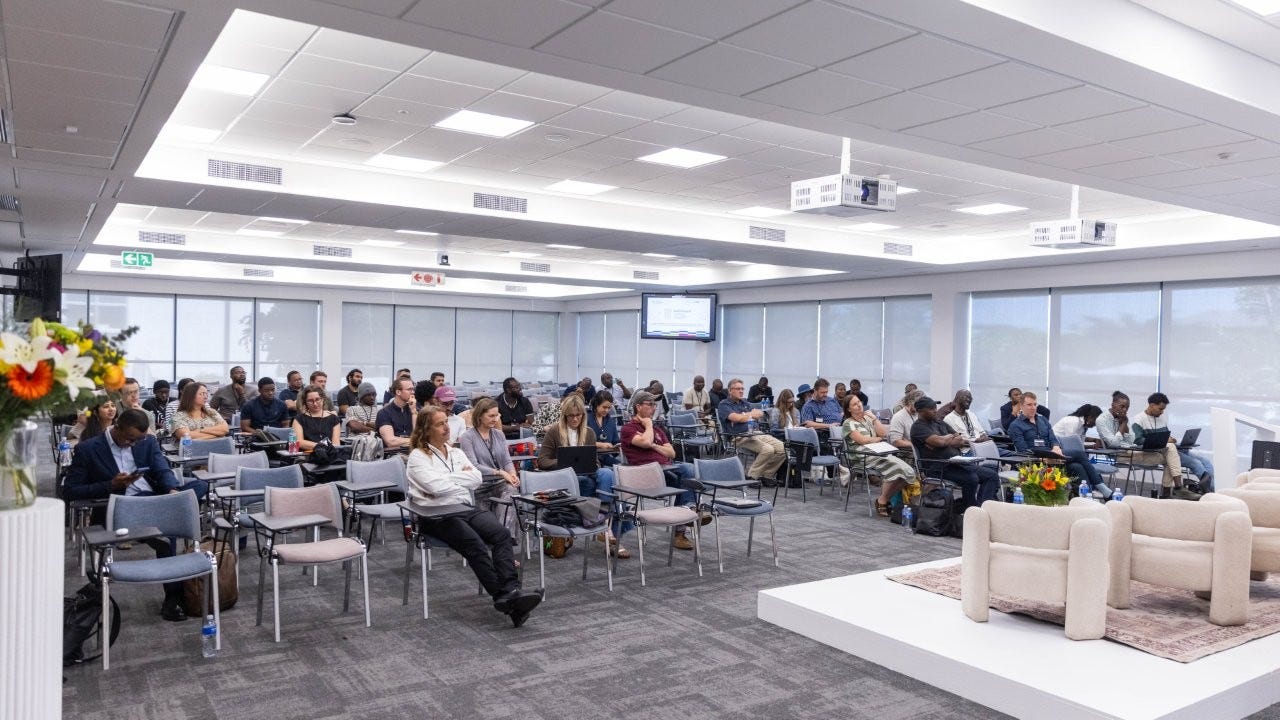
Prof Francesco Petruccione, Director of the National Institute for Theoretical and Computational Sciences (NITheCS), also emphasised the potential to improve scientific research. “We don’t want to produce mediocre science. We should use AI to do not more but better science.”
Hosting the national launch reflects SU’s commitment to advancing AI research, education, and capacity development across Africa.
CERI has established a substantial research programme applying AI and machine learning to infectious disease research, including pathogen genomics, epidemic intelligence, and predicting emerging health threats.
CERI researchers are participating in the AIRF workshop and will subsequently help deliver the curriculum across Stellenbosch University in 2027, expanding opportunities for researchers and students to develop advanced AI skills.
“It is a great pleasure to host the launch of this AI training initiative in South Africa. More than ever, it is important that university researchers and students receive advanced AI training, not only to use artificial intelligence ethically and effectively, but also to develop and programme their own models to address health and societal challenges across Africa,” said Prof Tulio de Oliveira, Director of CERI.
©Higher Education Media Services.