


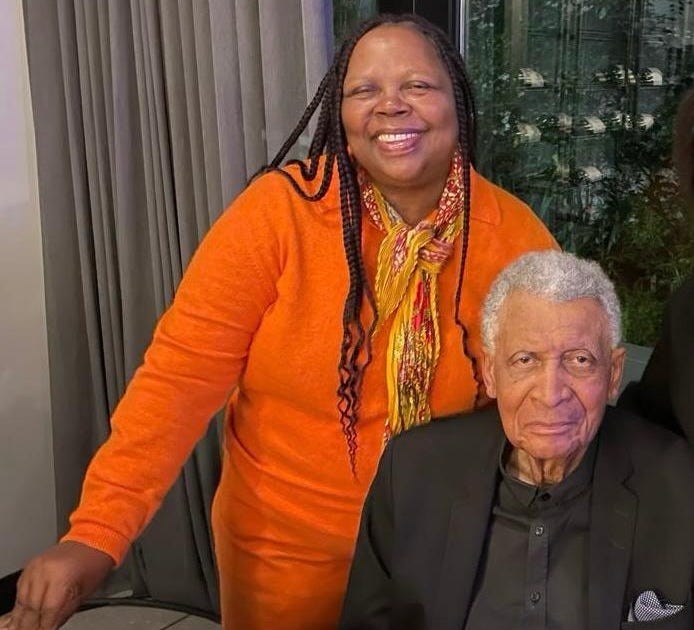
Music lovers across the world have joined millions of South Africans in mourning the passing of Abdullah Ibrahim, a global music giant, a jazz maestro, composer and pianist at the age of 91.
Wits University that bestowed an Honorary Doctorate of Music on Ibrahim in 2009 said the final curtain has come down for Abdullah Ibrahim, but his music will live on in our hearts forever.
TUT Chancellor and Wiphold co-founder Gloria Serobe remembers Ibrahim with fond memories after their last encounter at “a small intimate dinner just to celebrate him” at Sanctuary Mandela - a boutique hotel at the former Houghton residence of President Nelson Mandela - in April 2024.
Serobe said: “He was soo very, very happy. May he rest in peace”.
With his passing, South Africa has lost one of its greatest cultural ambassadors, one of the most influential jazz musicians of the twentieth and twenty-first centuries, and a towering figure whose music gave voice to the hopes, pain, resilience and aspirations of oppressed people everywhere, the South African Federation of Trade Unions (Saftu) said.
Born in District Six, Cape Town, Abdullah Ibrahim emerged from the harsh realities of apartheid to become one of the world’s most respected musicians.
Through a remarkable career spanning more than seven decades, he fused African musical traditions, jazz, gospel, spiritual influences and the sounds of working-class communities into a unique and unmistakable musical language that touched hearts across continents.
His music was never merely entertainment. It was a form of resistance, Saftu said. At a time when apartheid sought to silence the voices of the oppressed, Abdullah Ibrahim used music as a weapon of struggle, memory and hope.
His compositions captured the humanity of those who endured forced removals, racial oppression and economic exploitation. His internationally acclaimed work helped expose the brutality of apartheid while celebrating the beauty, dignity and resilience of South Africa’s people.
Few musical compositions have carried the emotional and political significance of his masterpiece, Mannenberg.
“The song became an unofficial anthem of resistance, echoing through townships, community halls, union gatherings and protest meetings. It inspired generations of activists, workers, students and freedom fighters and remains one of the most important musical contributions to the struggle against apartheid.
“Throughout his life, Abdullah Ibrahim demonstrated that artists have a critical role to play in society. He reminded us that culture is not separate from politics, economics and social justice. He understood that music could build bridges between peoples, challenge oppression and inspire collective action.
“His work resonated deeply with workers and the poor because it reflected their lived experiences. It spoke of displacement, hardship, longing, dignity and the enduring dream of freedom. In doing so, he became not only a musical giant but also a custodian of the collective memory of our people.
“As we mourn his passing, we celebrate a life extraordinarily well lived. His music will continue to inspire future generations to dream, create, resist injustice and fight for a more humane and equal world,” said Saftu in his tribute to the legend.
Abdullah Ibrahim, born Adolph Johannes Brand on 9 October 1934 in Kensington, Cape Town, was taught how to play the piano from the age of seven by his grandmother, Margaret, who founded a local branch of the African Methodist Episcopalian church. A heterogeneous ethnic mix of religions and music formed his earliest cultural memories, on the fringe of District Six.
At age 15 he began performing as a vocalist, then played the piano with big bands such as the Tuxedo Slickers and the Willie Max Orchestra. During this phase, Ibrahim forged his own style as a composer and performer.
When he was refused entry to the University of Cape Town’s College of Music because of his race, he decided to study alone, reading everything in the local public library, and haunting Cape Town’s dockside, getting the latest jazz records from visiting American GIs during World War II. This led his friends to nickname him Dollar Brand.
In the late 1950s Ibrahim formed Jazz Epistles with Johnny Gertze (bass), Makaya Ntshoko (drums), Jonas Gwangwa (trombone), and Hugh Masekela (trumpet). They toured South Africa, packing halls everywhere they went, making their first recording, Jazz Epistle Verse 1, in 1960.
This album was popular with both black and white jazz fans. Its music foreshadowed a juxtaposition of African, Malay and Western styles for which Ibrahim later became famous, and featured the piano tremolo that became his early hallmark.
After Gwangwa and Masekela left for the USA in 1961, Ibrahim recorded Dollar Brand Plays Sphere Jazz with Gertze and Ntshoko. His technique and style of playing were more demanding for audiences than South African jazz of the time, with the influence of Monk, Parker and Ellington embedded in his avant-garde harmonies.
As conditions became increasingly difficult for emerging black musicians, Ibrahim left South Africa in 1962. He first worked as a club pianist in Zurich. He was recorded by Duke Ellington in Paris (Duke Ellington Presents The Dollar Brand Trio, 1964), effectively launching his international career. He married his partner, South African jazz singer Sathima Bea Benjamin in 1965.
The albums This is Dollar Brand, Anatomy of a South African Village and The Dream date from the prolific year 1965, when he moved to New York. At this time, Ibrahim took up music studies, focusing on the cello, at the Julliard School of Music under Hall Overton. Ibrahim’s love of string sounds has pursued him all his life and he has had several productive associations with string quartets and orchestras.
Ibrahim’s concerts on university campuses especially at Wits were legendary, for all who attended them, as nostalgic points of reference for academics and students alike, particularly since his music was deeply imbued with the spirit of the anti-apartheid struggle.
His growth as an artist coincided with the rise of Africanism, partly inspired by the Black Consciousness Movement in the United States, whose political, cultural and religious side deeply affected a whole generation of black musicians on both sides of the Atlantic.
“Hamba Kahle, Abdullah, you have made every moment count. Our thoughts are with you and those dear to you, whom you leave behind,” Wits said in a statement last night.
©Higher Education Media Services.