


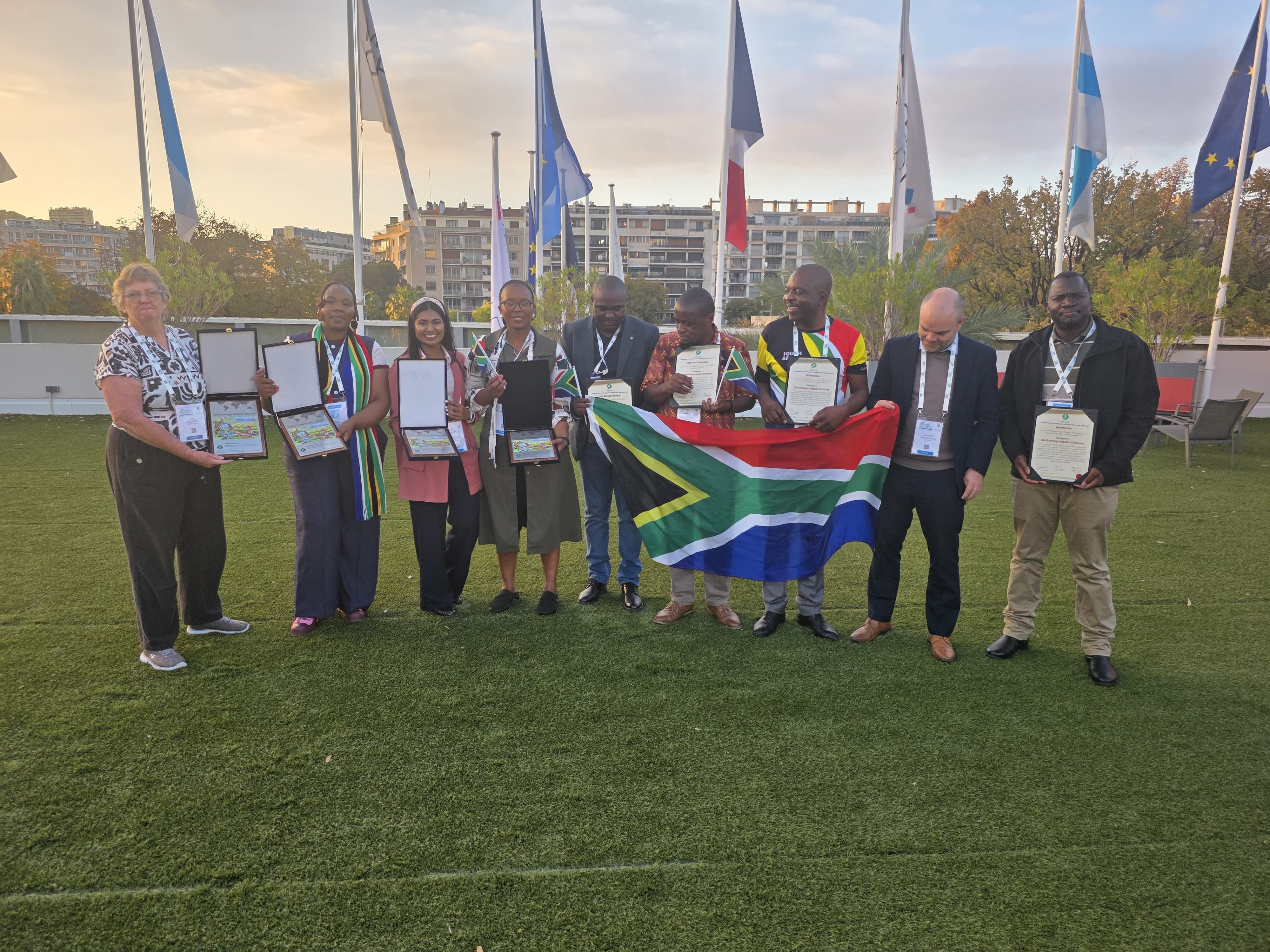
The South African Environmental Observation Network (NRF-SAEON) congratulates Dr Zanele Ntshidi, its Arid Land Node Manager, and the South African National Committee on Irrigation and Drainage (SANCID) for winning five awards yesterday, 14 October 2026, at the International Commission on Irrigation and Drainage (ICID) conference held in Marseille, France.
Ntshidi is an executive member of SANCID and travelled to Marseille as part of the South African delegation that walked away with five coveted awards.
The ICID awards recognise researchers behind some of the world’s outstanding and innovative work aimed at promoting efficient utilisation of water in agriculture, thus contributing to food and water security.
South Africa’s awards include the addition of four World Heritage Irrigation structures (WHIS) to the global register. The heritage sites recognised at the 26th ICID conference are: 1) Bulshoek Dam, 2) Nqweba Dam, 3) Upper Van Stadens Dam, and 4) Vaal Barrage Structure.
The global register is a repository of information about irrigation and drainage schemes across the world, recognised for advancing food security by ensuring timely, adequate and sustainable agricultural water supply.
SANCID also won the best-performing National Committee, seeing off Iran, Indonesia, Malaysia and Thailand. Researchers from NRF-SAEON, the Water Research Commission, the Agricultural Research Council, the University of the Free State, and the Department of Agriculture proudly received these awards for the country. This underscores the importance of Private-Public-Partnerships in tackling pressing environmental challenges.
Says Ntshidi, “This achievement is a testament to the power of collaboration and strong partnerships. By bringing together diverse stakeholders, expertise, and resources around a shared vision, we were able to maximise our collective impact and achieve this desirable result.”
SANCID, a multi-stakeholder committee that represents South Africa at ICID, aligns its operational objectives with the foundational vision centred around sustainable water management for the future.
Its overarching strategic vision is focused on sustainable irrigation water management aligned with Vision 2030 and the National Water Resource Strategy, committed to using water efficiently and building resilient water resources to ensure:
(1) Food Security – enhancing agricultural output through smart irrigation, (2) Economic Growth – facilitating development while managing a highly stressed national water infrastructure, and (3) Resource Sustainability – mitigating the threats that water scarcity poses to energy production and overall quality of life.
Ntshidi presented her work at the ICID conference, entitled Long-term research on water and food security: Empowering female emerging farmers to grow food that feeds nations. She focused on adopting climate-smart agriculture and building climate-resilient, food-secure communities.
©Higher Education Media Services.