


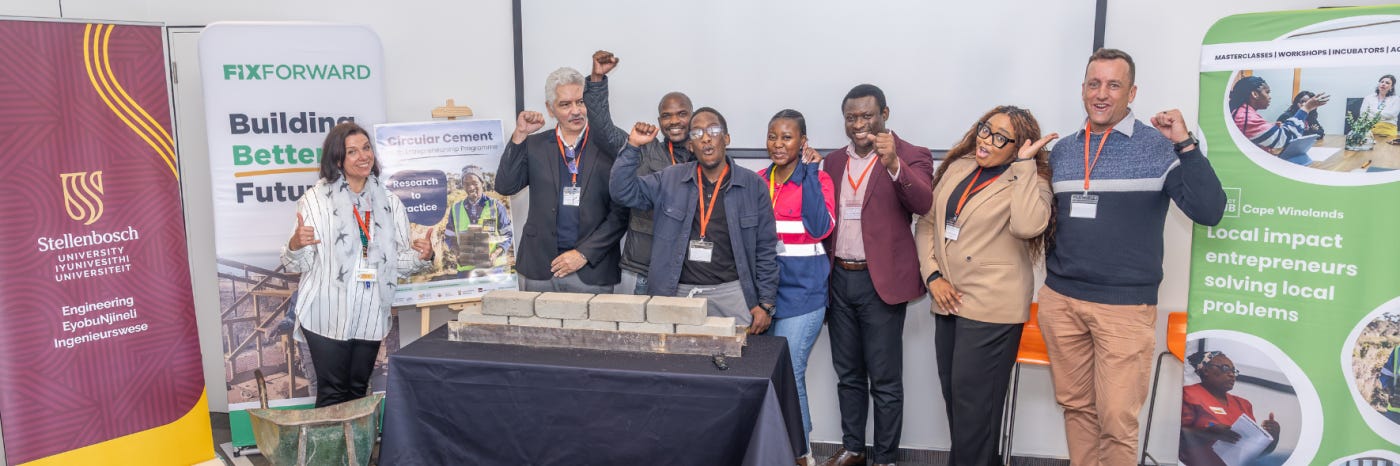
Years of research into sustainable alternatives to conventional cement by Professor John Babafemi, Professor of Sustainable Concrete Materials at Stellenbosch University (SU), are now transforming the way young entrepreneurs across South Africa build, grow businesses, and reduce costs.
Launched at the Council for Scientific and Industrial Research (CSIR) in Stellenbosch, the Circular Cement Youth Entrepreneurship Programme (CCYEP) will support 100 young entrepreneurs from underserved communities in the Western Cape, KwaZulu-Natal, Mpumalanga and North West.
The initiative teaches participants to use locally available industrial and agricultural waste materials as substitutes for conventional cement, lowering construction costs while promoting climate-friendly building practices.
Developed by Fix Forward and Impact Hub Cape Winelands in collaboration with SU, and funded by the Industrial Development Corporation (IDC) through the Presidential Youth Employment Initiative (PYEI) and the Department of Employment and Labour, the programme exemplifies how academia, government and civil society can work together to translate research into real-world opportunities.
“I’ve always had this dream of touching the local community,” said Babafemi. “I want to see people building with these materials. I want to see informal settlements being transformed.”
Research with Impact
Babafemi’s research focuses on replacing portions of conventional cement with locally available by-products such as fly ash, slag, agricultural waste and waste glass. Cement production accounts for around 8% of global carbon dioxide emissions, making this innovation critical to reducing the construction sector’s environmental footprint.
But the programme is not only about emissions. By taking proven research beyond the laboratory, it aims to help small builders and brickmakers cut input costs, improve profit margins, create jobs, and make building materials more affordable in their communities.
Collaboration Across Sectors
The idea took shape after Marli Goussard, CEO of Impact Hub Cape Winelands, met Babafemi at an SU Social Impact Committee meeting. Recognising the potential for local application, she initiated a partnership that now blends academic research, enterprise development, public funding and grassroots entrepreneurship.
“Local people are best positioned to solve local challenges,” Goussard said. “This programme shows the power of collaboration to ensure research translates into opportunities that improve lives.”
Professor Wikus van Niekerk, Dean of SU’s Faculty of Engineering, added:
“We are not satisfied with knowledge that remains on the shelf. Our responsibility is to ensure research becomes useful in society.”
Building Dreams, Creating Jobs
For entrepreneurs like Vuyisile Handa, a brickmaker and participant, the benefits are immediate:
“This programme has ignited so many dreams. Now we can save on cement, make climate-friendly bricks, and sell more affordable products to our communities.”
By reducing production costs, Handa hopes to expand his business, employ more people, and help families access quality building materials at lower prices.
The first cohort of 100 entrepreneurs will serve as a pilot to refine the model for broader rollout. The programme will also map waste material availability across provinces, ensuring entrepreneurs can source locally and avoid costly transport.
Noluthando Miambo, representing the PYEI, said:
“If we support these 100 entrepreneurs and prove the concept, we can replicate it and create a value chain. It was important for us that young people should benefit.”
From Lab to Community
For Babafemi, the launch represents more than academic achievement. It is the moment when years of research began finding its way into the hands of people who can use it to change their communities.
©Higher Education Media Services.